 Haris
Haris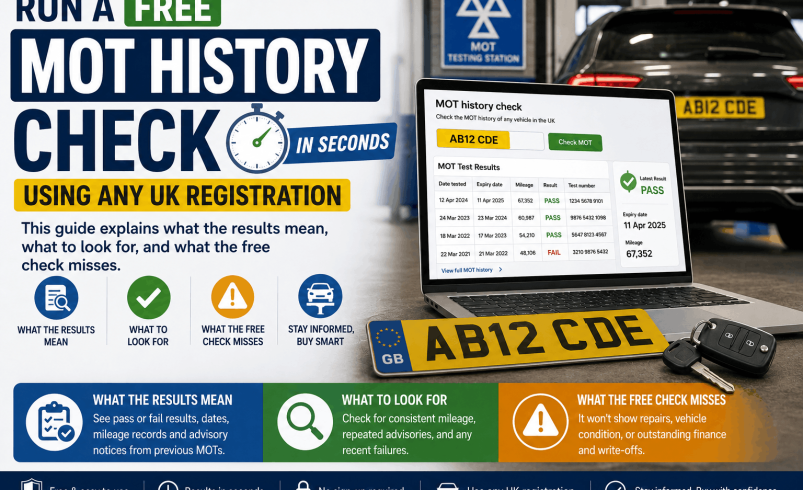
Running an MOT history check on any UK vehicle is free, takes under a minute, and tells you more about a car’s condition than most sellers want you to know. The official service is at check-mot.service.gov.uk, and all you need is the vehicle’s registration number.
The check pulls directly from the Driver and Vehicle Standards Agency (DVSA) database, which holds MOT records going back to 2005 for cars, vans, and motorcycles. It shows every test result, recorded mileage at each test, advisory notices, and the specific reasons for any failures. If you’re buying a used car, verifying your own vehicle, or trying to spot mileage fraud, this is where you start.
This guide explains how to run the check, what every result means in practice, and the red flags worth acting on.
How to Do an MOT History Check
The official GOV.UK check at check-mot.service.gov.uk is the fastest and most reliable route. It pulls data directly from the DVSA database, requires no login, costs nothing, and has no limit on how many checks you can run.
Type the registration number into the box on the page and press search. Results load within a few seconds. You don’t need to create an account or enter payment details.
What you’ll see:
- The vehicle’s current MOT status and expiry date
- Every MOT test on record since 2005, listed in reverse date order
- The mileage recorded by the tester at each test
- Whether each test was a pass or fail
- The specific reasons for any failures
- Advisory notices from each test
- The name and location of the test centre (for tests in England, Scotland, or Wales)
You can also download a copy of the current MOT certificate and previous ones directly from the results page.
The DVSA also has a related page at gov.uk/check-mot-status for checking only the current MOT status and expiry date, without the full test history.
What the MOT History Results Actually Mean
Most pages about MOT history checks stop at “enter the reg and see what comes up.” This section explains what each part of the results actually tells you, and why it matters more than it might first appear.
Pass and Fail Results
A pass confirms the vehicle met minimum roadworthiness standards on that date. It doesn’t mean the car was in perfect condition. A pass can include several advisory notices (see below), and the standard tested is the minimum required by law rather than a measure of overall mechanical health.
A fail means at least one item did not meet the standard required. The results page shows the exact reasons. What matters is what it failed on. A car that failed on a blown indicator bulb and retested the same day is very different from one that failed on structural corrosion or brake inefficiency. Read the failure reasons carefully, not just the pass/fail count.
MOT History and Mileage Records
Every MOT test records the odometer reading at the time of the test. These readings build up into a mileage timeline across the vehicle’s life, and that timeline is one of the most useful things the MOT history gives you.
The mileage readings should increase consistently year on year. A drop in recorded mileage between two tests is physically impossible under normal use. Any decrease in recorded mileage between consecutive tests indicates odometer tampering, a practice known as clocking.
Mileage clocking is illegal under the Consumer Protection from Unfair Trading Regulations 2008 in the UK. It remains a persistent problem in the used car market, with estimates of around 1 in 14 to 1 in 16 used cars showing some form of mileage discrepancy (based on figures cited by HPI and the RAC). The MOT history is your best free tool for detecting it.
When you view a car in person, compare the current odometer reading against the most recent MOT-recorded mileage. If the physical odometer reads lower than what the last MOT recorded, do not buy the car. The mileage has been wound back.
Advisory Notices
An advisory is an item the tester flagged as approaching failure or worth monitoring, but not yet serious enough to cause a fail. Advisories are not failures, but they matter.
A single advisory on a high-mileage car is normal. What changes the picture is pattern. If the same item appears as an advisory across two, three, or four consecutive tests and is getting progressively worse, the previous owner was repeatedly warned and chose not to act. That tells you something about how the car was maintained.
[Table: MOT defect category definitions since 2018]
| Category | What it means | Can you drive away? |
| Advisory | Not yet at fail level, but worth monitoring | Yes |
| Minor | Below the required standard but not immediately dangerous | Yes |
| Major | Fails the test; affects safety or the environment | Yes, if no dangerous defect also present |
| Dangerous | Poses an immediate risk to road safety or the environment | No — tester must advise you not to drive it |
Gaps in the Test History
If a year is missing from the test history, the car had no MOT recorded for that period. There are legitimate reasons for this: the vehicle may have been declared SORN (Statutory Off Road Notification), or it may have been owned by a business with a fleet of exempt vehicles. But a gap could also mean the car was driven without a valid MOT, which is illegal.
Ask the seller to explain any gaps. If they can’t, or the explanation doesn’t match the records, that’s a reason to be cautious.
Frequency of Tests
A car with multiple MOTs in the same year is unusual enough to investigate. It could mean the car failed and was retested multiple times, or it could indicate the vehicle changed hands and the new owner wanted the reassurance of a fresh test. Either explanation adds context.
MOT History Check: What the Free Tool Doesn’t Show
The DVSA check is free and genuinely useful, but it has clear limits. Knowing what it doesn’t show is as important as knowing what it does.
The free MOT history check at GOV.UK does not show:
- Outstanding finance (hire purchase, PCP, or lease agreements where the finance company still owns the vehicle)
- Insurance write-off status (whether the car has been declared a Category S or N write-off)
- Stolen vehicle markers from the Police National Computer
- Detailed keeper count and dates of ownership changes (DVLA records the number of keepers, but this is not part of the free DVSA check)
- Accident damage history not reflected in an MOT failure
These gaps matter in specific situations. Around 1 in 4 HPI checks on used cars flags outstanding finance (HPI data). A vehicle on outstanding finance is legally owned by the finance company, not the seller. If you buy it without knowing, the finance company can repossess the car, and you lose both the car and the money you paid for it.
A paid vehicle history check from providers such as HPI Check, RAC, Motorscan, or AA covers these areas in addition to the free DVSA data. Prices vary; at the time of writing, single reports were available from around £4.99 to £19.99 depending on the provider. Check current pricing at the provider’s site before purchasing, as prices change.
[Table: Free DVSA check vs paid vehicle history check]
| What’s checked | Free DVSA check | Paid history check |
| MOT history (passes, fails, advisories) | Yes | Yes |
| Mileage at each test | Yes | Yes |
| Failure reasons | Yes | Yes |
| Current MOT status and expiry | Yes | Yes |
| Outstanding finance | No | Yes |
| Insurance write-off (Cat S/N) | No | Yes |
| Stolen vehicle check (PNC) | No | Yes |
| Number of previous keepers | Partial | Yes (full detail) |
| Plate change history | No | Yes |
MOT History Check for Northern Ireland Vehicles
Northern Ireland’s MOT system is run by the Driver and Vehicle Agency (DVA), a separate body from the DVSA, which administers MOT testing in England, Scotland, and Wales.
The DVSA extended its check-mot.service.gov.uk service to include Northern Ireland vehicles in 2023. You can now check the MOT history of any UK-registered light vehicle, including those in Northern Ireland, using the same GOV.UK service and the same registration number. Northern Ireland records are available from 2017 onwards.
One practical difference: Northern Ireland’s first MOT falls at four years from first registration, compared to three years in Great Britain. If you’re checking a newer vehicle with an NI registration and it has no MOT history yet, that may simply mean it hasn’t reached the four-year threshold rather than indicating a problem.
Vehicles Exempt from MOT: When the History Will Be Short
Some vehicles don’t appear in the DVSA MOT database because they’re legally exempt from testing. If you run a check and find a very short history or no history, consider whether the vehicle might qualify for exemption.
Historic vehicles aged over 40 years are exempt from MOT testing in England, Scotland, and Wales, provided no substantial changes have been made to the vehicle in the past 30 years. The exemption applies on a rolling basis: in 2026, vehicles first registered before 1 January 1986 can qualify. Owners declare the exemption when taxing the vehicle using form V112. Even if the car doesn’t legally need an MOT, many owners still submit one voluntarily for peace of mind, insurance purposes, and to provide reassurance to future buyers.
The exemption does not apply automatically to vehicles used commercially (such as hire cars or taxis), to HGVs over 3.5 tonnes used for work, or to buses used as public service vehicles.
Other vehicles exempt from routine MOT testing include:
- Vehicles over 40 years old that have not been substantially altered (the main historic vehicle class)
- Some new vehicles, which don’t need their first test until their third anniversary of first registration
- Vehicles on SORN, which are legally required to be kept off public roads entirely
What to Do When the MOT History Raises Questions
If your check turns up something that doesn’t add up, the right response depends on what you’ve found.
Falling mileage between tests: Don’t buy the car. Clocked mileage is not correctable after purchase, and you’ll face an undervalued vehicle with far higher wear than the odometer shows.
Recurring advisories on the same item: Get a pre-purchase inspection from an independent garage before you commit. Ask them specifically about the items flagged in the MOT history. This typically costs £100 to £150 and can save you several times that in unexpected repairs.
A long list of failures or advisories: Price the cost of any outstanding work before negotiating. A car with several advisories isn’t necessarily one to walk away from, but you should know what it will cost to address them and factor that into the price you’re willing to pay.
Gaps in the test record: Ask the seller to account for the gap. A SORN declaration from the relevant period would explain it. If the seller can’t explain it, factor that uncertainty into your decision.
Mismatch between seller’s claimed mileage and the MOT records: If the seller claims 40,000 miles and the last MOT shows 67,000, the mileage claim is false. Raise this directly and walk away if the seller can’t explain it.
MOT History Check: FAQ
Q: Is an MOT history check free?
Yes, the official DVSA check at check-mot.service.gov.uk is completely free to use. You don’t need to create an account, register, or pay anything. All you need is the vehicle’s registration number. It shows all test results since 2005, recorded mileage at each test, advisories, and failure reasons.
Q: How do I check my MOT history?
Go to check-mot.service.gov.uk and enter the vehicle’s registration number. Results load in seconds. The page shows the full test history including pass/fail results, mileage recorded at each test, advisories, and failure reasons. You can also download previous MOT certificates from the results page.
Q: Can I check anyone’s car MOT history?
Yes. The DVSA database is publicly accessible and you can check any UK-registered vehicle’s MOT history using its registration number. There’s no restriction on whose vehicle you check and no limit on the number of searches you can run.
Q: What does an MOT advisory mean?
An advisory is an item the MOT tester noted during inspection that isn’t yet bad enough to fail the vehicle but that may need attention soon. The vehicle still passes the test, but the advisory is a warning. Repeated advisories for the same item across multiple tests suggest the issue has been getting progressively worse and has been repeatedly ignored.
Q: What is mileage clocking and can the MOT history detect it?
Clocking means tampering with the odometer to make a car appear to have lower mileage than it actually has. It’s illegal in the UK. The MOT history records the odometer reading at every test. If the mileage shown at any test is lower than the mileage shown at the previous test, the odometer has been tampered with. This is the most reliable free way to spot clocking.
Q: Does an MOT history check show outstanding finance?
No. The free DVSA check only shows MOT test data. Outstanding finance is held on separate databases (Experian) and is only accessible through a paid vehicle history check from providers such as HPI Check, RAC, or Motorscan. If you’re buying privately, a paid check covering finance, write-off, and stolen markers is worth running before you pay.
Q: How far back does the MOT history check go?
The DVSA database holds records from 2005 onwards for cars, motorcycles, and vans. For HGVs, trailers, buses, and coaches, records go back to 2018. For Northern Ireland vehicles, records begin from 2017. Tests carried out before these dates were done on paper and are not on the system.
Q: What if my car is over 40 years old and there’s no MOT history?
Vehicles first registered more than 40 years ago that have not been substantially altered are exempt from MOT testing in England, Scotland, and Wales. If the car you’re checking is old enough to qualify for historic vehicle status, an absence of recent MOT records isn’t necessarily a problem. Check with the owner whether they’ve been declaring the exemption or voluntarily testing the car.