



Britons Support 80+ Driving Ban? What the Data Shows
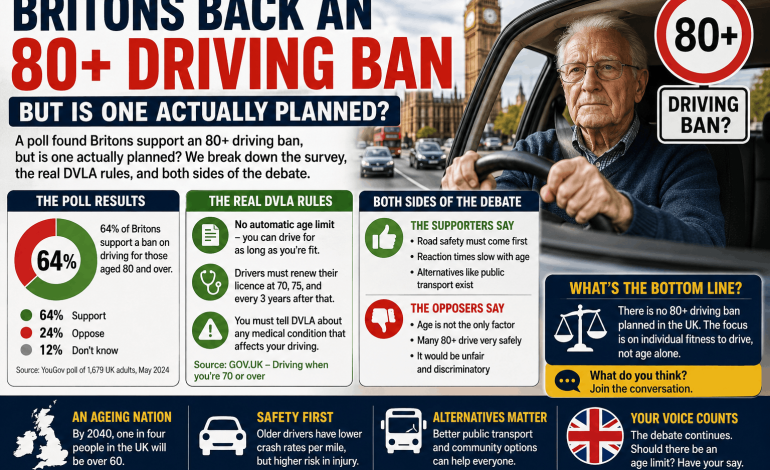

A recent survey found that a large share of Britons support an 80+ driving ban, with 38% of respondents saying people aged 80 and over should be banned from driving. That figure comes from a poll, not a government proposal: there is currently no law, consultation or plan to ban drivers of any age in Great Britain based purely on how old they are.
This piece looks at where that 38% figure came from, what the DVLA actually requires of drivers once they turn 70, and what the government’s Road Safety Strategy proposed instead. You’ll also find the accident data behind the debate, arguments from both sides, and what to expect if you or a family member is approaching 70.
What the Survey on an 80+ Driving Ban Actually Found
The 38% figure comes from research commissioned by car-buying platform ChooseMyCar.com, which polled British adults on their views of older drivers. Support for a ban was strongest among younger age groups, with 53% of both 18 to 29-year-olds and 30 to 45-year-olds backing the idea, compared with lower support among older respondents.
The poll’s findings sit alongside genuine Department for Transport data. Government figures show that 42% of road incidents involving drivers over 70 were linked to sight problems, which the survey’s authors pointed to as part of the public concern behind the numbers. That’s a real data point from DfT, but it’s about incident causes, not proof that a ban would reduce them.
Is There a Real Government Proposal to Ban Over-80s From Driving?
No. Nothing in current UK law sets an upper age limit for driving a car, and the government’s own Road Safety Strategy, published in January 2026, does not propose banning drivers at 80 or any other age. What it does propose is narrower: a consultation on replacing the current self-declaration eyesight check for drivers over 70 with a mandatory eyesight test.
That consultation ran from 7 January 2026 to 11 May 2026 and has since closed. The Department for Transport has said it’s analysing responses, but no decision or published outcome has been announced as of this article’s last update. Check the DfT’s consultation page on GOV.UK for the current status before assuming any change has taken effect.
[Image: screenshot of the GOV.UK Road Safety Strategy consultation page]
The Current DVLA Rules for Drivers Over 70
Under the Road Traffic Act 1988, every driving licence in Great Britain automatically expires on the holder’s 70th birthday, regardless of driving history. This isn’t new and isn’t part of any proposed ban; it’s been the rule for years and applies to every driver, not a select group.
How the Renewal Process Works
The DVLA sends a renewal form (D46P) roughly 90 days before your 70th birthday. Renewing is free and can be done online through GOV.UK or by post, and the process is a self-declaration rather than a test: you confirm your eyesight meets the legal standard and disclose any medical condition that could affect your driving. There’s no practical retest.
Once renewed, the licence is valid for three years rather than the usual ten, and this repeats for as long as you keep driving; there’s no upper age cutoff in the current system. Be wary of third-party websites charging a fee for this service, since the DVLA never charges for a standard over-70 renewal and the only official site is GOV.UK.
What the Road Safety Strategy Consultation Proposed Instead
The consultation asked whether the self-declaration system should be scrapped in favour of a mandatory eyesight test carried out by an optician, and whether 70 remains the right age for that check to start. It also asked about introducing cognitive testing, recognising the added road risk from conditions such as dementia.
The government’s stated goal for the wider Road Safety Strategy is to cut deaths and serious injuries on Britain’s roads by 65% by 2035, with a stretch target of 70% for children under 16. Ministers have framed the eyesight proposal as an attempt to preserve older drivers’ independence where possible while closing a genuine safety gap, rather than as a step toward age-based bans.
[Table: comparison of current 70+ renewal rules vs proposed mandatory eyesight test]
The Case for Tighter Rules on Older Drivers
Supporters of reform point to a mix of survey opinion and DfT casualty data. 24% of all car drivers killed in 2024 were aged 70 or older, even though drivers in that age group make up a smaller share of the total driving population. AA president Edmund King has said crash likelihood rises after 70 and increases markedly for drivers over 80, peaking around age 86, with eyesight often a contributing factor.
Professional bodies including the College of Optometrists and the Association of Optometrists have also backed mandatory eye tests at licence renewal, arguing that regular checks would catch treatable conditions earlier and could let some drivers keep driving safely for longer rather than losing their licence unexpectedly.
The Case Against an Age-Based Driving Ban
Opponents argue that singling out age, rather than actual driving ability, risks penalising large numbers of safe drivers to catch a smaller group of unsafe ones. Age UK has questioned the logic of an eyesight test starting specifically at 70, since eye conditions can develop at any age, and has suggested regular eye tests for drivers of all ages would avoid the appearance of targeting older people specifically.
Road safety organisation IAM Roadsmart has made a similar point about outright bans, noting that older drivers are statistically among the safest road users overall, and that new and young drivers are consistently the group most involved in injury collisions. A 2024 DfT breakdown found that drivers aged 17 to 29 accounted for more male road fatalities than drivers over 70, which critics of an 80+ ban use to argue that age alone is a poor predictor of risk.
How Crash Risk Actually Compares by Age
| Group | Share of drivers | Share of casualties or fatalities |
| Drivers 70 and over | Smaller share of licence holders | 24% of car driver deaths in 2024 |
| Drivers 70 and over | Smaller share of licence holders | 12% of car collision casualties |
| Drivers 17 to 29 | Larger share of licence holders | Higher number of male fatalities than over-70s in 2024 |
The picture is genuinely mixed rather than one-sided. Older drivers make up a disproportionate share of fatalities relative to how many miles they typically drive, but younger drivers remain a larger overall contributor to injury collisions. Neither age group is simply “safe” or “unsafe” once you look past the headline percentage.
What Could Change Next for Older Drivers
If the mandatory eyesight test proposal goes ahead, drivers would need evidence of a recent eye test from an optician at each renewal from 70 onward, replacing the current self-declaration form. One point raised during the consultation debate, including by Conservative MP Andrew Snowden, was whether a centralised testing contract would favour large chains over independent opticians; Specsavers currently holds a £12.34 million DVLA contract for related eyesight services, running to March 2028.
No date has been set for the government’s response, so there’s no confirmed timeline for when, or whether, any change would take effect. Anyone approaching 70 in the near term should plan around the current self-declaration system rather than a system that hasn’t been confirmed.
How to Prepare If You’re Approaching 70
- Watch for the D46P renewal form roughly 90 days before your 70th birthday, and use the free GOV.UK online service rather than a paid third-party site.
- Book a routine eye test with an optician even before any new rule requires it, since undiagnosed sight problems are a genuine factor in some road incidents involving older drivers.
- Keep evidence of any medical conditions and how they’re managed, in case the DVLA requests a medical report as part of your renewal.
- Check GOV.UK directly for the latest status of the eyesight test consultation rather than relying on older news coverage, since the outcome hadn’t been published as of this article’s last update.
[Image: photo of an eye test at a UK opticians, use royalty-free image from Unsplash or Pexels]
FAQs
Q: Is there really a law to ban drivers over 80 in the UK? No, there is no law, consultation or government plan to ban drivers based on reaching 80 or any other age. The 38% figure comes from a public opinion survey by ChooseMyCar.com, not a policy proposal, and current law sets no upper age limit for driving.
Q: Do drivers over 70 have to take a driving test to renew their licence? No, renewal at 70 and every three years afterward is a self-declaration, not a practical test. You confirm your eyesight meets the legal standard and declare any relevant medical conditions, though the DVLA can request a medical report or eyesight check if you disclose a condition.
Q: How much does it cost to renew a driving licence over 70? Renewing at 70 or over is free, whether you apply online through GOV.UK or by post. Be cautious of third-party websites that charge £50 to £100 for “processing,” since these aren’t affiliated with the DVLA and the official renewal never carries a fee.
Q: What is the Road Safety Strategy eyesight test consultation? It’s a government consultation, run by the Department for Transport from 7 January to 11 May 2026, asking whether the self-declaration eyesight check for over-70s should be replaced with a mandatory test. It closed in May 2026 and the government hadn’t published its response as of this article’s last update.
Q: Are older drivers actually more dangerous than younger drivers? It depends on the measure used. Drivers 70 and over accounted for 24% of car driver deaths in 2024 despite being a smaller share of licence holders, while drivers aged 17 to 29 accounted for more male road fatalities overall in the same year, so neither group is simply the “most dangerous.”
Q: Why do younger people support an over-80s driving ban more than older people? The ChooseMyCar survey found 53% support among 18 to 29 and 30 to 45-year-olds, higher than older age brackets. The survey itself didn’t establish a single reason, though commentary around it has pointed to concerns about reaction times and eyesight as commonly cited factors.
Q: Will I lose my licence automatically if I fail an eyesight test in future? Not automatically. Under the current system, failing a roadside or DVLA-requested eyesight check can lead to licence restrictions or removal, but drivers are generally given the chance to seek treatment, glasses or other correction first, and the mandatory testing proposal hasn’t been confirmed as law.


