 Haris
Haris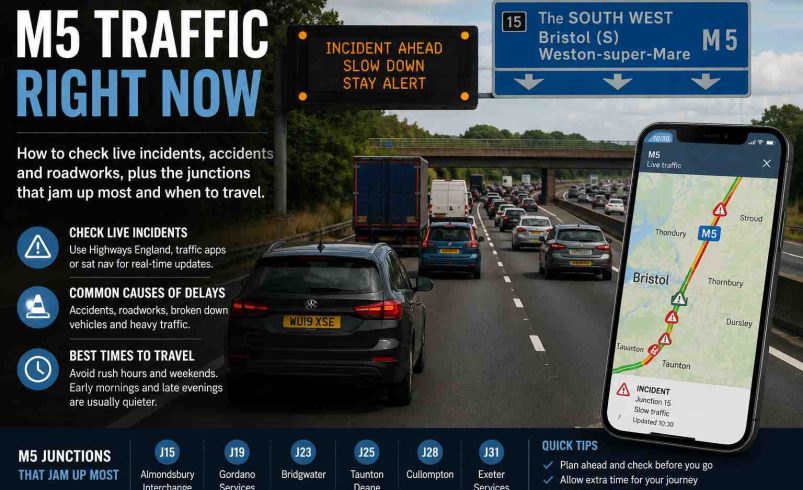
If you’ve typed “M5 traffic” into Google, you probably want to know one thing: is the road clear right now, and if not, how long will it take. The short answer is that M5 traffic changes minute to minute, so no article, including this one, can tell you what’s happening on the road at the exact moment you’re reading it. What this guide can do is show you exactly where to check live conditions, explain why the M5 jams up where it does, and help you plan around the worst of it.
You’ll find the official sources for live incidents, the junctions with the worst reputation for delays, what typically causes hold-ups, and a full FAQ covering accidents, roadworks, and the busiest travel times.
Where to Check Live M5 Traffic Right Now
The only source you should treat as authoritative for live M5 conditions is National Highways, the government body responsible for England’s motorways. Its live traffic page at nationalhighways.co.uk updates from the same data feed that drives the overhead matrix signs on the motorway itself.
You’ve got a few practical ways to check before or during a journey:
- National Highways website: the official source, listing every open incident, lane closure and roadworks scheme by junction.
- National Highways on X: regional accounts, including the South West team, post incidents as they happen, often faster than the website updates.
- Sat nav apps: Google Maps and Waze pull from live traffic sensor data and will reroute you automatically around a jam.
- BBC local travel news: useful for context on major incidents, particularly during severe weather or holiday getaway weekends.
Don’t rely on a general search results page or a third-party traffic site as your only check before setting off. Cross-reference against National Highways if a delay could genuinely affect your plans, because third-party pages can lag behind the official feed by several minutes.
M5 Junction Traffic: The Hotspots to Know
Some stretches of the M5 jam up far more often than others, and knowing them helps you judge whether a reported delay is routine or something worse.
Junction 21 to Junction 20 (Weston-super-Mare to Clevedon) sees frequent congestion, partly because of merging traffic from local routes and partly because this section carries heavy holiday traffic heading to and from the South West. Junction 25 to Junction 27 (Taunton to Tiverton) is another regular pinch point, especially on Friday afternoons and Saturday mornings in summer when Devon and Cornwall-bound traffic peaks.
Closer to Bristol, Junction 14 to Junction 19 (the interchange with the M4 and M49) carries some of the heaviest daily commuter volume on the whole route, so expect slower speeds here at any time on a weekday, not just during incidents.
[Table: M5 junction hotspot comparison showing junction numbers, nearby towns, and typical cause of delay]
| Junction section | Nearby towns | Typical cause |
| J14 to J19 | Bristol, Avonmouth | Daily commuter volume, M4/M49 merge |
| J20 to J21 | Clevedon, Weston-super-Mare | Local merging traffic, holiday getaway |
| J25 to J27 | Taunton, Wellington, Tiverton | Holiday traffic, seasonal peaks |
| J29 to J30 | Exeter | Airport and city traffic merging |
M5 Traffic Accident Today: What Actually Happens After a Crash
When there’s an accident on the M5, National Highways and the relevant police force (Avon and Somerset, Devon and Cornwall, or Gloucestershire, depending on location) manage the scene jointly. Lanes typically close first, then the road may close fully if there are serious injuries or debris across multiple lanes.
Recovery time varies hugely depending on severity. A minor shunt with no injuries might clear in under an hour once vehicles are moved to the hard shoulder. A serious collision requiring air ambulance access or a police investigation can close a section of the motorway for several hours, sometimes into the following morning if it happens overnight. National Highways posts estimated reopening times once they’re known, but these are estimates, not guarantees.
If you’re stuck in queuing traffic behind an incident, stay in your lane where possible and follow instructions from any officers or National Highways traffic officers on scene. Don’t attempt to reverse or perform a U-turn on the carriageway.
M5 Traffic Now vs Planning Ahead: Two Different Problems
“M5 traffic now” and “M5 traffic later” need different tools. If you’re already on the road or about to leave, a live sat nav feed is your best bet, since it reacts to real-time sensor data and reroutes automatically. If you’re planning a journey for tomorrow or next week, check the roadworks schedule instead.
National Highways publishes planned roadworks and overnight closures weeks in advance on its roadworks page, broken down by junction and date. This matters because scheduled closures, unlike accidents, are predictable, and you can plan your route or travel time around them entirely.
- Same-day travel: use a live sat nav app or the National Highways live page immediately before you leave.
- Travel this week: check the National Highways roadworks schedule for planned overnight or weekend closures.
- Holiday period travel: expect significantly heavier traffic on Fridays and Saturdays in July and August, particularly southbound towards Devon and Cornwall.
Why the M5 Gets So Congested
The M5 runs for roughly 160 miles between Junction 8 near West Bromwich, where it meets the M6, and Junction 31 at Exeter. Because it’s the main route from the Midlands and the North into Devon and Cornwall, it carries a mix of daily commuter traffic around Birmingham and Bristol alongside long-distance holiday traffic heading further south.
That combination is what makes the M5 different from a purely commuter motorway. On an ordinary Tuesday, the Bristol stretch behaves like any busy urban motorway. On a Friday in August, the same road can back up for miles from Taunton southwards purely from holiday volume, even with no accident at all.
Mistakes Drivers Make When Checking M5 Traffic
A few habits consistently lead people into worse delays than necessary.
Checking traffic once before leaving and not again is the most common one. Conditions on a 160-mile motorway can change entirely in the 30 minutes it takes to get in the car, especially around an unfolding incident. A second check just before you set off, or live updates via sat nav once you’re moving, catches changes the first check missed.
Relying on a single third-party app is another. Some traffic apps lag the official National Highways feed by several minutes, which matters when you’re deciding whether to divert. Cross-checking against nationalhighways.co.uk before a long or time-critical journey is worth the extra minute.
Ignoring the difference between “delay” and “closure” trips people up too. National Highways alerts distinguish between congestion causing a delay of X minutes and a full lane or carriageway closure. The wording matters for how you plan your route.
FAQ
Q: Is the M5 closed right now?
Whether the M5 is closed depends entirely on live conditions at the moment you’re checking, so this article can’t answer it for you. Check nationalhighways.co.uk or a live traffic app immediately before travelling. Full closures are relatively rare and are usually reserved for serious accidents or planned overnight roadworks between set hours.
Q: What junction of the M5 has the most accidents?
There’s no single official published ranking of M5 accident hotspots by junction. In practice, the Bristol interchange area (Junctions 14 to 19) and the Weston-super-Mare to Clevedon stretch (Junctions 20 to 21) see frequent incidents due to high merging traffic volume, though this varies year to year.
Q: How long do M5 delays usually last?
It depends on the cause. Congestion from heavy holiday traffic can ease within an hour once volume drops, while a serious accident causing a lane or carriageway closure can add delays of 45 minutes or more and take several hours to fully clear. Check the estimated reopening time on National Highways for a specific incident.
Q: Why is the M5 traffic so bad on Fridays?
Friday afternoons and evenings see the M5 combine two types of traffic at once: local commuters finishing work and holidaymakers starting a getaway to Devon or Cornwall. This overlap, particularly in July and August, is why Friday delays tend to be worse than an ordinary weekday.
Q: Does the M5 have variable speed limits?
Some sections of the M5, including parts of the smart motorway network, use variable speed limits shown on overhead gantry signs during periods of congestion or incidents. Always follow the speed shown on the gantry rather than the standard 70mph limit if a lower speed is displayed.
Q: Can I get compensation for M5 traffic delays?
There’s no general compensation scheme for drivers delayed by ordinary congestion or accidents on the M5. Compensation claims are handled case by case and typically relate to specific circumstances such as vehicle damage from road defects, which would go through National Highways’ claims process, not a general delay claim.
Q: What’s the best time to avoid M5 traffic?
Weekday mornings before 07:00 and after 09:30, and evenings after 19:00, tend to see lighter traffic on the commuter-heavy sections near Bristol and Birmingham. On summer weekends, travelling before 08:00 on a Saturday or after 19:00 avoids the worst of the holiday getaway traffic on the southbound stretch towards Devon and Cornwall.