M6 Walsall Birmingham Lanes Closure: What’s Happening
- August 5, 2026
- 0
The M6 Walsall Birmingham lanes closure is one of the most searched traffic topics in the West Midlands right now, and for good reason. If you’re on this


9621 Agnes Crossing, Lake Suzanneview, New Mexico Island 84604-9295.
The M6 Walsall Birmingham lanes closure is one of the most searched traffic topics in the West Midlands right now, and for good reason. If you’re on this
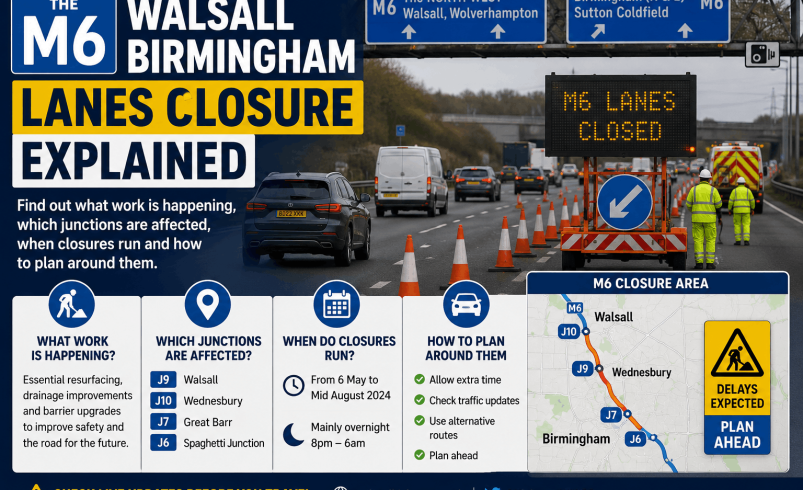
The M6 Walsall Birmingham lanes closure is one of the most searched traffic topics in the West Midlands right now, and for good reason. If you’re on this road regularly, you’ll know that the disruption feels relentless. Lane restrictions, overnight full closures, and HS2-related weekend shutdowns are all happening at the same time across the same corridor.
This article covers what’s actually confirmed by National Highways, which junctions are affected, what the closures involve, when they run, what the official diversion routes are, and how to stay updated. Most articles on this topic either repeat vague generalities or contain outright invented information. This one is built from National Highways’ official West Midlands maintenance page and primary sources only.
This stretch of the M6 is one of the heaviest-used transport corridors in the country. The section between Junction 6 (Gravelly Hill, Birmingham) and Junction 10 (Walsall) carries a dense mix of commuter traffic, freight, and long-distance vehicles every day. Peak journey times on the M6 between Junctions 5 and 8 have historically run 55% to 65% above free-flow conditions even without any works in place, according to official government transport data cited in National Highways’ planning material for the corridor.
That baseline congestion is why the M6 Walsall Birmingham lanes closure causes such widespread problems. When even one lane comes out of service near Junction 6 or Junction 7, the knock-on effect travels back miles quickly. Drivers who divert onto the A34, A38, or Black Country Route then congest those roads too, spreading the delay well beyond the motorway itself.
The closures happening in 2026 are not random. They fall into three distinct categories: planned resurfacing work on the M6 southbound running through to October, bridge joint maintenance that was scheduled earlier in the year, and HS2 construction weekend closures on the M6 and M42 which run from late June through to November.
This is the longest-running confirmed scheme on the corridor. National Highways is resurfacing the M6 southbound between junctions 6 and 4. The work runs weeknights only, between 9pm and 6am, and is scheduled to continue until 16 October 2026.
The closures rotate in phases. From the National Highways West Midlands maintenance page, the confirmed sequence is:
Signed diversion routes are in place for each phase. National Highways explicitly states that closure details can change at short notice, so any article setting out these dates, including this one, should be treated as a reference point rather than a guarantee. Check the daily closures report before travelling overnight.
This scheme has now completed, but it explains much of the disruption drivers noticed in April and early May. National Highways carried out bridge joint replacement on the M6 between Junction 6 (Gravelly Hill) and Junction 7 (Great Barr, A34). The works ran to full closure level in three phases:
Bridge joint replacement sounds like routine maintenance, but the components are critical on a structure that carries tens of thousands of vehicles daily. Bridge joints allow the structure to flex and move with temperature change. If they fail, the surrounding concrete and structural integrity of the deck deteriorates far more rapidly, which would eventually force far longer and more disruptive emergency closures.
A separate temporary prohibition order was made for link roads at Junction 6 (Gravelly Hill Interchange, also known as Spaghetti Junction) in April 2026. This covered overnight works between 21:00 and 05:00, starting 12 April 2026 for five nights, affecting several link roads including the connection from the A38(M) Aston Expressway northbound to the M6 northbound. The diversion route for that closure ran via Salford Circus, the A5127, Dartmouth Circus, Park Circus, Waterlinks Boulevard and Lichfield Road.
Separate from National Highways’ maintenance programme, HS2 construction work is driving a series of weekend motorway closures on the M6 and M42 from June through to November 2026. These closures are full carriageway shutdowns from Friday evening to Monday morning, not overnight-only restrictions.
The HS2 work involves building three railway structures over the motorway network:
The confirmed weekend closure schedule from HS2 is:
HS2 coordinators have worked to condense what was originally planned as nine motorway closures down to six by combining overlapping works. Diversion routes differ for each closure and are published by HS2 in advance. Drivers are advised to follow signed diversion routes rather than satnav instructions during these weekends, as satnavs frequently route vehicles onto unsuitable local roads that become severely congested.
You can find the full HS2 closure information and diversion maps at hs2.org.uk, under the West Midlands motorway works section.
| Weekend | Roads affected | Work |
| 26-29 June 2026 | M42 NB J5A-J7, M6 SB J6-J7 | Twin-box roof deck installation |
| 24-27 July 2026 | M42 J6-J9 NB, J7A-J6 SB, M6toll restrictions | Water Orton viaducts over motorway |
| 21-24 Aug 2026 | M6 near Chelmsley Wood | M6 South Viaduct West deck slide |
| 18-21 Sep 2026 | M42/Water Orton area | Final beam installation |
| 23-26 Oct 2026 | Water Orton viaducts area | Parapet installation |
All dates subject to change. Confirm at hs2.org.uk before travelling.
Understanding the junction layout helps make sense of where the disruption concentrates.
Junction 6 (Gravelly Hill Interchange / Spaghetti Junction): This is the most complex junction on the West Midlands M6. Opened in May 1972, it covers 30 acres, serves 18 routes, and includes 4km of slip roads. It is where the M6 meets the A38(M) Aston Expressway and several key local routes. Any work at or near Junction 6 has an outsized effect because traffic cannot easily redistribute across the interchange when lanes are restricted.
Junction 7 (Great Barr / A34): This is the primary exit for Walsall-bound traffic. The A34 running north from Junction 7 connects directly to Walsall town centre and the surrounding area. When the M6 between Junctions 6 and 7 is closed or restricted, traffic that normally exits here has to re-route, and the A34 becomes heavily loaded with diverted vehicles.
Junction 10 (Walsall / A454): This junction was the subject of a major £78m improvement scheme that was completed in March 2024. The upgrade replaced two two-lane bridges with four-lane bridges, widened slip roads, and expanded the roundabout. That scheme finished and all traffic management was lifted by the end of March 2024. Junction 10 itself is not the focus of current active works.
When the M6 southbound is fully closed between junctions 6 and 4 or 6 and 5, National Highways puts signed diversion routes in place. The exact routing varies between phases, and dedicated diversion maps are published on the National Highways maintenance page. However, the general pattern sends southbound M6 traffic onto the A38 or local connector roads around the Birmingham ring network before re-joining the M6 further south.
When work between Junction 6 and 7 closed the northbound carriageway, National Highways signed diversions via Salford Circus, the A5127, Dartmouth Circus and Lichfield Road in some phases.
The A454 (Black Country Route), A4148, and A34 were signposted as diversion routes during the March 2026 overnight works between Junction 10 and Junction 7 on the M6 southbound. West Midlands Roads confirmed those diversions on social media when the bridge joint works ran from 23 to 27 March 2026.
It is worth knowing that when an M6 closure pushes significant volumes onto the A34 or A38, those roads frequently become heavily congested themselves within 30 to 60 minutes of a closure starting. The Black Country Route Eastbound, the Walsall Ring Road, and the A41 through West Bromwich towards Junction 1 of the M5 are commonly the worst-affected secondary routes.
The only reliable place to check the current status of planned M6 closures is National Highways’ own daily closures report at nationalhighways.co.uk/travel-updates/road-closure-report/. This page is updated twice daily, Monday to Friday, and lists planned full closures for the next seven days by road. If the M6 is not listed, no full closure is scheduled for that day.
For live incidents, use nationalhighways.co.uk/travel-updates/travel-alerts/. Traffic England at trafficengland.com also shows live incidents and delays. National Highways’ West Midlands account on X (formerly Twitter) at @HighwaysWMIDS posts updates during active incidents and publishes warnings before planned closures.
The resurfacing scheme runs weeknights only, between 9pm and 6am. If you can travel before 8pm or after 7am, you avoid the period when full closures are in force. The M6 is typically busiest between 07:00 and 09:30 and again between 16:00 and 19:30 on weekdays, so morning and evening rush hours carry the highest congestion risk even when the closures themselves have lifted for the day.
For southbound journeys from the Walsall area, the M6 Toll provides a parallel route that avoids Junctions 6 to 8 of the main M6. It is not free, and the current toll rate varies. Check m6toll.co.uk for the current pricing before making it part of a daily routine. The M6 Toll is directly affected by some of the HS2 weekend closures, so check m6toll.co.uk’s HS2 works page for restriction dates before using it as an HS2 alternative.
National Highways offers email subscription updates for specific roads. To receive updates about M6 work in the West Midlands, email noreplM6wmids@nationalhighways.co.uk to join the mailing list.
The M6 southbound resurfacing scheme runs until 16 October 2026, weeknights only. This is the longest-running active closure programme on the corridor.
HS2 weekend closures are scheduled through to 26 October 2026, with the final planned operation in that programme being parapet installation for the Water Orton viaducts. All HS2 closure dates are subject to consent and operational requirements, so hs2.org.uk should be checked for any updates to that schedule.
After October 2026, the resurfacing scheme will have been completed, and HS2 is expected to have concluded the main motorway closure phase for the current series of viaduct and bridge installations. That said, HS2 has further structures to build in the West Midlands and further closures in future years are likely as the project continues. National Highways also carries out regular maintenance on this corridor, so planned overnight works in some form will continue to be a feature of the M6 between Walsall and Birmingham.
Q: Why is the M6 closed between Walsall and Birmingham?
Two main programmes are responsible in 2026. National Highways is resurfacing the M6 southbound between junctions 6 and 4, running weeknights between 9pm and 6am until 16 October 2026. Separately, HS2 construction work is driving weekend closures on the M6 and M42 from late June through to October 2026, to allow installation of railway viaducts over the motorway network.
Q: When does the M6 close near Walsall and Birmingham?
The National Highways resurfacing scheme runs weeknights only, between 9pm and 6am, until 16 October 2026. HS2 weekend closures operate from 9pm on Fridays to 5am on Mondays on specific dates. Always confirm dates on the National Highways daily closures page at nationalhighways.co.uk/travel-updates/road-closure-report/ before travelling.
Q: Which junctions are closed on the M6 near Birmingham?
The main resurfacing scheme affects the M6 southbound between junctions 6 and 4, with some phases closing between junctions 6 and 5. The completed bridge joint scheme (April to May 2026) affected the stretch between junctions 6 and 7. HS2 weekend closures in summer 2026 have affected the M6 near junctions 6 and 7, and the M42 between junctions 5A and 9.
Q: What is the diversion when the M6 is closed southbound near Birmingham?
Signed diversion routes are put in place by National Highways for each phase. The exact routing varies: diversion maps for the current scheme are available on the National Highways West Midlands maintenance page. Common diversions use the A38 and connect Birmingham ring roads. Follow signs on the night rather than relying on satnav, which can overload unsuitable local roads.
Q: How do I check if the M6 is closed tonight?
Go to nationalhighways.co.uk/travel-updates/road-closure-report/ for the daily closures report, which is updated twice daily on weekdays. For live incidents, visit nationalhighways.co.uk/travel-updates/travel-alerts/ or follow @HighwaysWMIDS on X for real-time updates.
Q: Does the M6 closure near Birmingham affect the M6 Toll?
Some of the HS2 weekend closures do affect the M6 Toll, particularly the July 2026 weekend which included restrictions on the M6toll northbound connecting road between M6 J3a and T1. Check m6toll.co.uk/hs2/ for specific dates when the Toll road is restricted. On nights when only the National Highways resurfacing scheme is running, the M6 Toll is generally not directly affected.
Q: When will the M6 Walsall Birmingham works finish?
The National Highways resurfacing scheme is scheduled to complete by 16 October 2026. HS2 weekend closures on the M6 and M42 are planned through to 26 October 2026 for the current series of viaduct installations. Both programmes are subject to change, and further maintenance works on the corridor will continue in future years.
Q: Is the M6 Junction 10 Walsall improvement scheme still causing delays?
No. The £78m Junction 10 improvement scheme, which widened bridges from two to four lanes and added slip road capacity, completed in March 2024. All temporary traffic management was lifted at the end of March 2024. The junction itself is not the source of current active disruption.