


Kebab Near Me: Your UK Guide to Choosing a Good One
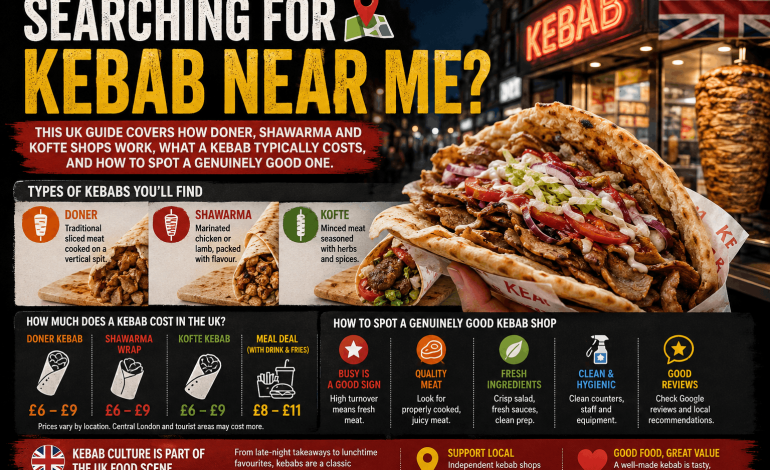

Typing “kebab near me” into Google usually means one thing: you want a doner, shawarma or kofte within the next 20 minutes, not a history lesson. The quickest routes are a delivery app search, a Google Maps search, or walking to your nearest late-night takeaway strip. Which one works best depends on whether you want it delivered, collected, or eaten on the spot.
This guide covers how to actually find a decent kebab near you, what one should cost, how to check a shop’s food hygiene rating before you order, and the difference between doner, shawarma and kofte. There’s also a look at common ordering mistakes and a section on late-night opening hours across the UK.
What Counts as a “Kebab” in the UK
In most UK takeaways, “kebab” covers several distinct dishes rather than one specific item. The doner is the most common: seasoned lamb, chicken or a mix, cooked on a vertical rotating spit and shaved into pitta or a wrap with salad and sauce. Shawarma follows the same cooking method but usually comes with different spicing and is often served in flatbread rather than pitta.
Kofte and shish kebabs are different again. Kofte is minced and seasoned meat formed into patties or skewers and grilled, while shish is cubed meat on a skewer, also grilled rather than spit-roasted. Most kebab shops that describe themselves as “kebab near me” results on Google Maps will serve two or three of these styles side by side, alongside chips, pizza and fried chicken.
How to Actually Find a Good Kebab Near You
Using Just Eat, Uber Eats and Deliveroo
Delivery platforms are the fastest way to compare kebab shops near your address, since they show star ratings, delivery times and minimum order values in one place. Filter by “Kebab” as a cuisine category rather than searching the word “kebab” directly, as some platforms treat it as a dish filter rather than a shop category and will miss relevant results otherwise.
Check the star rating alongside the number of reviews, not just the score on its own. A shop with a 4.5 rating from over 200 reviews is a safer bet than one with a 5.0 rating from 6 reviews, since a small review count can swing wildly from a handful of opinions.
Searching Directly on Google Maps
Google Maps often surfaces independent kebab shops that don’t appear on delivery platforms, particularly smaller or cash-only takeaways. Search “kebab near me” directly in Maps rather than Google Search for this, since Maps prioritises proximity and opening hours over general search ranking.
Look at recent reviews specifically, not just the overall star average. A shop with a strong historic rating but several recent complaints about service or food quality has likely changed hands or dropped in standards since those older reviews were left.
What a Kebab Should Cost in the UK
Prices vary by region, shop size and whether you’re eating in, collecting, or having it delivered. London and other major cities generally sit at the higher end of the range, while smaller towns tend to be cheaper.
[Table: kebab price comparison by size and order type, showing small doner, large doner, meal deal, and delivery vs collection]
- Small doner in pitta: roughly £5 to £7 at the counter
- Large doner or mixed meat wrap: roughly £7 to £10 at the counter
- Kebab meal deal with chips and a drink: roughly £8 to £12 at the counter
- Delivery through an app: add a delivery fee of roughly £1.50 to £4.50, plus a service fee on some platforms
Prices change often and vary by shop, so treat these as a general guide rather than a fixed rate. Check the menu on the shop’s own page or delivery app listing for the current price before you order.
Checking Food Hygiene Ratings Before You Order
Most people searching “kebab near me” skip this step entirely, but it’s worth doing before you commit to a shop you haven’t used before. Every food business in England, Wales and Northern Ireland that serves the public is inspected under the Food Hygiene Rating Scheme, run by the Food Standards Agency in partnership with local authorities, and given a score from 0 to 5, where 5 means hygiene standards are very good and 0 means urgent improvement is required.
Displaying the rating sticker is a legal requirement in Wales and Northern Ireland, but only encouraged, not required by law, in England, so some English takeaways won’t have one visible even if they’ve been inspected. You can check any shop’s current rating for free by searching its name or postcode on the Food Standards Agency’s website at food.gov.uk, regardless of whether the sticker is displayed.
Scotland runs a separate scheme, the Food Hygiene Information Scheme, which works on a pass or improvement-required basis rather than a 0 to 5 scale, so don’t expect to see the same numeric rating north of the border.
[Image: screenshot of the Food Standards Agency ratings search page]
Doner vs Shawarma vs Kofte: What’s the Difference
| Style | Meat cut | Cooking method | Typical serving |
| Doner | Layered, seasoned lamb or chicken | Vertical rotating spit | Pitta or wrap with salad and sauce |
| Shawarma | Layered, seasoned lamb, chicken or mixed | Vertical rotating spit, different spice blend | Flatbread, often with garlic sauce |
| Kofte | Minced, seasoned meat | Grilled patties or skewers | Flatbread or plate with rice and salad |
| Shish | Cubed meat | Grilled on a skewer | Flatbread or plate with rice and salad |
Doner and shawarma are cooked the same way but taste noticeably different because of the spice mix used, which typically leans more toward cumin and chilli for doner and toward garlic, turmeric and cardamom for shawarma. If a shop offers both, ordering each from the same place is the easiest way to compare them directly.
Delivery vs Collection: Which Is Better
Collection almost always works out cheaper, since you avoid delivery and service fees, and the food arrives fresher because there’s no travel time before it reaches you. It suits anyone within a short walk or drive of the shop and anyone who wants to see the shop’s hygiene standards for themselves before ordering again.
Delivery makes more sense when the nearest decent-rated shop is too far to collect from conveniently, or when weather or lack of transport rules out a trip. Bear in mind that pitta and wraps can go soft during a longer delivery journey, so shops closer to your address tend to arrive in better condition than ones further away, even with the same courier service.
Common Mistakes People Make When Ordering a Kebab
- Ordering from the first result without checking review volume. A shop that appears first on a delivery app isn’t necessarily the closest or the best-rated; sponsored listings and paid placement affect ordering.
- Ignoring the hygiene rating entirely. Around a third of UK adults say they consider the food hygiene rating when choosing a takeaway, which means most people skip a free, two-minute check that could avoid a bad experience.
- Not checking the meat option before ordering. Some kebab shops serve halal meat only, others serve both halal and non-halal, and menus don’t always make this obvious until you look closely or ask.
- Assuming all sauces are mild. Chilli sauce at UK kebab shops ranges from barely warm to genuinely hot, and there’s no standard scale between shops, so it’s worth asking if you’re unsure.
- Forgetting the shop’s actual closing time. Late-night kebab shops don’t all close at the same time, and delivery app cut-off times are usually earlier than the shop’s actual closing time for walk-in customers.
Kebab Shop Opening Hours and Late-Night Ordering
Independent kebab shops in town and city centres commonly stay open until midnight or later on Friday and Saturday nights, particularly in areas near pubs, clubs or student housing. Smaller towns and suburban shops tend to close earlier, often by 10pm or 11pm even at weekends.
Delivery apps generally stop taking orders earlier than a shop’s actual closing time, since couriers need enough time to collect and deliver before the kitchen shuts. If you’re ordering close to closing time, it’s worth calling the shop directly or checking its own website rather than relying solely on the app’s cut-off.
FAQs
Q: What is the difference between a doner kebab and a shawarma? Both are cooked on a vertical rotating spit, but they use different spice blends and are typically served differently. Doner leans toward cumin and chilli and comes in pitta or a wrap, while shawarma leans toward garlic, turmeric and cardamom and comes in flatbread, often with garlic sauce.
Q: How much does an average kebab cost in the UK? A small doner in pitta typically costs £5 to £7 at the counter, while a large one or a meal deal with chips and a drink runs £7 to £12. Prices vary by region and shop, with cities generally costing more than smaller towns, and delivery adds a further £1.50 to £4.50 in fees.
Q: Is kebab meat always halal in the UK? Not always; some shops serve halal meat exclusively, others serve both halal and non-halal options, and some don’t serve halal meat at all. Check the shop’s menu, website or delivery app listing, or ask directly, since this isn’t always stated clearly on signage.
Q: How do I check if a kebab shop near me has a good hygiene rating? Search the shop’s name or postcode on the Food Standards Agency’s website at food.gov.uk, which lists every inspected business in England, Wales and Northern Ireland with its current score from 0 to 5. Scotland uses a separate pass or improvement-required scheme instead of the numeric rating.
Q: Why do kebab shops stay open so late? Many kebab shops are positioned near pubs, clubs and nightlife areas and deliberately stay open past midnight on weekends to serve people leaving those venues. Suburban and small-town shops without that footfall usually close earlier, often by 10pm or 11pm.
Q: Is it cheaper to collect a kebab than to get it delivered? Yes, collection is almost always cheaper because it avoids delivery and service fees charged by apps like Just Eat, Uber Eats and Deliveroo. Collection also tends to mean fresher food, since there’s no travel time between the shop and your address.
Q: What’s in a typical kebab meal deal in the UK? A standard meal deal usually includes a kebab, a portion of chips and a canned or bottled drink, priced roughly £8 to £12 depending on the shop and region. Some shops substitute the drink for a can from a fridge display, while others include a small side salad or garlic bread instead.