Indian Restaurant Near Me: A Diner’s Practical Guide
- August 18, 2026
- 0
If you’ve searched “indian restaurant near me” and are now staring at a map full of five-star reviews that all look identical, the honest answer is that star
If you’ve searched “indian restaurant near me” and are now staring at a map full of five-star reviews that all look identical, the honest answer is that star
If you’ve searched “indian restaurant near me” and are now staring at a map full of five-star reviews that all look identical, the honest answer is that star ratings alone won’t tell you much. What actually matters is the hygiene rating, whether the menu covers the region of Indian cooking you actually want, and whether the price on the app matches what you’ll pay at the table.
This guide covers how to read search results properly, what to check before you book or order, what a meal actually costs once service charges are added, and the mistakes that catch out most diners, from ordering the wrong heat level to misunderstanding tipping rules. There’s also a section on dine-in versus delivery, since the two experiences differ more than people expect.
A local search typically returns a map pack of nearby options, a mix of star ratings pulled from different platforms, and a scattering of paid listings that look identical to organic results. None of that tells you anything about hygiene standards, since star ratings measure customer satisfaction with food and service, not how the kitchen is run.
The gap most people miss is that review platforms and search engines don’t pull food safety data into their listings automatically. You have to check that separately, and it takes about thirty seconds once you know where to look.
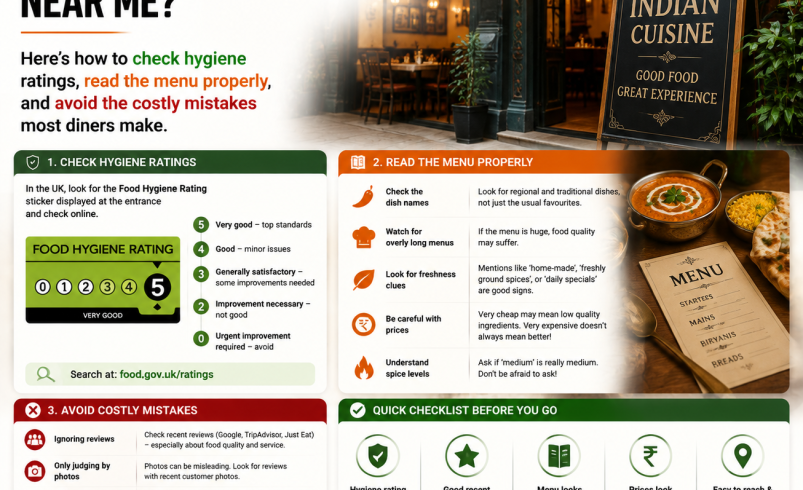
Every food business in England, Wales and Northern Ireland that serves food to the public gets inspected by a local authority food safety officer and given a rating between 0 and 5. A rating of 5 means the hygiene standards are very good, and the scale runs down to 0. Restaurants aren’t obliged to display the sticker in England, though most do, so the safest way to check is directly online.
The Food Hygiene Rating Scheme helps consumers choose where to eat out by giving clear information about a business’s hygiene standards, and a food safety officer checks how hygienically food is handled, the physical condition of the premises, and how the business manages food safety systems. You can search any restaurant by name or postcode at ratings.food.gov.uk before you commit to a booking.
Scotland runs a separate scheme. Rather than a numerical score, Scotland’s Food Hygiene Information Scheme (FHIS) gives a simple pass or improvement-required outcome, so don’t expect to see a number if you’re searching for a restaurant north of the border.
Indian food covers an enormous range of regional cuisines, and a menu labelled generically as “Indian” might lean heavily towards Punjabi, South Indian, Bengali or Goan cooking without saying so clearly. If you’re after something specific, dosas and idlis point to South Indian cooking, while rich, creamy gravies like butter chicken and korma point towards North Indian and Punjabi styles.
Heat levels also vary wildly between restaurants with no consistent standard. A vindaloo at one restaurant might be genuinely fierce, while at another it’s been toned down for a broader audience, so don’t assume the same dish name means the same experience everywhere.
Restaurants serving freshly prepared, non-prepacked food, which covers the vast majority of sit-down Indian restaurants, aren’t required to print full ingredient labels on every dish. Instead, allergen information has to be available either verbally from staff or in writing, such as on the menu itself or a separate allergen chart.
Before you order, it’s worth asking directly about the following, since cross-contact is common in busy kitchens using shared woks and fryers:
Prices vary enormously depending on location and whether you’re at a casual high-street spot or a more upmarket restaurant, so treat the figures below as a general guide rather than a fixed price.
[Table: typical UK Indian restaurant price ranges]
| Item | Typical price range |
| Starter (samosa, onion bhaji, seekh kebab) | £4 to £8 |
| Main course curry | £9 to £16 |
| Rice or naan | £3 to £5 |
| Thali or set meal | £15 to £25 |
| Tasting menu at a higher-end restaurant | £35 to £60+ per person |
Set meals and thalis are often better value than ordering individual dishes if you want to try several things, since they bundle a curry, rice, bread and sometimes a starter or dessert into one price. A tasting menu at a more upmarket restaurant is a different proposition entirely, aimed at trying a chef’s range of dishes rather than a full meal in the traditional sense.
Since 1 October 2024, it’s been illegal for employers to withhold tips, gratuities or service charges from staff. The Employment (Allocation of Tips) Act 2023, which received Royal Assent in May 2023, means it’s now unlawful for businesses to hold back service charges from employees, ensuring staff receive all the tips they’ve earned. If you leave a tip in cash, on a card machine, or as an added service charge on the bill, the whole thing has to reach staff, minus only the normal tax and National Insurance deductions.
Restaurants must also share these tips between workers in a fair and transparent way, following the statutory Code of Practice, and have a written policy about how tips are handled. A discretionary service charge, often 10% to 12.5%, is common on larger tables in the UK, and you’re within your rights to ask for it to be removed if service was genuinely poor, since it’s not a legal requirement unless the menu or terms specifically say otherwise.
The same restaurant can behave very differently depending on how you order.
[Table: dine-in vs takeaway vs delivery app]
| Option | What changes | What to watch for |
| Dine-in | Full menu, service charge may apply | Ask about allergens directly with staff |
| Collection or direct takeaway | Usually cheaper, no service charge | Confirm allergen info is provided in writing if ordering online |
| Delivery app (Deliveroo, Uber Eats, Just Eat) | Menu prices are often higher than in-house takeaway prices | Delivery fees and service fees stack on top, so compare against calling the restaurant directly |
Ordering through a delivery app is convenient, but menu prices on these platforms are frequently marked up compared with calling the restaurant directly, on top of the delivery and service fees the app itself charges. If a restaurant offers direct ordering by phone or its own website, it’s worth comparing the total cost before defaulting to the app.
A few checks before you book save a wasted trip or an awkward evening.
A handful of avoidable errors come up again and again.
Assuming every “Indian restaurant near me” result serves the same style of food is a common one, since a menu heavy on Punjabi curries is a very different experience from a South Indian dosa house, even though both get filed under the same broad category by search engines and review sites. Ordering the hottest dish on the menu to test bravado, rather than asking staff how it’s actually rated at that specific restaurant, is another, since heat levels aren’t standardised across kitchens.
Skipping the hygiene check because the reviews look good is a mistake worth avoiding, since a five-star rating on a review site reflects taste and service rather than food safety. Not asking about allergens clearly enough, particularly assuming a dish is “probably” nut-free based on its name, catches out more diners than it should given how easy the check is.
Q: How do I find a good Indian restaurant near me?
Start with a local search or map listing, then cross-check the hygiene rating separately at ratings.food.gov.uk before booking. Star ratings on review platforms reflect taste and service, not food safety, so treat the two as separate checks rather than assuming one covers the other.
Q: How much does a meal at an Indian restaurant cost in the UK?
A typical main course curry costs £9 to £16, with starters around £4 to £8 and rice or naan £3 to £5 extra. A set thali meal usually runs £15 to £25 and often works out better value than ordering several dishes separately.
Q: Do I have to tip at an Indian restaurant?
No, tipping is voluntary in the UK, though many restaurants add a discretionary service charge of around 10% to 12.5% to larger tables. You can ask for this to be removed if service was genuinely poor, and by law any tip or service charge left now has to reach staff in full.
Q: How do I check food hygiene ratings for a restaurant?
Search the restaurant by name or postcode at ratings.food.gov.uk, the Food Standards Agency’s official ratings site covering England, Wales and Northern Ireland. Scotland uses a separate pass or improvement-required scheme rather than a numerical score.
Q: Is it cheaper to order delivery or collect in person?
Collection or calling the restaurant directly is usually cheaper than ordering through a delivery app, since menu prices on apps like Deliveroo and Uber Eats are often marked up compared with in-house prices. Delivery and service fees stack on top of that markup, so it’s worth comparing the total cost before defaulting to an app.
Q: What should I ask about if I have a food allergy?
Ask staff directly which dishes contain your specific allergen, since restaurants serving freshly prepared food must provide this information verbally or in writing rather than on a printed label. Common concerns worth raising include nuts in sauces, ghee for dairy avoidance, and gluten in naan and battered starters.
Q: What’s the difference between a thali and ordering separate dishes?
A thali is a set meal bundling a curry, rice, bread and often a starter or dessert into one fixed price, usually £15 to £25. Ordering dishes separately gives more choice but typically costs more overall if you want to try several items.