 Haris
Haris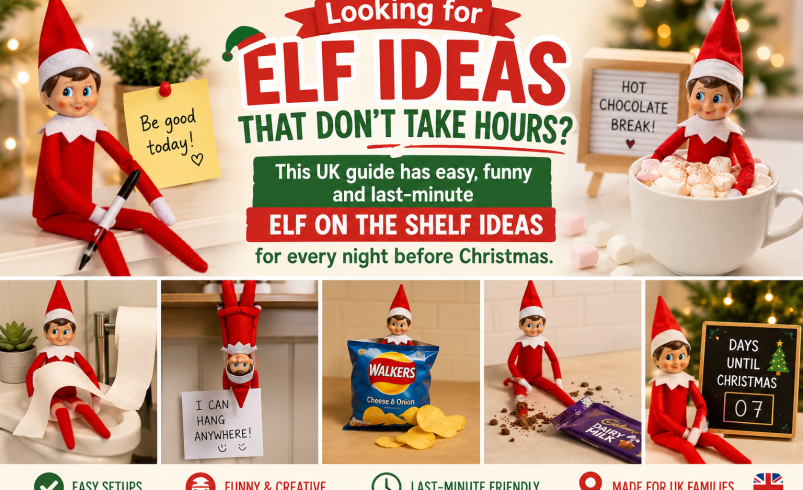
“What do I do with the elf tonight?” is the question that lands in most parents’ heads somewhere around 10pm, most nights, from the start of December. If that’s you right now, the short answer is: keep it simple, use what’s already in the kitchen drawer, and save the elaborate scenes for the years when the kids are old enough to help you set them up. This guide is built around exactly that, with elf ideas sorted by how much time and mess they need, plus guidance on timing, safety and what to do if you’ve forgotten three nights running.
You’ll find easy options that take seconds, proper last-minute rescues for the nights you’ve genuinely forgotten, funnier and messier ideas for when you’ve got more energy, and answers to the questions that come up most often, from when the elf should arrive to what to do if a child catches them mid-move.
What Elf on the Shelf Actually Involves
The tradition comes from a 2005 picture book, The Elf on the Shelf: A Christmas Tradition, written by Carol Aebersold and her daughter Chanda Bell, based on a family custom from Aebersold’s own childhood. The book comes with a toy elf that families are encouraged to name and treat as a scout for Santa.
The premise is simple: the elf watches the children during the day, flies back to the North Pole each night to report on their behaviour, and reappears somewhere new in the house each morning. Children aren’t meant to touch the elf, since the “magic” is supposed to wear off if they do, which is also a handy rule for parents who’d rather the toy stayed out of small hands.
How to Introduce Your Elf on Day One
- Choose your elf’s arrival date, typically 1 December, and pick a name with the children if you want to make it an event.
- Read the accompanying book together, if your elf came with one, so the “rules” are set from the start.
- Place the elf somewhere easy to spot for the first morning, such as sitting on the breakfast table.
- Explain that the elf can’t be touched or it may lose its magic, which also discourages little hands from moving it themselves.
- Take a photo of the first placement so you’ve got a record for comparison later in the month.
Easy Elf on the Shelf Ideas for Busy Parents
Most of the internet’s elf photos are staged, elaborate scenes that took twenty minutes and three trips to the craft cupboard. You don’t need that. These easy elf on the shelf ideas use things already in the house and take under five minutes:
- Sitting at the bottom of the stairs, waiting to be found on the way down.
- Perched on top of the children’s school bags or shoes, ready for the morning rush.
- Tucked into the fruit bowl or bread bin, peeking out from behind an apple.
- Sitting on the Christmas tree among the baubles, as if it climbed up overnight.
- Riding a toy car or sitting inside a mug on the kitchen counter.
None of these need props beyond what you’ve already got out. Rotating between five or six simple spots and just varying which room the elf turns up in is enough to keep most children entertained for the whole run-up to Christmas.
Last-Minute Elf on the Shelf Ideas (Under 60 Seconds)
Some nights you’ll only remember once you’re already in bed. These last-minute elf on the shelf ideas take less time than it takes to read this sentence:
- Move the elf to the opposite end of the same shelf it was already on.
- Sit it on top of the TV or a bookshelf, facing the door.
- Prop it against a picture frame in the hallway.
- Hide it half inside a stocking hanging on the fireplace or bannister.
- Leave it sitting on the doormat, as if it’s just arrived.
If you’ve genuinely forgotten and the children are already awake, the classic rescue is to say the elf’s magic doesn’t always work perfectly and it’s running a little behind that morning. That buys you time to move it properly before bedtime.
[Table: elf idea difficulty levels showing time needed and example setups]
| Level | Time needed | Example |
| Last-minute | Under 1 minute | Elf moved to the next shelf along |
| Easy | 2 to 5 minutes | Elf sitting in the fruit bowl |
| Funny or cheeky | 5 to 15 minutes | Elf covered in flour “snow” footprints |
| Elaborate | 20 minutes or more | Elf-built Lego scene or zip line |
Funny and Cheeky Elf Ideas Kids Love
When you’ve got a bit more time, these are the elf ideas that reliably get the biggest reaction, based on what parents report their children asking for again the next year:
- Elf wrapped in toilet roll like a mini mummy, sitting on the bathroom shelf.
- Elf “caught” mid-raid on the biscuit tin, with a couple of crumbs scattered nearby.
- Elf with tiny felt-tip freckles or a drawn-on moustache, as if it got into the pens overnight.
- Elf ziplining across the living room on a length of string, holding onto a peg.
- Elf sitting in a Lego jail built by “the other toys” after being caught somewhere naughty.
Keep anything involving food or mess to surfaces you can wipe down quickly. Flour, ketchup and icing sugar all work well for effect but leave a trace if they touch fabric, so stick to hard surfaces like a chopping board or kitchen counter.
Elf on Shelf Ideas by Room
Spreading the elf across different rooms rather than always the living room keeps the game feeling fresh without any extra effort. A few reliable elf on shelf ideas by location:
In the kitchen, sit the elf on the bread board with a piece of “toast” made from folded paper, or balance it on the edge of a mixing bowl as though it’s been baking. In the bathroom, perch it on the edge of the sink with the toothpaste lid off, or sitting inside an empty toilet roll tube like a periscope.
In bedrooms, the elf works well tucked half under a duvet with just its hat visible, or sitting on top of a wardrobe watching the room. In the hallway, it can be found halfway up the bannister or sitting in a wellington boot by the front door.
Elf Ideas for Toddlers and Younger Children
Very young children don’t need, or always understand, elaborate scenes, and an elf that’s too mischievous can be more confusing than fun for toddlers who are still working out what’s real. For under-fives, keep the elf visible, stationary in easy-to-reach (but not touchable) spots, and avoid anything that could be mistaken for a genuine mess to clean up, since toddlers often can’t tell staged chaos from an actual accident.
A simpler version of the tradition also works well here: the elf just sits somewhere new each morning without any props at all, and the “story” is kept to a single sentence, such as “the elf’s been to say hello.” That’s enough to hold a toddler’s attention without setting expectations you’ll need to top every night for the next three weeks.
When to Start and End the Elf on the Shelf Tradition in the UK
Most UK families bring the elf out on 1 December, in line with the start of advent calendars, and send it back to “the North Pole” on Christmas Eve, 24 December. There’s no fixed rule here though, and some families start later in the month if December feels too long a stretch to keep up nightly moves.
If you’re juggling a school run and a full-time job, there’s nothing wrong with starting the elf mid-month instead, or only moving it on weekdays and leaving it in place at weekends when the household is busier. The tradition works around your schedule, not the other way round.
Elf on the Shelf Safety and Etiquette
A few practical points don’t get covered often enough. Keep the elf, and any props used with it, out of reach of very young children or pets, since small accessories and loose parts are a choking risk for toddlers and babies. If other children are visiting the house, check with their parents before involving them in the “elf watching you” story, since not every family does the tradition and some children find the idea unsettling rather than fun.
Avoid using anything that could stain furniture or carpet permanently, and test food-based props like ketchup or food colouring on a small hidden area first if you’re setting them up near soft furnishings. If a child accidentally touches or moves the elf, the simplest fix is to say the magic just needs “topping up” overnight rather than making a big deal of it.
Frequently Asked Questions
Q: What is the easiest elf on the shelf idea?
Simply moving the elf to a new spot on the same shelf, or sitting it somewhere visible like the breakfast table, takes under a minute and needs no props. This works well on nights when time is tight or you’ve forgotten until the last moment.
Q: What do you do if you forget to move the elf?
Move it first thing before the children are up, even to a spot just a few feet from where it was. If they’ve already seen it hasn’t moved, saying the elf’s magic is running a little behind that morning is the simplest cover and buys you time to move it properly that evening.
Q: When should Elf on the Shelf start and end?
Most UK families start on 1 December and send the elf back to the North Pole on Christmas Eve, 24 December. There’s no official rule, so starting later in the month or skipping weekends is common for busy households.
Q: Can you touch the elf?
According to the original book’s rules, children shouldn’t touch the elf or it’s said to lose its Christmas magic. In practice, this is mainly a useful way to stop the toy being handled and broken by younger siblings.
Q: What are good elf ideas for toddlers?
Keep it simple: a stationary elf in a new, visible spot each morning without props or mess works best for under-fives. Elaborate scenes can confuse toddlers who can’t yet tell a staged prank from an actual mess.
Q: What can the elf bring the kids?
Small extras like a note, an activity for the day, or the day’s advent calendar chocolate are common, but nothing is required. Some families skip gifts from the elf altogether and just use it for the daily “find the elf” game.
Q: Is Elf on the Shelf a British tradition?
No, it originated in the United States with a 2005 book by Carol Aebersold and Chanda Bell, but it has become widely adopted by UK families over the past decade, particularly since the mid-2010s