 Haris
Haris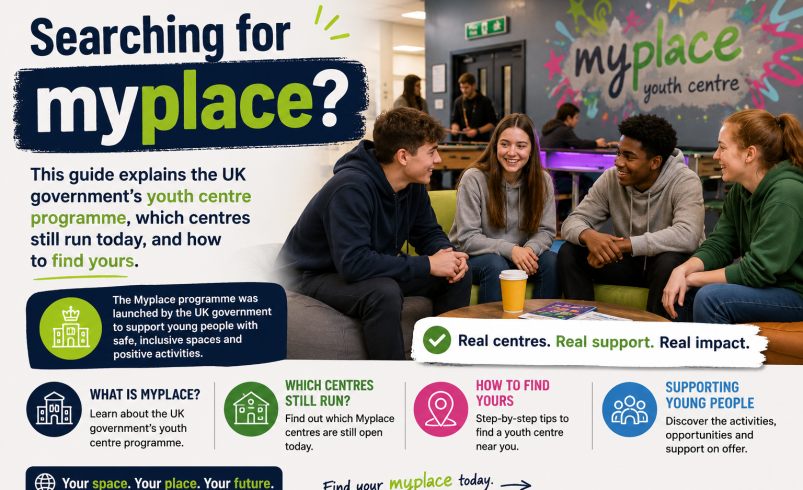
If you’ve typed “myplace” into Google, you’re likely trying to work out what the term actually refers to, since it’s used by several unrelated services. This article covers one specific, well-documented answer: Myplace was a government-funded capital programme that built youth centres across England between 2008 and 2013, and many of those buildings, including sites in Middlesbrough, Havering and Doncaster, are still open and running youth services today.
You’ll find what the programme funded, which centres exist, what happened once central government funding stopped, and how to find and use your nearest one.
What Was the Myplace Programme?
Myplace was a capital funding scheme run by the Department for Education, aimed at building high-quality youth centres in some of the most deprived areas of England. It launched in April 2008, and ran through three competitive bidding rounds where local partnerships applied for money to design and build new facilities for young people.
The idea behind Myplace wasn’t just “more youth clubs.” The programme specifically funded ambitious, purpose-built venues, with facilities like theatres, recording studios and sports halls that many existing youth services couldn’t offer. Local authorities, charities and community groups bid together, and the resulting buildings were meant to serve as long-term community assets rather than temporary projects.
How Myplace Was Funded
The Department for Education invested around £240 million of central government capital funding into the programme by the time it completed in 2013. This was distributed as 63 capital grants, each worth between £1 million and £5 million, with some grants covering multi-site projects rather than a single building.
That’s a significant amount for youth provision specifically, and it’s worth comparing to typical local authority youth service budgets, which rarely see capital investment on this scale in one go. The funding covered construction and fit-out costs; it wasn’t intended to cover ongoing running costs once a centre opened, which became a significant factor in what happened next.
Where Myplace Centres Were Built
Myplace centres exist across England, and no two were built to the same design, since each partnership shaped its centre around local needs. A few examples show the range:
- Middlesbrough’s myplace cost £4.3 million and opened on 30 June 2012, with a theatre, TV and recording studio, sensory room and amphitheatre.
- Havering’s MyPlace centre in Harold Hill opened in 2012 and reports more than 80,000 visitors annually, with a performance hall, music room and health and counselling rooms.
- Doncaster runs two purpose-built centres, in Bentley and Denaby Main, each shaped around the needs of its local area rather than a shared template.
This programme applied to England specifically, since youth service funding and structures differ across Scotland, Wales and Northern Ireland, which run their own separate schemes rather than falling under Myplace.
[Table: example Myplace centres showing location, opened date and key facilities]
| Centre | Opened | Notable facilities |
| Middlesbrough myplace | 30 June 2012 | Theatre, recording studio, sensory room |
| Havering MyPlace (Harold Hill) | 2012 | Performance hall, counselling room, nursery setting |
| Doncaster (Bentley and Denaby Main) | Various | Two separate purpose-built centres |
Is Myplace Still Running Today?
Many Myplace centres are still open, though their situation varies a lot by area, and there’s no single national answer. Central government capital funding stopped on 31 March 2013, with no further central investment planned for youth facilities beyond that date, so what happened to each centre afterwards depended entirely on local funding decisions.
Some centres, like Havering’s, continued as council-run flagship venues with a full programme of activities. Others struggled once dedicated funding streams ran out. Rotherham’s myplace, for instance, saw its youth clubs close temporarily when a four-year Big Lottery Fund grant ended, before reopening with new funding and a relaunched programme. This pattern, strong initial investment followed by a scramble for ongoing funding, shaped how the wider programme aged.
What You Can Do at a Myplace Centre
Activities differ by site, but most Myplace centres run a similar mix of youth work, arts and community services, since they were built around the same core aims. Common offerings include:
- Open-access youth clubs for young people typically aged 10 to 19.
- Arts and performance activities, including drama, dance and music sessions.
- Health, counselling and wellbeing support delivered by partner organisations.
- Room hire for community groups, meetings and local businesses.
- Family and early years provision, including nursery settings at some sites.
Some centres also run adult-focused sessions, from mental health support groups to fitness classes, reflecting their role as community hubs rather than purely youth-only spaces.
Myplace vs Other Local Youth Provision
Myplace centres are usually larger and better resourced than a typical council-run youth club, since they were purpose-built with dedicated capital funding rather than adapted from an existing building. That doesn’t automatically make them the best option for every family though; a smaller, informal youth club closer to home might suit some young people better than travelling to a flagship centre.
If you’re choosing between local options, it’s worth checking what each provides directly rather than assuming scale means a better fit. A Myplace centre with a theatre and recording studio might suit a teenager interested in the arts, while a smaller local youth group might work better for a younger child who wants something closer and less formal.
What Happened After Government Funding Ended in 2013
From April 2013, the Education Funding Agency took on responsibility for protecting the government’s investment in Myplace assets, rather than funding their ongoing operation. This protection is limited: it only covers legal matters, such as requests to change use, transfer ownership, or address breaches of the original funding conditions.
In practice, this meant individual centres needed to find their own sustainable funding models, whether through local authority budgets, charitable grants, room hire income, or partnerships with health and voluntary sector organisations. Any organisation wanting to change how a Myplace building is used or owned needs to contact the Education Funding Agency directly, since these legal protections remain in place regardless of who currently runs the centre day to day.
How to Find Your Nearest Myplace Centre
- Search your local council’s website for “youth centre” or “myplace”, since most councils that host one list it under community hubs or youth services.
- Check the centre’s own page for current opening hours and activity programmes, as these change more often than the building itself.
- Contact the centre directly by phone or email if you can’t find current information online, since some pages aren’t updated regularly.
- Ask about age ranges and any booking requirements before visiting, particularly for specific activity sessions rather than general drop-in time.
Frequently Asked Questions
Q: What does myplace mean?
In this context, myplace refers to a government-funded programme that built youth centres across England between 2008 and 2013. The same term is also used separately by some universities, councils and private businesses for unrelated services, so it’s worth checking which one a specific link or search result refers to.
Q: When did the Myplace programme start and end?
The programme launched in April 2008 and completed its capital funding phase in 2013, with the Department for Education investing around £240 million in total. No further central government capital or revenue funding was planned for youth facilities after 31 March 2013.
Q: Are Myplace youth centres free to use?
This depends on the individual centre and activity, since Myplace didn’t set a single national pricing policy. Many drop-in youth sessions are free, while specific classes, room hire or nursery provision usually carry a charge, so check with your local centre directly.
Q: How much did Myplace centres cost to build?
Individual grants ranged from £1 million to £5 million per project, with some covering multiple sites. Middlesbrough’s centre, for example, cost £4.3 million and opened in 2012.
Q: Is there a Myplace centre in Scotland, Wales or Northern Ireland?
No, the Myplace programme applied specifically to England. Scotland, Wales and Northern Ireland run their own separate youth service funding structures rather than falling under this scheme.
Q: Who runs Myplace centres now?
Local authorities, charities or partnerships run individual centres day to day, since central government funding covered construction rather than ongoing operation. The Education Funding Agency retains a legal role protecting the original investment, but doesn’t fund or manage the centres directly.
Q: What age group can use a Myplace centre?
Most centres focus on young people aged around 10 to 19, though this varies by site and some also run family or adult sessions. Check the specific centre’s programme for exact age ranges on individual activities.