 Haris
Haris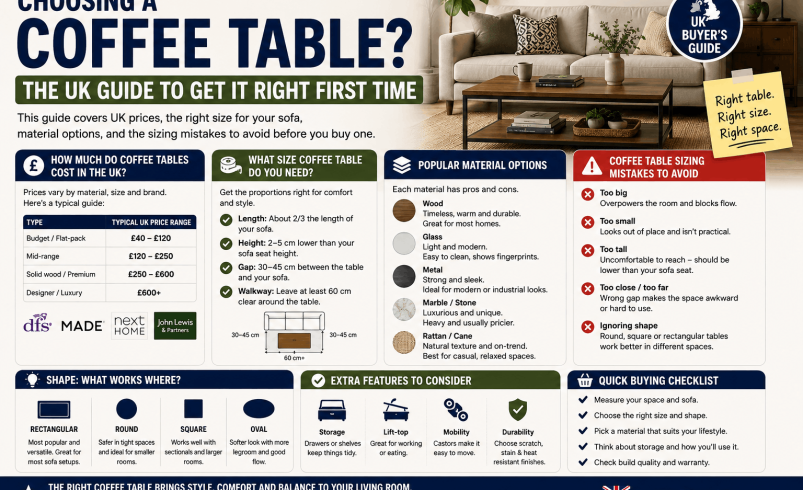
If you’re choosing a coffee table, the questions that actually matter are what size fits your sofa, what it should cost, and which material suits how you’ll use it. This guide answers all three, along with the sizing mistake that trips up most first-time buyers.
You’ll also find a breakdown of coffee table styles, a UK price comparison across major retailers, guidance on materials and safety standards, and answers to the questions people search alongside “coffee table.”
Coffee Table Prices in the UK
Prices span a wide range depending on material, brand and size, but most UK buyers land somewhere in the middle. Budget options from IKEA and Argos start as low as £10 to £20 for a basic laminate or veneer table. Mid-range tables, including many of the marble-effect and wood-finish designs now popular at Dunelm and B&Q, typically run £150 to £370. Premium and designer pieces from Wayfair, Made and Furniture Village can reach £900 or more, with solid wood and stone options at the top end.
| Retailer | Typical entry price | Typical mid-range price |
| IKEA | From £10 | £40 to £130 |
| Argos | From £12 | £50 to £150 |
| Dunelm | From £40 | £150 to £370 |
| Wayfair | From £18 | £100 to £300 |
| John Lewis | From £80 | £250 to £400 |
Prices and stock change regularly across all of these retailers, so treat the table above as a starting point rather than a fixed figure, and check the current listing before you commit to a specific model.
What Size Coffee Table You Actually Need
This is the step most buyers skip, and it’s the one that causes the most returns. Two simple rules cover almost every living room layout.
The length rule. Your coffee table should measure roughly two-thirds the length of your sofa. A 210cm sofa suits a table around 140cm long, while a 180cm sofa pairs well with a table closer to 120cm. Go too long and the table blocks the room’s flow; too short and it looks like an afterthought next to the sofa.
The height rule. The tabletop should sit level with your sofa’s seat cushion, or up to 2 to 3cm lower. Most sofa seats sit around 40 to 46cm off the floor, so a coffee table in that same range will feel natural to reach from a seated position. Anything noticeably taller starts to feel more like a dining table than a coffee table.
The clearance rule. Leave 35 to 45cm between the front edge of your sofa and the table’s nearest edge. Less than this and you’ll catch your shins standing up; more than this and the table starts to feel out of reach for setting down a drink.
If you’re unsure, mark the table’s footprint on the floor with tape before you order and sit on the sofa to check the reach and the walking space around it. It takes five minutes and saves the cost of a return.
Coffee Table Materials: What to Choose and Why
Solid wood is the most durable option and can be refinished if it gets scratched, but it’s the most expensive material and the heaviest to move. Oak and walnut are the most common UK choices, typically priced from £150 upward for a genuinely solid piece rather than a veneer.
Wood veneer and laminate cost far less, since a thin real-wood or printed layer sits over a composite base. These are lighter, more affordable, and fine for most households, though they can’t be sanded down or refinished if damaged, and water exposure can cause lasting marks.
Glass gives a lighter, more open feel in smaller rooms, since it doesn’t visually block floor space the way a solid material does. Any glass coffee table sold in the UK should use toughened glass certified to BS EN 12150, the British standard for thermally toughened safety glass, which is designed to break into small, blunt fragments rather than sharp shards if it fails. Check for a permanent etched mark referencing this standard on the glass itself, not just a removable sticker, before you buy.
Metal and rattan frames, often paired with a glass or wood top, suit more industrial or coastal styling and tend to sit in the mid-price range. Rattan needs a dry indoor spot, since it isn’t designed for damp conditions.
Coffee Table Shapes and When Each Works Best
- Rectangular tables suit straight sofas and larger rooms, and are the easiest shape to apply the two-thirds length rule to directly.
- Round and oval tables work well in smaller or more awkward-shaped rooms, since they have no sharp corners to catch on and often read as taking up less visual space.
- Square tables suit L-shaped sectionals, where a round or rectangular table can leave one seating side further from the table than the rest.
- Nesting tables, sold as a set of two or three, offer flexibility in small flats, since you can pull the smaller table out for extra surface space and tuck it away again afterwards.
Coffee Tables with Storage
A growing share of the UK market now includes built-in storage, either as a lift-top surface that raises to reveal hidden space, a shelf underneath for magazines and books, or drawers along the front. These typically cost £20 to £50 more than an equivalent table without storage, and the trade-off is usually a slightly bulkier profile.
If you’re buying primarily for a small flat or a room without much other storage, this extra cost is often worth it. If your main goal is a light, open look, a simple table with an under-shelf gives some storage without the visual weight of drawers.
Where to Buy a Coffee Table in the UK
IKEA offers the widest budget range, with the LACK series remaining one of the most consistently affordable options on the UK market, alongside showrooms where you can see pieces in person before buying.
Argos offers convenient click-and-collect alongside home delivery, with a broad range under the Argos Home and Habitat brands.
Dunelm has expanded its mid-range offering significantly, particularly in marble-effect and wood-finish designs, and regularly runs sales that bring mid-range tables closer to budget pricing.
Wayfair carries the largest overall selection by volume, with over 10,000 coffee tables in stock at any time and detailed customer photos, which makes it useful for comparing very similar styles across price points.
John Lewis sits at the premium end, with a two-year guarantee as standard and in-store advice, which suits buyers who want reassurance on a bigger purchase rather than the cheapest possible price.
Mistakes to Avoid When Buying a Coffee Table
Buying by eye rather than by measurement. A table that looks the right size in a product photo can be noticeably too large or small once it’s in your actual room. Always check the exact dimensions against your sofa and floor space before ordering.
Choosing a table taller than the sofa seat. This is the most common comfort complaint in coffee table reviews. Reaching up and over a tall table is far less natural than reaching slightly down to one at or below seat height.
Overlooking clearance for walking paths. Beyond the sofa-to-table gap, leave at least 60 to 75cm of walking space on any side of the table that people need to pass through regularly, particularly if the room doubles as a walkway to another door.
Buying untoughened glass. Ordinary annealed glass shatters into large, sharp shards if it breaks, which is a genuine hazard in a busy living room. Confirm any glass tabletop is certified to BS EN 12150 before buying, especially from marketplace sellers where standards aren’t always clearly stated.
Ignoring assembly requirements. Many budget and mid-range tables arrive flat-packed. If you’re not confident assembling flat-pack furniture, check whether the retailer offers a paid assembly service before you order, rather than discovering the requirement after delivery.
FAQ
Q: What size coffee table should I get for my sofa?
Your coffee table should measure roughly two-thirds the length of your sofa, so a 210cm sofa suits a table around 140cm long. Height should sit level with or slightly below your sofa’s seat cushion, typically 40 to 46cm, with 35 to 45cm of clearance between the sofa and the table’s edge.
Q: How much should a coffee table cost?
Budget options from IKEA and Argos start around £10 to £20, mid-range tables from retailers like Dunelm typically cost £150 to £370, and premium solid wood or designer pieces can reach £900 or more. Most UK buyers spend somewhere between £100 and £260 for a mid-range table that will last several years.
Q: What’s the best material for a coffee table with kids or pets?
Solid wood or laminate tables with rounded corners tend to be the safest and most durable choice, since they can withstand knocks better than glass and don’t chip as easily as some finishes. If you do choose glass, make sure it’s toughened and certified to BS EN 12150.
Q: Is glass or wood better for a coffee table?
This depends on your room and household. Glass suits smaller rooms where you want a lighter, more open feel, while wood offers more durability and warmth and is generally the safer choice around young children. Toughened glass certified to BS EN 12150 is the minimum standard to look for if you choose glass.
Q: How tall should a coffee table be?
Most coffee tables sit between 40 and 46cm tall, matching or sitting slightly below the seat height of a standard sofa. Going taller than this starts to feel awkward for reaching across, while going shorter can make the table difficult to use comfortably from a seated position.
Q: Can a coffee table be too big for a small room?
Yes. In a small living room, a table that takes up too much of the two-thirds length rule relative to a compact sofa can dominate the space and block walking paths. Round or oval tables, or a set of nesting tables, often work better than a large rectangular table in tighter rooms.
Q: Do I need to assemble a coffee table myself?
Most budget and mid-range coffee tables arrive flat-packed and need assembly, typically taking 20 minutes to an hour depending on the design. Premium retailers sometimes offer white-glove delivery with assembly included, so check the delivery options before ordering if you’d rather avoid building it yourself.
Q: What’s the difference between a coffee table and a side table?
A coffee table is the larger, central table typically placed in front of a sofa, while a side table is smaller and sits beside a chair or at the end of a sofa. Side tables are usually similar in height to a coffee table but take up far less floor space.