 Haris
Haris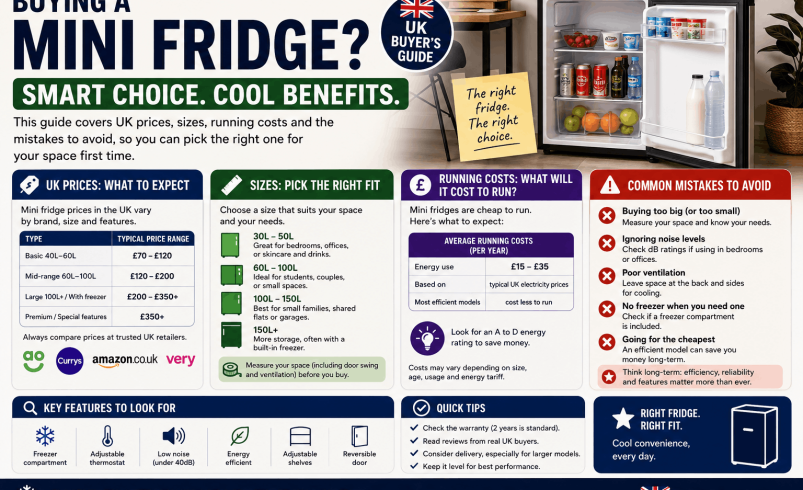
If you’re looking to buy a mini fridge, the main things you need to know are what size you actually need, how much it will cost to buy and run, and which type suits your space. This guide answers all three, along with the mistakes that lead people to return or regret their purchase.
You’ll also find a breakdown of the different types of mini fridge, a size and price comparison, guidance on where to buy in the UK, and answers to the questions people search alongside “mini fridge.”
What Counts as a Mini Fridge
A mini fridge is any compact refrigerator with a capacity roughly between 15 and 50 litres, small enough to sit on a desk, worktop or floor without taking up the space of a full-size appliance. Anything above that range starts to overlap with under-counter fridges, which are a separate category built to fit into kitchen units.
Most mini fridges fall into one of three types:
- Table top fridges, the smallest and cheapest option, usually 15 to 30 litres and designed to sit on a surface rather than the floor.
- Drinks coolers, often glass-fronted, built specifically for cans and bottles rather than fresh food, with capacities up to around 48 litres.
- Retro and branded fridges, styled after vintage designs or licensed with drinks brands, priced higher for the look rather than any extra function.
Mini Fridge Prices in the UK
Prices vary by size, cooling type and brand, but the UK market splits fairly cleanly into three price bands. Budget table top models start from around £30 to £65, mid-range models with more storage or a glass front typically run £65 to £130, and branded or retro-styled fridges can reach £130 or more for a similar capacity.
Major UK retailers stocking mini fridges include Argos, Currys, AO.com and supermarkets such as Tesco and ASDA, with prices and stock changing regularly across all of them. It’s worth comparing two or three retailers rather than buying from the first one you find, since the same or a similar model can vary by £10 to £20 between sellers.
| Type | Typical capacity | Typical UK price range |
| Table top fridge | 15 to 30 litres | £30 to £65 |
| Drinks cooler (glass door) | 30 to 48 litres | £65 to £130 |
| Retro or branded fridge | 20 to 48 litres | £100 to £180+ |
Check the current price at your chosen retailer before buying, since mini fridges are frequently discounted and prices can shift by season.
Mini Fridge Sizes: How Much Space You Actually Need
Capacity is measured in litres, and it’s easy to underestimate how little a small number actually holds. A 4-litre mini fridge, sometimes marketed as a skincare or cosmetics fridge, holds only a handful of small items and isn’t suitable for everyday food storage. For genuinely useful drink or food chilling, most buyers are better served by something in the 15 to 30 litre range.
As a rough guide, a 15-litre fridge holds around 12 to 15 standard 330ml cans, while a 48-litre model can hold 40 or more. If you’re buying for a bedroom, office desk or gaming setup, 15 to 20 litres is usually enough. For a caravan, shed, garage or shared house kitchen, look at 30 litres upward.
Measure your intended spot before ordering, including the clearance needed for the door to open fully and for air to circulate around the back. Thermoelectric mini fridges in particular need a gap behind them to vent heat properly, so don’t push one flush against a wall.
How Much a Mini Fridge Costs to Run
Running costs depend heavily on the cooling technology inside the fridge, and this is where many buyers get caught out by a cheap upfront price. There are two main types.
Compressor mini fridges use a small motor, similar to a full-size fridge, and are the more efficient option. A typical compressor mini fridge uses around 0.3 to 0.5 kWh per day, which works out to roughly £27 to £55 a year at current electricity prices.
Thermoelectric mini fridges use a peltier plate with no moving parts, which makes them quieter but noticeably less efficient. These typically use 0.7 to 1.2 kWh per day, costing roughly £63 to £108 a year, close to double the running cost of a compressor model for similar cooling.
Electricity unit rates change with the Ofgem price cap, so treat these figures as a guide rather than an exact bill, and check the current unit rate on your own energy account or Ofgem’s website before comparing models closely.
| Cooling type | Typical daily use | Typical annual cost |
| Compressor | 0.3 to 0.5 kWh | £27 to £55 |
| Thermoelectric | 0.7 to 1.2 kWh | £63 to £108 |
Beyond the cooling type, the energy label on the box gives you a rating from A to G, with A-rated models using meaningfully less power than D-rated or older equivalents. If two fridges are a similar price, the one with the better energy rating usually pays for the difference within a year or two.
Table Top Fridge vs Drinks Cooler: Which One Do You Need
This is the decision most buyers actually face, since these are the two most common types sold in the UK.
A table top fridge is built for general small-scale food and drink storage, typically with a solid door, one or two shelves, and a small freezer compartment or ice box in some models. It’s the more practical choice if you want to keep milk, snacks or leftovers cold alongside drinks.
A drinks cooler is built around visibility and capacity for cans and bottles, usually with a glass door and internal shelving designed for standing bottles upright. It’s the better choice if drinks are genuinely the only thing you’re storing, since the glass front lets heat in more easily than a solid door, which can make it slightly less efficient for anything beyond quick access chilling.
Where to Buy a Mini Fridge in the UK
Large retailers such as Argos, Currys and AO.com carry the widest range, with next-day delivery in most areas and clear filtering by capacity, colour and energy rating. These are usually the easiest place to compare like-for-like models.
Supermarkets including Tesco and ASDA stock a smaller, more budget-focused range, often cheaper but with less choice in size and features.
Marketplace sellers, including eBay and small specialist retailers, can undercut the big names on price but check the seller’s return policy and warranty terms before buying, since mini fridges from unfamiliar brands sometimes carry shorter or less clearly stated guarantees.
Whichever route you choose, check the manufacturer’s warranty length before buying. Most mainstream mini fridges carry a one-year manufacturer warranty as standard, with some retailers offering optional extended cover for an additional cost.
Mistakes to Avoid When Buying a Mini Fridge
Buying on capacity alone without checking dimensions. Two fridges with the same litre rating can have very different external dimensions depending on wall thickness and shelf design. Always check the height, width and depth in centimetres against your actual space, not just the litre figure.
Choosing a thermoelectric model for fresh food. Thermoelectric coolers don’t reach or hold as low a temperature as compressor fridges and struggle in warm rooms. They’re fine for chilling drinks but aren’t recommended for dairy, meat or anything that needs a consistent, low fridge temperature.
Ignoring the noise level. Compressor fridges cycle on and off and produce a low hum, which is rarely noticeable in a kitchen but can be distracting next to a bed or in a quiet office. If noise matters to you, check the decibel rating listed in the product specification before buying.
Placing it somewhere without ventilation. Pushing a mini fridge flush against a wall or into a tight cupboard restricts airflow, makes the compressor work harder, and shortens its lifespan. Leave a few centimetres of clearance on the back and sides where the manufacturer’s instructions recommend it.
Forgetting about disposal of the old one. If you’re replacing an existing appliance, don’t put it in general waste. Fridges are covered by WEEE regulations and must go through an approved collection route rather than a household bin.
Mini Fridge Disposal and Recycling
UK law requires waste electrical items, including fridges, to be recycled through approved routes rather than thrown away with general rubbish. Under the Waste Electrical and Electronic Equipment Regulations, retailers with a sales floor larger than 400 square metres must accept small WEEE items, including most mini fridges, for free from any customer without requiring a new purchase.
For larger retailers and online orders, many offer a paid or free collection of your old appliance when a new one is delivered, so it’s worth asking about this at checkout rather than arranging separate disposal afterwards. Councils also accept fridges for free at household recycling centres if you’d rather drop it off yourself.
FAQ
Q: What size mini fridge do I need?
This depends on what you’re storing. For drinks and light snacks in a bedroom or office, 15 to 20 litres is usually enough. For a shared kitchen, caravan or garage where you need more capacity, look at 30 litres or above. Always check the external dimensions too, not just the litre rating, since these vary between models with the same capacity.
Q: How much electricity does a mini fridge use?
A compressor mini fridge typically uses around 0.3 to 0.5 kWh per day, costing roughly £27 to £55 a year at current electricity prices. Thermoelectric models use more, typically £63 to £108 a year for similar cooling. Check the energy label on the specific model for its exact annual kWh figure.
Q: Is a mini fridge cheaper to run than a normal fridge?
Yes, in absolute terms. A full-size fridge typically costs £45 to £135 a year to run, compared with £27 to £108 a year for a mini fridge depending on the cooling type. Per litre of storage, though, mini fridges are often less efficient than full-size models because of proportionally greater heat loss through the walls and door.
Q: Can a mini fridge keep food safe, not just drinks cold?
A compressor mini fridge can hold food at a safe fridge temperature if set correctly, typically between 3°C and 5°C. A thermoelectric model is less reliable for this, especially in a warm room, and isn’t recommended for dairy, meat or anything requiring consistent refrigeration.
Q: How noisy is a mini fridge?
Compressor models produce a low hum as the motor cycles on and off, which most people find unnoticeable in daily use but which can be distracting in a quiet bedroom. Thermoelectric models run silently since they have no moving parts, though they’re less efficient at cooling.
Q: Do mini fridges need to warm up or settle before use?
Yes. Most manufacturers recommend leaving a mini fridge upright and unplugged for a few hours after delivery before switching it on, to let the refrigerant settle after transport. Check the instructions included with your specific model, since recommended settling times vary.
Q: How do I get rid of my old mini fridge?
Fridges are covered by WEEE regulations and can’t go in general waste. Larger retailers must accept small WEEE items for free in-store, many offer paid or free collection when delivering a replacement, and your local council will accept it for free at a household recycling centre.
Q: Can I put a mini fridge on carpet?
Most manufacturers recommend a hard, level, ventilated surface rather than carpet, since carpet can restrict airflow underneath and around the unit. Check your specific model’s instructions, as some designs are more tolerant of this than others.