House for Sale: Your UK Buying Process and Costs Guide
- August 18, 2026
- 0
Typing “house for sale” into Google usually means one of two things: you want to browse current listings, or you’re trying to understand what buying a house for
Typing “house for sale” into Google usually means one of two things: you want to browse current listings, or you’re trying to understand what buying a house for
Typing “house for sale” into Google usually means one of two things: you want to browse current listings, or you’re trying to understand what buying a house for sale actually involves before you commit. Both come down to the same starting point, since every UK property portal pulls its house for sale listings from the same pool of estate agent data, and the buying process behind any listing follows the same legal steps regardless of price. This piece covers where those listings actually come from, what a purchase costs beyond the asking price, and the mistakes that catch out most first-time buyers.
Every major UK property portal, including Rightmove, Zoopla and OnTheMarket, displays listings supplied directly by estate agents rather than compiling its own independent database. That means the same house for sale often appears on multiple portals with identical photos and descriptions, so searching more than one site rarely turns up different properties, just different ways of filtering the same ones.
New build homes are the exception. Developers frequently list directly through their own sales offices and websites before, or instead of, appearing on the major portals, which is worth checking separately if you’re specifically looking at new build.
Most buyers start with a portal search and narrow down from there, but knowing how each source works helps you avoid missing listings that never make it onto the big three sites.
Rightmove and Zoopla are the two largest UK property portals and between them list the overwhelming majority of estate agent instructed properties for sale. OnTheMarket operates on a similar model with a smaller but still substantial listings pool. Filtering by price, bedrooms, property type and location works similarly across all three, and setting up email alerts on your preferred portal is the most reliable way to see a new house for sale the moment it’s listed rather than days later.
Registering directly with local estate agents, rather than relying purely on portal alerts, often gets you early access to a house for sale before it’s publicly listed, since agents frequently offer properties to registered buyers first. For new build, going straight to the developer’s own site or sales office gives you access to plots and phases that may not appear on the portals at all until later in the build programme.
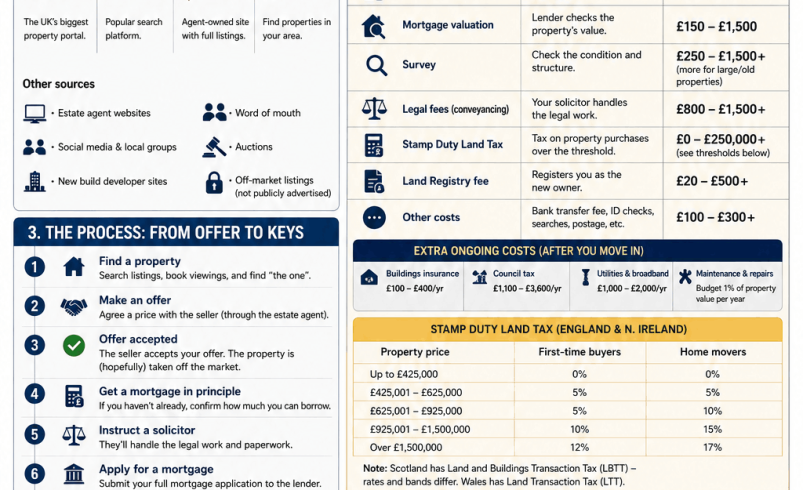
The asking price is only the starting point. Budgeting for the full cost of buying prevents the most common source of last-minute stress in a purchase: discovering a fee you hadn’t planned for right before completion.
| Cost | Typical range |
| Stamp Duty Land Tax | £0 to 12%, depending on price and buyer status |
| Conveyancing and legal fees | £800 to £1,900 |
| Survey | £300 to £1,500, depending on survey level |
| Mortgage valuation | Often free, up to £300 if charged separately |
| Mortgage arrangement fee | Up to £1,500, unless you choose a fee-free deal |
| Removals | £450 to £1,400 |
[Table: worked example showing total upfront cost for a £300,000 first-time buyer purchase versus a £300,000 home mover purchase]
Stamp Duty Land Tax applies to residential purchases in England and Northern Ireland, with the standard nil-rate band set at £125,000, followed by 2% up to £250,000, 5% up to £925,000, 10% up to £1.5 million and 12% above that, according to GOV.UK’s current rates. First-time buyers pay no SDLT up to £300,000 and 5% on the portion between £300,001 and £500,000, but lose the relief entirely if the purchase price goes over £500,000.
If you already own a residential property anywhere in the world, you’ll usually pay an additional 5% surcharge on top of the standard rates. Scotland uses Land and Buildings Transaction Tax instead, and Wales uses Land Transaction Tax, both with different thresholds from the England and Northern Ireland SDLT bands, so check the relevant calculator for your nation before budgeting.
Conveyancing fees for buying, including legal fees and disbursements such as searches and Land Registry costs, typically run from £800 to £1,900 according to consumer guidance from the HomeOwners Alliance, with leasehold properties costing more due to the extra legal work involved. A basic mortgage valuation is often included free by your lender, but a proper survey, which checks the physical condition of the property rather than just its value for lending purposes, costs separately.
Survey costs range from around £300 for a basic condition report to £1,500 or more for a full structural survey, and the right level depends on the property’s age and condition rather than its price. Older or unusual properties generally justify the more detailed survey level, since that’s where expensive structural issues are most likely to surface.
Buying a house for sale in the UK follows a consistent legal sequence, whether you’re a first-time buyer or moving for the fifth time.
Most avoidable delays and disputes trace back to a small set of recurring mistakes, rather than anything unusual about the property itself.
A typical UK house purchase takes around 12 to 20 weeks from accepted offer to completion, though this varies significantly depending on chain length, mortgage processing times and how quickly searches come back. Buying a property with no chain, such as a new build or a probate sale, is usually faster, since there’s no dependency on someone else’s sale completing at the same time.
Delays most commonly happen at the survey and search stage or while waiting for mortgage offer confirmation, so staying in regular contact with your conveyancer and mortgage broker during these periods helps catch problems early rather than discovering them close to your planned completion date.
Q: Where can I find a house for sale near me? Rightmove, Zoopla and OnTheMarket are the three main UK property portals and between them cover the overwhelming majority of estate agent listings. Registering directly with local estate agents can also give you access to properties before they’re publicly listed.
Q: How much deposit do I need to buy a house? Most mortgage lenders require a minimum deposit of 5% to 10% of the purchase price, though a larger deposit typically unlocks better interest rates. The exact minimum depends on the lender and your individual circumstances, so check current requirements with a mortgage broker or lender directly.
Q: Is stamp duty payable on every house purchase? No, stamp duty only applies above certain thresholds. Standard buyers pay nothing on the first £125,000, while first-time buyers pay nothing up to £300,000, with different thresholds again in Scotland and Wales.
Q: How long does it take to buy a house in the UK? Most purchases complete in around 12 to 20 weeks from an accepted offer, though chain-free purchases like new builds tend to move faster. Mortgage processing and survey or search delays are the most common causes of a longer timeline.
Q: Do I need a survey if I’m getting a mortgage valuation? Yes, in most cases. A mortgage valuation only confirms the property is worth what the lender is being asked to lend against, while a survey checks its physical condition, and the two serve different purposes.
Q: What happens if my house purchase falls through? You typically lose any survey and conveyancing fees already paid, though the deposit is only at risk once contracts have been exchanged. Purchases most often fall through due to problems elsewhere in the chain rather than an issue specific to your own transaction.
Q: Can I make an offer on more than one house at once? Yes, there’s no legal restriction on making multiple offers simultaneously in England and Wales, since none are binding until exchange. It’s generally considered poor practice to accept more than one offer as a seller, but as a buyer, offering on several properties carries no legal risk.