



FPL Price Changes Explained: How and When They Happen

You’ve checked your Fantasy Premier League squad and a player’s value has shifted overnight, and you want to know why, and whether you can do anything about it before the next update. FPL price changes work like a supply and demand system: when a lot of managers buy a player, their price rises, and when a lot sell, it falls, in steps of £0.1m up to a maximum of £0.3m in any single Gameweek. This guide covers exactly how the mechanic works for the 2026/27 season, when prices actually update, how selling a risen player affects your bank, and the mistakes that cost managers team value over a season.
How FPL Price Changes Work
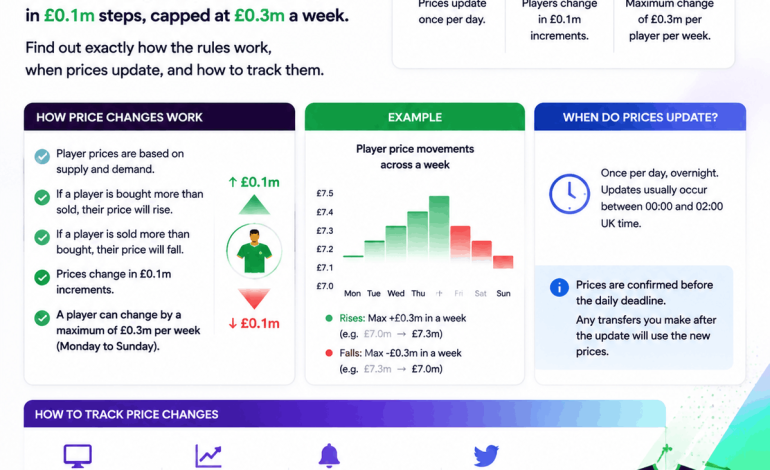
Every player starts the season with a fixed price set by the Fantasy Premier League game, and from the moment Gameweek 1 kicks off, that price can move based on transfer activity. If a player is bought into a large number of squads, their price rises by £0.1m. If they’re sold out of a large number of squads, it falls by the same amount.
Not every player moves every day. Only a small proportion of the player pool sees a price change on any given night, and it’s driven by the net balance of transfers in versus transfers out, not by performance alone. A player can still rise in price after a quiet Gameweek if enough managers are buying ahead of a good fixture run, and a big-name player can fall after an injury even if they haven’t played badly.
[Image: screenshot of an FPL squad showing a player’s price change indicator]
When Do FPL Prices Change?
For the 2026/27 season, prices update once a day at midnight UK time, a change from the previous timing of around 1:30am GMT or 2:30am BST used in earlier seasons. A player can rise or fall by a maximum of £0.1m per day, and no player can move by more than £0.3m in a single Gameweek, whichever direction that movement goes.
Because the update happens overnight, most of the visible movement in a manager’s team value appears the next morning rather than in real time during the day. Keep an eye on official FPL communications for the exact timing, since Fantasy Premier League has adjusted this before and could do so again.
The Official Price Change Predictor Tool
For 2026/27, Fantasy Premier League introduced its own Price Change Predictor, a dedicated page on the official website that shows every player’s progress towards their next price movement as a percentage, updated roughly every 15 minutes using real transfer data. It labels players with statuses such as “Very Likely to Rise” or “Likely to Drop” rather than showing raw numbers, and the tool only appears once the Gameweek 1 deadline has passed.
This is a genuine change from previous seasons, when managers relied entirely on third-party sites such as Fantasy Football Scout and LiveFPL to estimate probable price changes from ownership trends, since the exact thresholds FPL uses have never been published. The official tool doesn’t remove uncertainty completely, since Fantasy Premier League still doesn’t publish the underlying formula, but it gives managers a same-day steer that wasn’t available before.
[Table: comparison of the official Price Change Predictor vs third-party prediction sites, showing update frequency, data source, and prediction format]
How Much Can a Player’s Price Rise or Fall?
Price movements are always in £0.1m increments, and the overall cap for any player in a single Gameweek is £0.3m, whether that’s three separate rises of £0.1m or three separate falls. Prices don’t move indefinitely in one direction either. A player who’s risen sharply after a hot start to the season can fall back down over subsequent weeks if enough managers start selling, and the same works in reverse for a player recovering from a slow start.
Wildcard and Free Hit transfers don’t count towards the transfer volume that drives price changes, so a mass wildcard rush on a popular player won’t move their price in the way a normal round of transfers would. This is a detail that trips up a lot of managers who assume every squad change they see reflected in ownership numbers is also affecting prices.
What Happens When You Sell a Player: The 50% Profit Rule
This is the part of FPL price changes that catches out the most managers, and it’s worth understanding properly before you start chasing rises. If a player you own has risen in price since you bought them, you don’t get the full increase back when you sell. FPL applies a sell-on fee of 50%, rounded down to the nearest £0.1m, so you only keep half the profit.
For example, if you bought a player for £10.0m and their price has risen to £10.6m, your profit is £0.6m, but you only receive £0.3m of that when you sell, meaning your selling price is £10.3m rather than £10.6m. Losses work differently: if a player’s price has fallen since you bought them, you take the full loss with no discount applied, so a player bought at £10.0m that’s fallen to £9.7m can only be sold for £9.7m.
| Scenario | Purchase price | Current price | Profit or loss | Actual selling price |
| Player has risen | £10.0m | £10.6m | £0.6m rise | £10.3m (50% of profit) |
| Player has risen slightly | £8.0m | £8.2m | £0.2m rise | £8.1m (50% of profit) |
| Player has fallen | £10.0m | £9.7m | £0.3m loss | £9.7m (full loss applied) |
The practical effect is that repeatedly buying and selling players to chase small price rises rarely builds significant team value once the sell-on fee is factored in, so it usually pays to have a genuine footballing reason for a transfer rather than treating price changes as the main driver.
Do Wildcard and Free Hit Transfers Affect Price Changes?
Wildcard and Free Hit transfers are excluded from the transfer counts that FPL uses to calculate price movements, which means using a chip to build your ideal squad for a Gameweek won’t itself push prices up or down in the way a standard transfer round would. Managers sometimes use a Wildcard specifically to reset their squad around players they expect to rise or fall, capturing value before a chip-driven transfer wave from other managers who haven’t yet made the same move.
This matters most around international breaks and season restarts after a long gap, when large numbers of managers make transfers in a short window and price volatility increases across the board. If you’re planning a Wildcard, it’s worth checking the Price Change Predictor beforehand so you’re not left buying a player the night before they were about to rise anyway.
Common Mistakes to Avoid With FPL Price Changes
A lot of the value managers lose over a season comes down to a small number of repeated errors rather than bad luck.
- Chasing a rise too early. Buying a player purely because they look “likely to rise” can backfire if a midweek injury or poor team news changes the picture before the deadline.
- Ignoring the sell-on fee. Selling a risen player expecting the full increase back leads to budgeting mistakes when the actual figure turns out to be half that amount.
- Assuming every transfer affects price. Wildcard and Free Hit moves don’t count, so tracking overall ownership swings during a chip rush can give a misleading picture of who’s about to move.
- Overvaluing team value at the expense of points. A higher squad value is useful for flexibility, but it doesn’t score points on its own, and prioritising it over genuinely good transfers is a common trap.
- Not checking the timing. Making a transfer expecting an overnight price change without confirming the current update time can mean missing it by hours.
Where to Track FPL Price Changes
The official Price Change Predictor on the Fantasy Premier League website is now the primary source, since it draws directly on the same transfer data FPL itself uses to decide movements. Third-party sites such as Fantasy Football Scout still publish their own estimates and historical price change data, which can be useful for cross-checking or for browsing past trends across a season.
[Image: screenshot of the official FPL Price Change Predictor page]
Whichever source you use, treat any prediction as a probability rather than a guarantee, since FPL doesn’t publish the exact thresholds that trigger a rise or fall, and last-minute swings in transfer activity can change a player’s status within hours.
What to Do Next
- FPL prices move once a day in £0.1m steps, capped at £0.3m per Gameweek, based on net transfers in and out.
- For 2026/27, prices update at midnight UK time, and the official Price Change Predictor shows each player’s live progress.
- Selling a risen player only returns 50% of the profit, rounded down to the nearest £0.1m, so factor that into your budgeting before making a transfer.
- Wildcard and Free Hit transfers don’t count towards price change calculations.
- Check the official Price Change Predictor on the Fantasy Premier League website before making a transfer you’re timing around a price move.
FAQ
Q: How often do FPL prices change? FPL prices can change once per day, and any single player is capped at a maximum movement of £0.3m within one Gameweek. Not every player moves every day, since it depends on that day’s net transfer activity for each individual player.
Q: What time do FPL prices update? For the 2026/27 season, prices update at midnight UK time, a change from the roughly 1:30am GMT or 2:30am BST timing used in previous seasons. Check official FPL communications for the current confirmed time, since this has changed before.
Q: How much profit do you get when you sell a risen FPL player? You get 50% of the profit, rounded down to the nearest £0.1m, not the full price rise. For example, a player bought at £10.0m that’s risen to £10.6m sells for £10.3m rather than £10.6m.
Q: Do wildcard transfers affect FPL price changes? No, transfers made using the Wildcard or Free Hit chip are excluded from the transfer counts that drive price movements. A mass wildcard rush on a player won’t push their price up the way normal transfers would.
Q: Is there an official tool to predict FPL price changes? Yes, Fantasy Premier League launched a Price Change Predictor for the 2026/27 season, showing each player’s live progress towards a rise or fall as a percentage. It updates roughly every 15 minutes using official transfer data.
Q: Do FPL prices change during pre-season? No, price changes only begin from the kickoff of Gameweek 1 onwards. Prices set before the season starts stay fixed until the season is under way.
Q: Can a player’s FPL price fall below their starting price? Yes, a player’s price can drop below their original season-start value if enough managers sell them, and it can later recover if demand picks up again. There’s no rule preventing a price from moving in either direction multiple times across a season.
Q: Why hasn’t my FPL player’s price changed even though loads of people are buying them? Price changes depend on the net balance of transfers in and out relative to that player’s ownership level, not just the raw number of managers buying them. A widely-owned player needs a much larger volume of net transfers to move £0.1m than a player who’s barely owned.