Houses for Sale in the UK: A Buyer’s Practical Guide
- August 18, 2026
- 0
If you’re scrolling through houses for sale wondering where to start, the honest answer is: before you fall for a listing, get your finances sorted and understand what
If you’re scrolling through houses for sale wondering where to start, the honest answer is: before you fall for a listing, get your finances sorted and understand what

If you’re scrolling through houses for sale wondering where to start, the honest answer is: before you fall for a listing, get your finances sorted and understand what the price on the portal actually costs you once fees, tax and surveys are added on. A lot of buyers make an offer first and work out the real numbers afterwards, which is exactly how people end up stretched or stuck in a chain that collapses.
This guide walks through how to search sensibly, what a mortgage in principle actually does for you, the full cost breakdown including Stamp Duty, the stage-by-stage buying process, and the mistakes that catch out first-time buyers and home movers alike. There’s also a section on what to check before you make an offer, since this is where most avoidable problems start.
Property portals show you the asking price, the photos, and a floor plan if you’re lucky. What they don’t show you is the property’s flood risk, whether it’s on a public right of way, whether the roof needs work, or what the seller’s actual motivation for moving is. All of that comes later, usually after you’ve already fallen for the kitchen.
Treat the listed price as the starting figure, not the total cost. Budget an extra amount on top for Stamp Duty, legal fees, surveys and moving costs, all covered in detail further down. Skipping this step is the single biggest reason buyers end up disappointed by how much cash they actually need on completion day.
[Image: photo of a UK terraced street with for sale signs, use royalty-free image from Unsplash or Pexels]
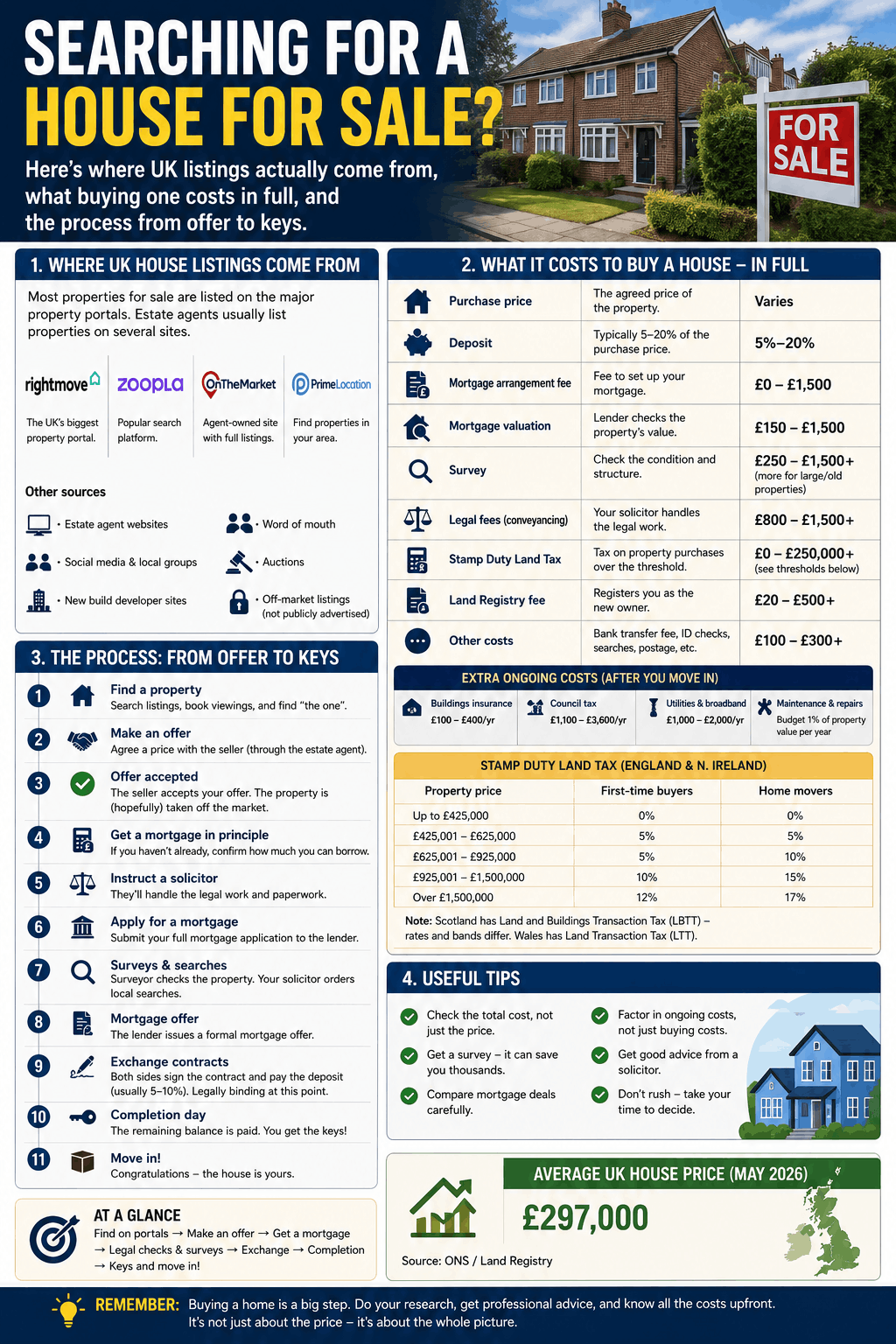
Most buyers start on the big property portals, but they’re not the only route into the market, and each has a different trade-off.
A search that only covers the big portals will miss anything sold through an agent’s private list or an auction house, so it’s worth casting a slightly wider net if you’re not finding what you want.
[Table: comparison of ways to search for houses for sale, showing typical timescale, selection, and best for]
| Route | Typical timescale to completion | Best for |
| Property portal + estate agent | 2 to 3 months from offer | Most buyers, widest choice |
| Auction | Under 60 days | Renovation projects, investors |
| New-build developer | Varies, often 6 to 12 months if buying off-plan | Buyers wanting a warranty and no chain |
Before you book a single viewing, work out what you can actually borrow and what deposit you have. A mortgage lender will confirm this in a document called a mortgage agreement in principle, sometimes called a decision in principle. Without one, most estate agents won’t take your offer seriously, since they’ve no way of knowing you can actually afford the property.
Getting an agreement in principle usually takes a soft credit check and a few details about your income and outgoings, and it’s typically valid for 60 to 90 days. If it expires before you’ve found somewhere, you simply ask your lender or broker to refresh it.
The purchase price is only part of the bill. Legal fees are usually about £2,000, including VAT at 20%, and that’s before searches, surveys and Stamp Duty are added.
[Table: typical upfront costs when buying a house in the UK]
| Cost | Typical range |
| Solicitor or conveyancer fees | Around £2,000 including VAT |
| Local authority searches | £250 to £300 |
| Mortgage valuation | £150 to £800, though many lenders cover this |
| Homebuyer survey | £400 to £1,500 depending on the level of detail |
| HM Land Registry registration fee | Based on purchase price, check the current fee on GOV.UK |
| Removals | £150 to £2,000 or more depending on distance and volume |
| Stamp Duty Land Tax | Depends on price and buyer status, see below |
Your solicitor’s local searches cost £250 to £300 and check for any local plans or problems, and this is separate from the survey, which looks at the physical condition of the property rather than legal issues around it. Ask your lender who covers the mortgage valuation cost, since usually lenders pay, but you might need to budget for it yourself depending on the deal.
Stamp Duty Land Tax (SDLT) applies to residential purchases in England and Northern Ireland above certain thresholds. Scotland uses Land and Buildings Transaction Tax and Wales uses Land Transaction Tax instead, each with different bands, so check the relevant devolved rates if you’re buying outside England or Northern Ireland.
For a standard purchase where the property will be your only home, the current rates are charged on a sliding scale.
[Table: SDLT residential rates for a single property]
| Portion of price | SDLT rate |
| Up to £125,000 | 0% |
| £125,001 to £250,000 | 2% |
| £250,001 to £925,000 | 5% |
| £925,001 to £1.5 million | 10% |
| Above £1.5 million | 12% |
Each rate only applies to the slice of the price within that band, not the whole purchase price. On a £295,000 house, you’d pay nothing on the first £125,000, 2% on the next £125,000, and 5% on the final £45,000, giving a total SDLT bill of £4,750.
If you and anyone you’re buying with have never owned a residential property anywhere in the world, you can claim first-time buyer relief. You’ll pay no SDLT up to £300,000, then 5% on the portion from £300,001 to £500,000. Above £500,000, the relief disappears entirely and you pay the standard rates on the full price.
Buying an additional property, such as a second home or buy-to-let, adds a further 5% surcharge on top of the standard rates. Whoever handles your conveyancing will usually submit the SDLT return and pay the tax on your behalf on completion day, and it’s due within 14 days of completion, so make sure the funds are with your solicitor in good time.
Buying a house in England, Wales or Northern Ireland follows a fairly consistent sequence, even though the exact timings vary from one purchase to the next.
Exchange of contracts is your last realistic chance to pull out without serious financial consequences, since after that point both sides are legally committed. On average, buying a house through an estate agent takes two to three months from offer to completion, though delays in a chain or a slow search result can push this out considerably. Buying at auction is faster, typically completing within 60 days of the sale.
A handful of checks before you offer can save you a lot of grief later.
Some mistakes come up again and again, and most are avoidable with a bit of forward planning.
Skipping the survey to save money is a false economy on anything but a brand-new build, since a Homebuyer Report or full Building Survey can flag structural issues worth far more than the £400 to £1,500 it costs to commission one. Underestimating the total cash needed on completion day is another common trap, since buyers often budget for the deposit and forget Stamp Duty, legal fees and moving costs add up to a meaningful extra sum on top.
Waiting until after an offer is accepted to instruct a solicitor slows everything down, since a good conveyancer needs time to get on top of the file. Not asking enough questions about the chain leaves buyers exposed to delays that have nothing to do with their own purchase. And underestimating how emotionally attached you can get to a property before you’ve had it properly surveyed leads some buyers to overlook red flags a professional would have caught immediately.
There’s no fixed timescale, and it depends heavily on the length of the chain, how quickly searches come back, and whether your mortgage application runs smoothly. On average, expect two to three months with an estate agent from offer accepted to completion, though this can run longer if problems surface during conveyancing, such as unexpected legal issues like chancel repair liability or unresolved boundary disputes. Buying at auction removes most of that uncertainty, since contracts are exchanged on the day of the sale and completion typically follows within 28 days.
Q: How much deposit do I need to buy a house?
Most mortgage lenders ask for a minimum deposit of 5% to 10% of the purchase price, though a larger deposit usually gets you access to better interest rates. The exact amount depends on your lender, your credit history, and the type of mortgage deal you’re applying for.
Q: How much does it cost to buy a house in the UK?
Beyond the purchase price, budget roughly £2,000 for legal fees, £250 to £300 for local searches, £400 to £1,500 for a survey, and any Stamp Duty due based on the price and your buyer status. Removals typically add another £150 to £2,000 depending on distance and volume.
Q: How long does it take to buy a house?
It typically takes two to three months from an accepted offer to completion when buying through an estate agent, though delays in a chain or slow searches can extend this. Auction purchases move faster, usually completing within 60 days of the sale.
Q: Do I need a survey if I’m getting a mortgage?
Your lender will arrange a mortgage valuation, but this only confirms the property is worth the loan amount and isn’t a full structural check. A separate Homebuyer Report or Building Survey, which you arrange and pay for yourself, is the only way to check the property’s actual condition.
Q: What’s the difference between exchange and completion?
Exchange of contracts is the point the sale becomes legally binding on both sides, and pulling out after this stage carries serious financial consequences. Completion is the day the money actually transfers and you get the keys, which usually follows exchange by anywhere from a few days to a few weeks.
Q: Can I pull out after making an offer?
Yes, in England, Wales and Northern Ireland you can withdraw at any point right up until contracts are exchanged, without any legal penalty, though you may lose money already spent on surveys or searches. Once contracts are exchanged, withdrawing typically means losing your deposit and facing further legal consequences.
Q: Do first-time buyers pay stamp duty?
Not usually, since first-time buyers pay no Stamp Duty on the first £300,000 of the purchase price, and 5% on the portion from £300,001 to £500,000. If the price is over £500,000, the relief doesn’t apply at all and standard rates are charged on the full amount.