Thornhill Park and Ride Thefts: What You Need to Know
- August 18, 2026
- 0
Thornhill park and ride thefts have made the news in Oxford more than once, most often involving catalytic converters cut from cars while owners are in the city
Thornhill park and ride thefts have made the news in Oxford more than once, most often involving catalytic converters cut from cars while owners are in the city
Thornhill park and ride thefts have made the news in Oxford more than once, most often involving catalytic converters cut from cars while owners are in the city for the day. This guide sets out what’s actually been reported at the site, what Oxfordshire County Council and Thames Valley Police have said about it, and the practical steps that reduce your risk if you use Thornhill or a similar site like Ingliston park and ride.
Thornhill is one of Oxford’s five park and ride sites, located off the A40 to the east of the city, and it’s popular with commuters who leave a car there all day while working in the centre. That combination, a large car park with vehicles left unattended for hours at a time, is exactly the pattern thieves target.
The most widely reported problem at Thornhill involves catalytic converters, which contain small amounts of platinum, palladium and rhodium and can be cut from underneath a car in under a minute with a battery-powered saw. BBC News reported the case of Richard Malloy, a Wheatley resident who had two catalytic converters stolen from the same car at Thornhill within a five-year period, the most recent reported on 2 February.
In that case, Thames Valley Police opened an investigation but later told Malloy it had reached a dead end, partly because the car park’s CCTV footage from the time of the theft was corrupted. Oxfordshire County Council’s position, as given to the BBC, is that vehicles are parked at the owner’s own risk.
Thornhill also has a documented history of bicycle theft, confirmed by a Freedom of Information request submitted to Oxfordshire County Council in November 2022 asking for the number of bikes stolen from the site over the previous five years. [FACT UNVERIFIED — CHECK BEFORE PUBLISHING: the exact number of bicycles reported stolen, which was provided in a PDF attachment to that FOI response and should be confirmed before publishing a specific figure.] If you cycle to Thornhill and leave your bike locked at the site, a D-lock through the frame and wheel, rather than just the wheel, is the baseline precaution worth taking.
Park and ride sites share a few features that make them more attractive to opportunist thieves than an ordinary street. Cars are left for predictable, extended periods, usually a full working day, which gives thieves a wide window to work in. Large sites also see a constant flow of unfamiliar people coming and going, so a stranger crouched by a car doesn’t stand out the way it would in a quiet residential street.
Catalytic converter theft in particular has risen across the UK in step with the market price of the precious metals inside them, and courier-style thefts, where a car is targeted, stripped and the thieves are gone within a minute, are hard for standard CCTV to catch clearly unless the cameras are positioned and maintained well.
If your car or bike is stolen or damaged at Thornhill, report it to Thames Valley Police on 101 for a non-emergency theft, or 999 only if the theft is in progress and you’re witnessing it happen. You’ll need your vehicle registration, the approximate time window you were parked, and any dashcam or personal footage you have.
It’s also worth reporting the incident to Oxfordshire County Council directly, since the council manages the site and may hold CCTV footage the police will request as part of any investigation. Ask specifically whether the camera covering your parking bay was working and recording at the time, since footage gaps and corrupted recordings have affected past cases at this site.
There’s no way to make a car completely theft-proof, but a few concrete steps make yours a less appealing target than the car next to it.
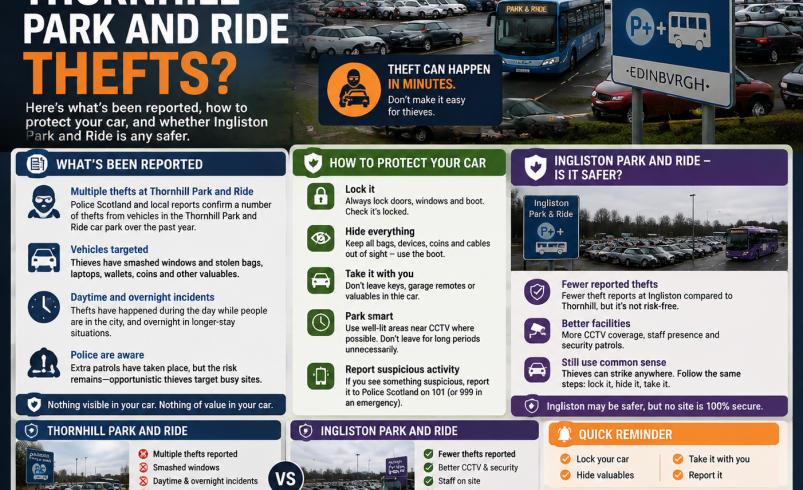
Ingliston park and ride, on the western edge of Edinburgh near the airport, is a different kind of site: it has over 1,000 free spaces, is served by the Edinburgh Tram as well as buses, and closes overnight between 02:00 and 04:00, when parked vehicles are removed. Public reporting doesn’t show the same pattern of repeated, documented theft cases that Thornhill has had, and the site has a general reputation among users as well lit and well covered by CCTV.
That said, the City of Edinburgh Council’s own terms for the site state plainly that vehicles and their contents are left at the owner’s sole risk, and the council accepts no liability for theft, loss or damage, which is the same legal position Oxfordshire County Council takes for Thornhill. A lower reported theft rate isn’t the same as no risk, so the same basic precautions, locking valuables out of sight and considering a catalytic converter clamp if your car is a common target model, apply just as much at Ingliston as anywhere else.
Both Oxfordshire County Council and the City of Edinburgh Council make clear in their published terms that they don’t accept liability for theft or damage in their park and ride car parks. That’s standard practice across most UK car parks, not something unique to these two sites, and it means your recourse after a theft runs through the police and your own insurer rather than the council operating the car park.
Whether your insurance pays out depends on your specific policy. Comprehensive car insurance generally covers theft of parts like a catalytic converter, but some policies apply a higher excess to this type of claim or exclude it for older or higher-risk vehicles, so it’s worth checking your policy documents or calling your insurer to confirm before you assume you’re covered.
Q: Is Thornhill park and ride safe to leave my car?
Thornhill is a normal, actively used park and ride site, but it has a documented history of catalytic converter and bicycle theft reported to Thames Valley Police and covered by the BBC. It’s not uniquely dangerous compared with other large UK car parks, but taking basic precautions, such as fitting a catalytic converter clamp, is a reasonable response to the reported pattern.
Q: What should I do if my catalytic converter is stolen at Thornhill?
Report it to Thames Valley Police on 101, note the approximate time you parked and returned, and contact Oxfordshire County Council to ask whether CCTV covering your bay was working. Then contact your car insurer to check whether the theft is covered under your policy and what excess applies.
Q: Why do thieves target catalytic converters specifically?
Catalytic converters contain small quantities of platinum, palladium and rhodium, valuable precious metals that can be sold on quickly. They can be removed from underneath a car in under a minute with a basic power saw, which makes them a fast, relatively low-risk target compared with stealing an entire vehicle.
Q: Does Oxfordshire County Council take responsibility for thefts at Thornhill?
No. The council’s stated position, given to the BBC in response to reported thefts, is that vehicles are parked at the owner’s own risk. This is standard across most UK car parks, including Edinburgh’s Ingliston site, so any claim for loss goes through the police and your own insurance rather than the council.
Q: Is Ingliston park and ride safer than Thornhill?
Public reporting doesn’t show the same documented pattern of repeated theft cases at Ingliston that Thornhill has had, and the site is generally described by users as well lit with good CCTV coverage. However, Edinburgh Council applies the same no-liability terms as Oxfordshire, so the same basic security precautions are still worth taking.
Q: Will my car insurance cover a stolen catalytic converter?
Most comprehensive car insurance policies cover catalytic converter theft, but the excess and any exclusions vary by insurer and by vehicle. Check your policy documents or call your insurer directly before assuming you’re covered, particularly if you drive an older vehicle or a model known to be a common target.
Q: Can I get a refund if my car is stolen from Thornhill park and ride?
Neither Oxfordshire County Council nor most UK car park operators offer compensation for theft, since their terms state cars are parked at the owner’s risk. Your only realistic routes to recovering costs are a successful insurance claim or, in rare cases, compensation ordered by a court if a suspect is caught and convicted.