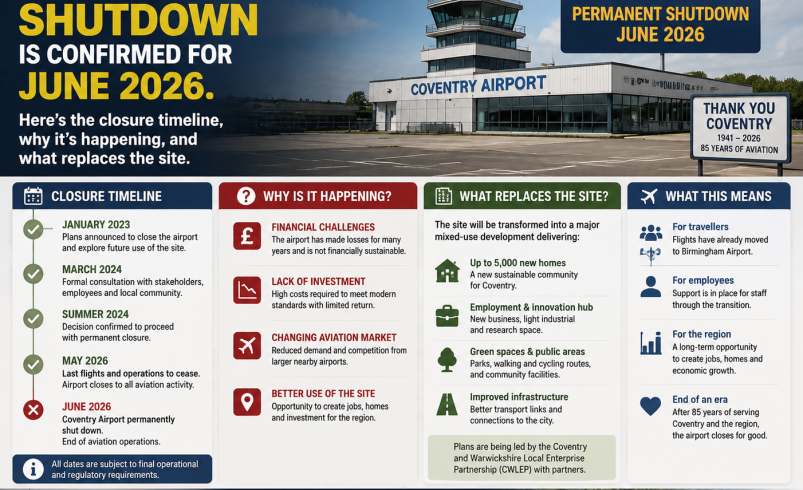
Coventry Airport’s permanent shutdown is now confirmed and dated, not speculation. The airport’s owners, the Rigby Group, gave formal notice to the Civil Aviation Authority that runway operations would end on 11 June 2026, with flights stopping a month earlier on 9 May 2026. This piece sets out the confirmed timeline, why the airport is closing after 90 years, and what happens to the site, tenants and surrounding area afterwards.
When Does Coventry Airport Close for Good
The closure has two distinct dates that are worth keeping separate. Flights and active flying operations at Coventry Airport stopped on 9 May 2026, the date by which the Rigby Group told tenants, including flight schools, maintenance firms and private aircraft owners, that they had to vacate the site. The airport’s licence and runway operations formally end on 11 June 2026, which is the date the Civil Aviation Authority confirmed as the point of permanent closure.
A CAA spokesperson confirmed the site’s owners gave formal notice of the closure directly to the regulator, which is the standard legal process for shutting down a licensed UK aerodrome. Coventry hasn’t run scheduled passenger flights since 2008, so this closure primarily affects general aviation: flight training, private and corporate aircraft, freight, and emergency and medical flights that continued to use the site.
Why Coventry Airport Is Closing
The site, known locally as Baginton, is being handed over to Greenpower Park, a manufacturing development focused on lithium-ion battery production, largely for electric vehicles. Greenpower Park is a joint venture between Coventry City Council and Coventry Airport, and the closure was effectively set in motion back in 2022, when local planning permission for the project was first granted.
The West Midlands Combined Authority (WMCA) put £23 million toward the project in January, funding the first phase of infrastructure work, which includes installing a 30 MVA power supply to serve future occupiers of the site. Councillor Jim O’Boyle, responsible for jobs and regeneration at Coventry City Council, framed the closure around the jobs the gigafactory is expected to bring to the area rather than the loss of the airport itself.
What Happens to Coventry Airport’s Airspace
Once runway operations stop, the airspace managed around the airport is also being removed, according to the Rigby Group’s statement to the BBC. Runway operations are being phased out in line with an approved infrastructure delivery schedule rather than stopping instantly, which explains the gap between the last flights in May and the formal closure date in June.
What This Means for Coventry Airport Tenants and Pilots
For the businesses and individuals actually based at Coventry, the closure has been far more disruptive than for the travelling public. Flight schools, aircraft maintenance operations and private owners were given notice to vacate by 9 May 2026, a tight window for relocating hangared aircraft and finding new premises for a flying business.
Nearby aerodromes such as Wellesbourne Mountford, Wolverhampton Halfpenny Green and Sywell are the most likely destinations for displaced flight schools and aircraft, though hangar space across UK general aviation sites is already limited. If you’re a pilot or tenant affected by the closure, contacting your target aerodrome directly and early gives you the best chance of securing space before capacity runs out.
One exception noted publicly is the Midlands Air Museum, which sits at one end of the airport’s runway. Warwick District Council has said it has worked with Coventry Airport’s owners and the CAA to allow certain missions based at the airport to continue flying after other operations end, though the detail of what continues and for how long hasn’t been fully confirmed. [FACT UNVERIFIED — CHECK BEFORE PUBLISHING: the specific scope and duration of any flying operations permitted to continue after 11 June 2026, which should be confirmed directly with Warwick District Council or the CAA before publishing further detail.]
Does the Coventry Airport Closure Affect Air Travellers
Very little, in practical terms. Coventry Airport hasn’t operated scheduled commercial passenger flights since 2008, so anyone travelling to or from Coventry by air has already been using Birmingham Airport, roughly 35 minutes away by road, or London airports further afield for over 15 years.
The closure mainly ends the airport’s role in freight, private and business aviation, air ambulance operations, and events such as its former Air Day airshow, rather than changing how ordinary travellers reach Coventry. If you’re planning travel to or from the city, nothing about your usual route through Birmingham Airport or the rail network changes because of this closure.
Coventry Airport’s History Before the Shutdown
The site opened as Baginton Aerodrome in 1936 and served as an RAF base during the Second World War, giving it a longer history than most people searching for the closure realise. It later hosted civilian flights, including a visit from Pope John Paul II during his 1982 UK tour, and became a regular fixture for aviation enthusiasts through decades of airshows.
Commercial passenger services ended in 2008, after which the site continued for close to two decades as a hub for freight, flight training, private aviation and emergency services. That 90-year run comes to a formal end with the June 2026 closure, making Coventry one of the more historically significant UK aerodromes to permanently shut in recent years.
FAQs
Q: Is Coventry Airport definitely closing permanently?
Yes. The Civil Aviation Authority has confirmed it received formal notice from the airport’s owners, the Rigby Group, of a permanent closure effective 11 June 2026. This isn’t a proposal or rumour: it’s a confirmed regulatory closure with flights already ending on 9 May 2026.
Q: What date does Coventry Airport actually close?
Flights stopped on 9 May 2026, the date tenants were told to vacate the site. The airport’s licence and runway operations formally end on 11 June 2026, which is the date confirmed by the Civil Aviation Authority as the permanent closure.
Q: Why is Coventry Airport closing?
The site is being redeveloped as Greenpower Park, a lithium-ion battery manufacturing site focused on electric vehicle production. The project is a joint venture between Coventry City Council and Coventry Airport, first given planning permission in 2022, with £23 million in West Midlands Combined Authority funding for initial infrastructure.
Q: Did Coventry Airport ever have passenger flights?
Yes, but not recently. Coventry Airport operated scheduled commercial passenger flights until 2008, after which it continued as a hub for freight, private and corporate aviation, flight training and emergency services until the 2026 closure.
Q: What will replace Coventry Airport?
Greenpower Park, a manufacturing site focused on lithium-ion battery production for electric vehicles, will occupy the site. The West Midlands Combined Authority has funded the first phase of infrastructure work, including a 30 MVA power supply for future occupiers of the site.
Q: Will the Midlands Air Museum stay open after Coventry Airport closes?
The museum, located at one end of the airport’s runway, has not been reported as closing alongside the airport. Warwick District Council has said it worked with the airport’s owners and the CAA on continuing certain flying operations, though the exact scope hasn’t been fully confirmed and should be checked directly before relying on it.
Q: Where will Coventry Airport’s flight schools and aircraft go?
Nearby aerodromes including Wellesbourne Mountford, Wolverhampton Halfpenny Green and Sywell are the most likely relocation options for displaced flight schools and private aircraft. Hangar space at UK general aviation sites is limited, so affected tenants have been advised to contact target aerodromes as early as possible.