Cockapoo UK Guide: Price, Health and What to Expect
- August 18, 2026
- 0
“What is a cockapoo actually like to own, and what does one cost?” is usually the real question behind the search. A cockapoo is a cross between a
“What is a cockapoo actually like to own, and what does one cost?” is usually the real question behind the search. A cockapoo is a cross between a
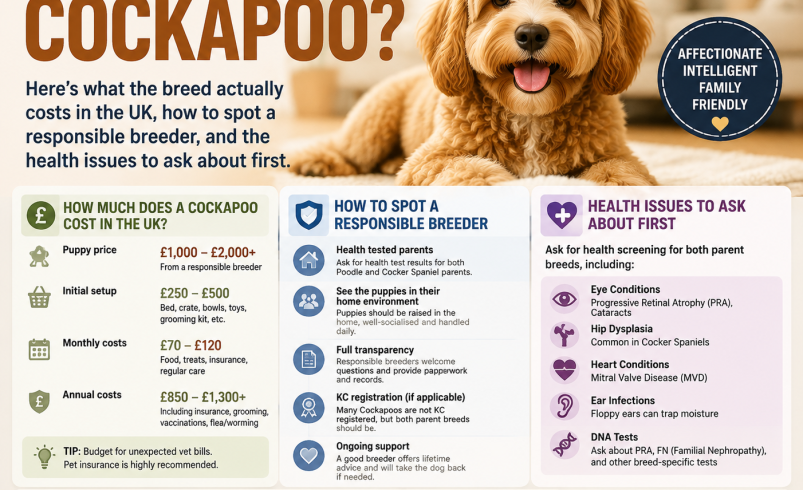
“What is a cockapoo actually like to own, and what does one cost?” is usually the real question behind the search. A cockapoo is a cross between a Cocker Spaniel and a Poodle, prized for a friendly temperament and a coat that sheds far less than most breeds. This guide covers what you’ll actually pay, how the breed’s health and temperament play out day to day, and the buying rules that protect you from the puppy farms still operating in the UK.
A cockapoo isn’t a recognised pedigree breed. It’s a crossbreed between a purebred Cocker Spaniel and a purebred Poodle, and the Kennel Club doesn’t register cockapoos because it only recognises established breeds with a fixed standard. That matters for buyers, because it means there’s no single official body checking that every cockapoo breeder meets a consistent welfare or health standard.
Breeders describe puppies by generation. An F1 cockapoo has one purebred Cocker Spaniel parent and one purebred Poodle parent, which gives the most predictable 50/50 mix. An F1b is a first-generation cockapoo bred back to a Poodle, usually to reduce shedding further, while F2 and later generations are cockapoo bred to cockapoo, which produces more variation in coat and temperament.
Prices vary enormously because there’s no fixed breed standard to anchor them. Across UK breeder listings, cockapoo puppies typically range from around £600 to £1,900, with most sold somewhere between £800 and £1,200. Coat colour, generation, location and whether the parents have been health tested all move the price.
City breeders, particularly around London, tend to charge more than breeders in rural areas or the north of the UK. A puppy from health-tested parents with hip and eye scores usually costs more than one without, and that’s generally money worth spending given the breed’s known eye and joint issues.
Beyond the purchase price, budget for the ongoing costs of ownership. Food typically runs to around £40 to £60 a month for an adult cockapoo, professional grooming every four to six weeks costs roughly £30 to £50 a session, and pet insurance for the breed commonly starts from around £20 to £35 a month depending on your provider and level of cover. Check current quotes before you commit, since insurance pricing shifts regularly with the market.
Full-grown cockapoos generally stand between 25cm and 38cm at the shoulder and weigh between 6kg and 11kg, though this depends heavily on whether the Poodle parent was a toy, miniature or standard. Most UK breeders work with miniature or toy Poodles, which keeps cockapoos in the small-to-medium range rather than producing the larger “maxi” cockapoos more common in the US.
The coat can be straight, wavy or tightly curled, and it isn’t fully predictable even within the same litter. Cockapoos are widely marketed as hypoallergenic, but no dog breed is truly hypoallergenic: lower shedding reduces the amount of dander and hair in the home, but it doesn’t eliminate the allergens that trigger reactions in sensitive people.
Cockapoos are consistently described as affectionate, sociable and eager to please, which is a large part of why the breed has become so popular with UK families. They tend to bond closely with their owners and can develop separation anxiety if left alone for long stretches without training to build up their tolerance gradually.
Most adult cockapoos need 30 to 60 minutes of exercise a day, split across one or two walks plus some mental stimulation through play or training. They’re intelligent enough to pick up basic training quickly, but that same intelligence means an under-stimulated cockapoo can develop nuisance behaviours like excessive barking or chewing.
Cockapoos generally live 12 to 15 years and are considered a reasonably healthy crossbreed, but they can inherit conditions from either parent breed. The main ones worth discussing with a breeder before you buy are:
Ask any breeder for evidence of health testing on both parents, including eye certification and hip or elbow scores where relevant. A breeder who can’t or won’t produce this paperwork is a warning sign, not a minor omission.
Buying from a pet shop or a third-party dealer selling a puppy under six months old is illegal in England under Lucy’s Law, introduced on 6 April 2020 specifically to shut down puppy farming and third-party puppy sales. You must buy directly from the breeder who bred the litter, or adopt from a genuine rescue.
If something feels rushed, secretive or too cheap for the area, it’s worth walking away. Puppy farms and dealers have adapted to Lucy’s Law by posing as home breeders, so seeing the puppy with its mother in a genuine family setting remains the single best check you can do in person.
Cockapoos are often compared with Cavapoos (Cavalier King Charles Spaniel crossed with a Poodle) and Labradoodles when families are choosing between similar low-shedding companion breeds.
Cockapoos tend to sit in the middle for size and exercise needs: smaller and generally less demanding than a Labradoodle, but slightly larger and more energetic than the typically laid-back Cavapoo. The right choice usually comes down to how much daily exercise your household can realistically provide and how much space you have.
Q: Are cockapoos hypoallergenic?
No dog breed is truly hypoallergenic, including cockapoos. Their low-shedding coat produces less loose hair and dander around the home than breeds like Labradors, which reduces allergen exposure for some people, but it doesn’t eliminate the proteins that trigger allergic reactions. If allergies are a serious concern, spend time with an adult cockapoo before committing rather than relying on the breed’s reputation alone.
Q: How big do cockapoos get?
Most UK cockapoos reach between 25cm and 38cm at the shoulder and weigh 6kg to 11kg as adults, depending mainly on whether the Poodle parent was toy, miniature or standard. Breeders working with miniature or toy Poodles, which is most common in the UK, tend to produce the smaller end of that range.
Q: Do cockapoos shed?
Cockapoos shed far less than double-coated breeds, but the amount varies with coat type. Dogs with a tighter, more Poodle-like curl shed the least, while those with a looser, more Cocker Spaniel-like coat can shed noticeably more. Coat type isn’t fully predictable from a puppy, even within the same litter.
Q: How much exercise does a cockapoo need?
Most adult cockapoos need 30 to 60 minutes of exercise a day, combined with some mental stimulation through training or play. Puppies need shorter, more frequent sessions rather than one long walk. An under-exercised cockapoo is more likely to develop nuisance behaviours like barking or chewing.
Q: Is a cockapoo a good first dog?
Cockapoos are often recommended as a first dog because of their manageable size, trainability and friendly temperament, though they still need daily exercise, regular grooming and consistent training like any dog. They can also develop separation anxiety if left alone too much too soon, so first-time owners should plan for gradual alone-time training from the start.
Q: Why are cockapoos so expensive?
Prices reflect breeder reputation, health testing, generation and location rather than any fixed breed standard, since the Kennel Club doesn’t register cockapoos. A puppy from health-tested parents with hip and eye certification typically costs more than an untested one, and that difference in price often correlates with a lower risk of inherited health problems later.
Q: What’s the difference between a cockapoo and a cavapoo?
Both are Poodle crosses, but a cavapoo is crossed with a Cavalier King Charles Spaniel rather than a Cocker Spaniel. Cavapoos tend to be slightly calmer and need less exercise than cockapoos, while cockapoos are generally a touch more energetic and food-motivated, which some owners find makes them easier to train.