August 5, 2026
General / Local UK

Pedal and Post Collapse: What Happened and What’s Next

  • August 5, 2026
  • 0

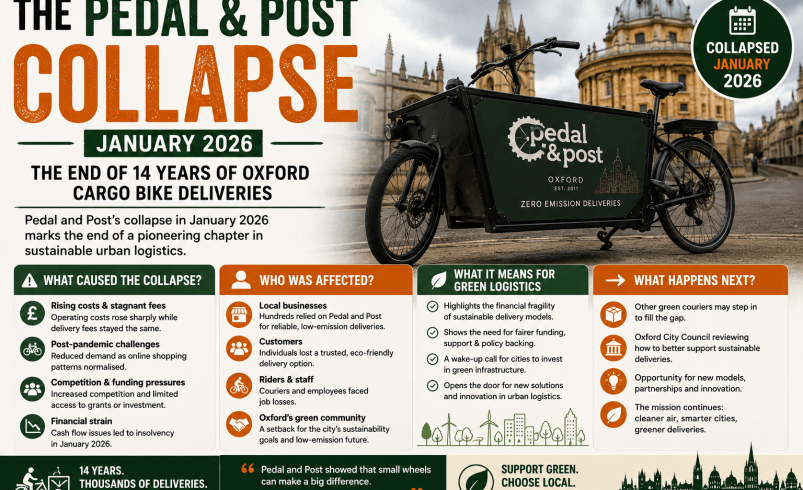
The Pedal and Post collapse in January 2026 brought an abrupt end to one of the UK’s most recognised eco-courier businesses after 14 years of operation. The Oxford-based

Pedal and Post Collapse: What Happened and What’s Next

The Pedal and Post collapse in January 2026 brought an abrupt end to one of the UK’s most recognised eco-courier businesses after 14 years of operation. The Oxford-based cargo bike delivery company entered voluntary liquidation on 20 February 2026, leaving 60 people out of work and investors unlikely to see any return on their money.

The direct trigger was a 30-day contract termination notice from micromobility company Voi. That single decision removed around 25% of Pedal and Post’s revenue and roughly 36% of its profit margins, which the business could not replace fast enough to survive.

This article covers the timeline of events, what caused the Pedal and Post collapse, the financial damage left behind, what happened to affected Evri deliveries, and what the closure means for the broader UK cargo bike sector.

What Was Pedal and Post?

Pedal and Post was founded in Oxford in 2013 by Chris Benton. The company set out to replace diesel van deliveries with e-cargo bikes, trikes, and electric vans for urban last-mile logistics. At its peak it was completing more than 1,000 deliveries a day in Oxford, and its own data indicated that its fleet saved approximately 100,000 van miles per year in the city.

The business was genuinely pioneering. It partnered with Oxford University Hospitals NHS Foundation Trust, where its cargo bikes were used to deliver chemotherapy drugs between hospital sites. That partnership cut NHS delivery times for those drugs by half and was highlighted by Oxford University Hospitals as a demonstration of how zero-emission couriers could improve patient care.

Other clients included Evri (one of the UK’s largest parcel carriers), six Oxford University colleges, Blackwell’s bookshops, and Wolfson College. The company also ran a temporary local grocery delivery service during the Covid pandemic, operated within Oxford’s Zero Emission Zone, and participated in Oxford’s first cargo bike trial in 2022.

In 2023, at the time of its crowdfunding campaign, Pedal and Post was valued at £2 million and was delivering across Oxford with 23 employees, with ambitions to grow to 8,000 deliveries a day.

The Timeline of the Pedal and Post Collapse

Understanding the sequence of events helps explain why things moved so quickly from apparent stability to closure.

2013: Chris Benton founds Pedal and Post in Oxford.

2022: The company participates in Oxford’s first cargo bike trial and is operating at the Osney Mead industrial estate.

April to May 2023: Pedal and Post launches a crowdfunding campaign on the ethical investment platform Ethex, targeting up to £500,000 to expand into Reading and scale up in Oxford. The campaign raises the full £500,000.

Summer 2025: The company expands into London, aiming to complete 100,000 zero-emission deliveries per year in the capital.

End of January 2026: Micromobility company Voi serves a 30-day contract termination notice on Pedal and Post. The termination is described by Benton as “not performance related”. On 26 January 2026, staff and shareholders are informed of the decision to close.

27 January 2026: Pedal and Post announces on social media that both its Oxford and London sites have closed. Benton describes the situation in an internal email as “major, unexpected and extremely difficult”.

Early February 2026: Evri customers in Oxford begin reporting missing or undelivered parcels after Pedal and Post, which had been handling deliveries within Oxford’s Clean Air Zone, ceases trading without notice.

20 February 2026: Formal creditors’ voluntary liquidation commences. Joint liquidators Brett Lee Barton and Margaret Carter of BK Plus, based in Walsall, are appointed by members and creditors.

Why Did Pedal and Post Collapse?

The immediate cause of the Pedal and Post collapse was the loss of the Voi contract. Voi is a micromobility company whose e-scooter operations in Oxford had been supported by Pedal and Post, which handled related logistics. Voi gave notice to end the contract at the end of January 2026.

According to Benton, the Voi contract represented around 25% of the company’s overall revenue and approximately 36% of its profit margins, because micromobility work was particularly high-margin compared to parcel delivery. Without it, the business could no longer demonstrate financial viability to any potential investors or lenders, and could not sustain itself long enough to replace the lost income.

Benton was direct about the structural fragility this exposed. In an interview with Zag Daily he said: “With simple, small businesses that are reliant on five to six major clients, it happens sometimes that you lose one and can’t sustain moving forward.”

The broader backdrop matters too. Being an ethical employer in a sector that often relies on self-employed gig workers is expensive. Pedal and Post paid employees on contracted terms rather than purely self-employed arrangements, which raised its labour costs relative to competitors. The company had argued publicly that this was the right approach, and that lower vehicle costs from cargo bikes helped offset it. But the margin for error was thin. A single large contract loss removed the cushion entirely.

The Financial Damage Left Behind

The Companies House insolvency record for Pedal and Post Ltd (company number 08517098) shows a creditors’ voluntary liquidation commencing 20 February 2026. The financial picture left behind was significant for a business of this size.

Total debt at the point of collapse was approximately £300,000, according to documents filed with Companies House. That figure included:

  • Unpaid employee redundancy claims
  • VAT owed to HMRC
  • Personal loans from the founder himself

Chris Benton had injected £30,000 of his own money into the business in its final period in an attempt to sustain it. That money is now part of the pool of claims unlikely to be recovered.

The £500,000 raised through the 2023 Ethex crowdfunding campaign is also gone. Shareholders and crowd investors were informed by Benton that they are “unlikely to get their investments returned” through the liquidation process. Benton told investors: “I fully recognise how hard this will be to hear and I am deeply sorry to be sharing this update in these circumstances.”

Richard Lofthouse, described as a significant investor who had backed the company since its founding, said publicly: “I’m shocked by the announcement. The business was created to reduce van movements in the city and had successfully delivered many thousands of parcels.”

The liquidation process means the joint liquidators will realise whatever value can be extracted from the company’s assets, before distributing proceeds to creditors in the legally required order of priority. Unsecured creditors (including most investors) stand behind secured creditors and preferential creditors (such as employees owed wages and HMRC for certain debts) in that order. Given the scale of debt relative to likely asset values, investor recoveries are expected to be negligible.

What Happened to Evri Deliveries in Oxford?

One of the most visible practical consequences of the Pedal and Post collapse was disruption to Evri’s parcel deliveries in Oxford, particularly within the Clean Air Zone.

Pedal and Post had served as Evri’s e-cargo bike delivery partner in the area. Because cargo bikes can operate in zones where vans face restrictions or emissions charges, Pedal and Post had become an operationally important part of Evri’s local delivery network.

When the courier ceased trading without notice at the end of January 2026, Evri was left with no partner to handle this portion of its Oxford deliveries. Parcels sat at local depots while alternative arrangements were made. Oxford residents reported packages going missing or failing to be delivered for more than a week after the scheduled dispatch date.

Carol Leonard, a resident in Grandpont, Oxford, became one of the reported cases. Parcels containing specialist cat food and litter, ordered on 29 and 31 January 2026, were not delivered until 10 February 2026, more than a week after they were expected. She was simultaneously told at different points that her parcels were out for delivery and that there was no record of them.

An Evri spokesperson confirmed the cause and apologised: “We were disappointed to learn that our e-cargo bike delivery partner in Oxford ceased trading without notice, which caused some temporary disruption for a small number of customers in the local area. We have quickly re-organised deliveries in the area.” Evri confirmed it had contacted Ms Leonard directly to apologise and that her parcels were delivered on 10 February 2026.

Pedal and Post Collapses: What This Means for UK Cargo Bike Delivery

The Pedal and Post collapse did not happen in isolation. Less than a year before, in January 2025, Zedify (trading name of Outspoken Logistics Limited) went into administration after failing to raise new funding despite having received a total of around £9 million from investors including Barclays Sustainable Impact Capital, Mercia Ventures, and the Midlands Engine Investment Fund. That administration made over 100 workers redundant across London, Manchester, and Birmingham. Zedify has since found new owners for some of its operations.

Two cargo bike delivery companies collapsing within a year of each other raises legitimate questions about the viability of this business model at scale.

Both Zedify and Pedal and Post faced versions of the same core tension. Running a cargo bike delivery operation as an ethical employer costs more in labour than the dominant model in delivery (self-employed gig work). Vehicle costs are lower for bikes than vans, but that saving doesn’t always close the gap fully. Contracts in urban last-mile logistics are often short-term and easily terminated. And the volumes needed to reach a profitable scale are very large.

The administrator’s report on Zedify was blunt: the company “was unprofitable ever since the business first launched”, despite genuine innovation and significant external investment.

Benton himself drew a distinction between the failure of a specific business and the future of the sector. “Our closure isn’t a reflection on cargo bike use or logistics,” he said. He pointed out that major carriers are now investing in bike-based urban delivery at scale, which is a different commercial environment from the one in which Pedal and Post and Zedify were operating.

Department for Transport research, cited in Pedal and Post’s 2023 crowdfunding materials, estimated that 33% of all urban deliveries could be done by cargo bikes or e-cargo bikes. The potential market is not in question. The business model needed to capture it profitably, at scale, is still being worked out.

What the Pedal and Post Collapse Meant for Its NHS Work

One of the lesser-reported aspects of the Pedal and Post story is the impact on its NHS partnership. Oxford University Hospitals NHS Foundation Trust had worked with the company to deliver chemotherapy drugs and other medical supplies between hospital sites using cargo bikes. That work had cut delivery times by half, eliminated diesel van emissions from those routes, and saved an estimated up to 10 tonnes of carbon emissions per year on those runs alone.

The loss of Pedal and Post meant the Trust had to return to van-based delivery for those routes, at least in the short term. Previous analysis by Benton estimated that a full switch from diesel vans to cargo bikes across all NHS and government deliveries could save over £4.2 billion across England by reducing congestion, air pollution, and associated health costs. The cost of a diesel van over its operational life to the NHS (in external health and congestion costs) was put at approximately £25,000, compared to around £150 for an e-cargo bike.

These figures were published by Pedal and Post alongside their 2023 crowdfunding campaign and were based on analysis drawing on Department for Transport data and academic research on the costs of diesel emissions. Whether future cargo bike operators will be able to rebuild relationships with NHS trusts in Oxford and elsewhere depends partly on what fills the gap left by the Pedal and Post closure.

Pedal and Post Collapse FAQs

Q: Why did Pedal and Post collapse? 

Pedal and Post entered voluntary liquidation in January 2026 after losing its contract with micromobility company Voi, which gave 30 days’ notice to terminate. The Voi contract was worth around 25% of revenue and roughly 36% of profits. Unable to replace that income or raise new funds, the business could not continue.

Q: When did Pedal and Post close? 

Pedal and Post announced closure on 27 January 2026. Formal creditors’ voluntary liquidation commenced on 20 February 2026, when joint liquidators were appointed from Walsall firm BK Plus.

Q: How many jobs were lost when Pedal and Post collapsed? 

Around 60 people lost their jobs, comprising a mix of employed staff and self-employed workers across Pedal and Post’s Oxford and London operations. Both sites closed when the company ceased trading.

Q: Will Pedal and Post investors get their money back? 

Very unlikely. Companies House insolvency records confirm a creditors’ voluntary liquidation with approximately £300,000 in total debt. Shareholders and crowd investors, including those who contributed to the £500,000 raised on Ethex in 2023, were informed they are unlikely to recover their investments. Secured and preferential creditors are paid first in a liquidation; unsecured investors typically receive little or nothing.

Q: Why were Evri deliveries delayed in Oxford after Pedal and Post collapsed? 

Pedal and Post was Evri’s e-cargo bike delivery partner for Oxford’s Clean Air Zone. When Pedal and Post stopped trading without notice in January 2026, Evri had no partner to complete those deliveries. Parcels sat at local depots for up to two weeks. Evri confirmed the cause, apologised to affected customers, and said it had re-organised deliveries in the area.

Q: Is Pedal and Post the same as the Zedify collapse? 

No. They are separate companies. Zedify (Outspoken Logistics) went into administration on 31 January 2025, over a year before the Pedal and Post collapse. Both were UK cargo bike delivery operators and both failed, but for different reasons: Zedify ran out of venture capital funding after receiving around £9 million from investors; Pedal and Post lost a key contract that removed 25% of its revenue.

Q: What happens to Pedal and Post’s assets in the liquidation? 

Joint liquidators Brett Lee Barton and Margaret Carter of BK Plus will identify and sell the company’s assets, including any remaining bikes, vehicles, and equipment. Proceeds go to creditors in the legal order of priority: secured creditors first, then preferential creditors (including certain employee claims and HMRC debts), and unsecured creditors last.

Q: Does the Pedal and Post collapse mean cargo bike delivery is finished in the UK? 

No. Benton was clear that the closure reflected specific business vulnerabilities rather than the viability of cargo bike logistics. Major carriers including large parcel companies are now investing in cargo bike urban delivery. The sector is growing, but the independent, ethical-employer model that Pedal and Post and Zedify represented has proved commercially fragile.

Leave a Reply

Your email address will not be published. Required fields are marked *