 Haris
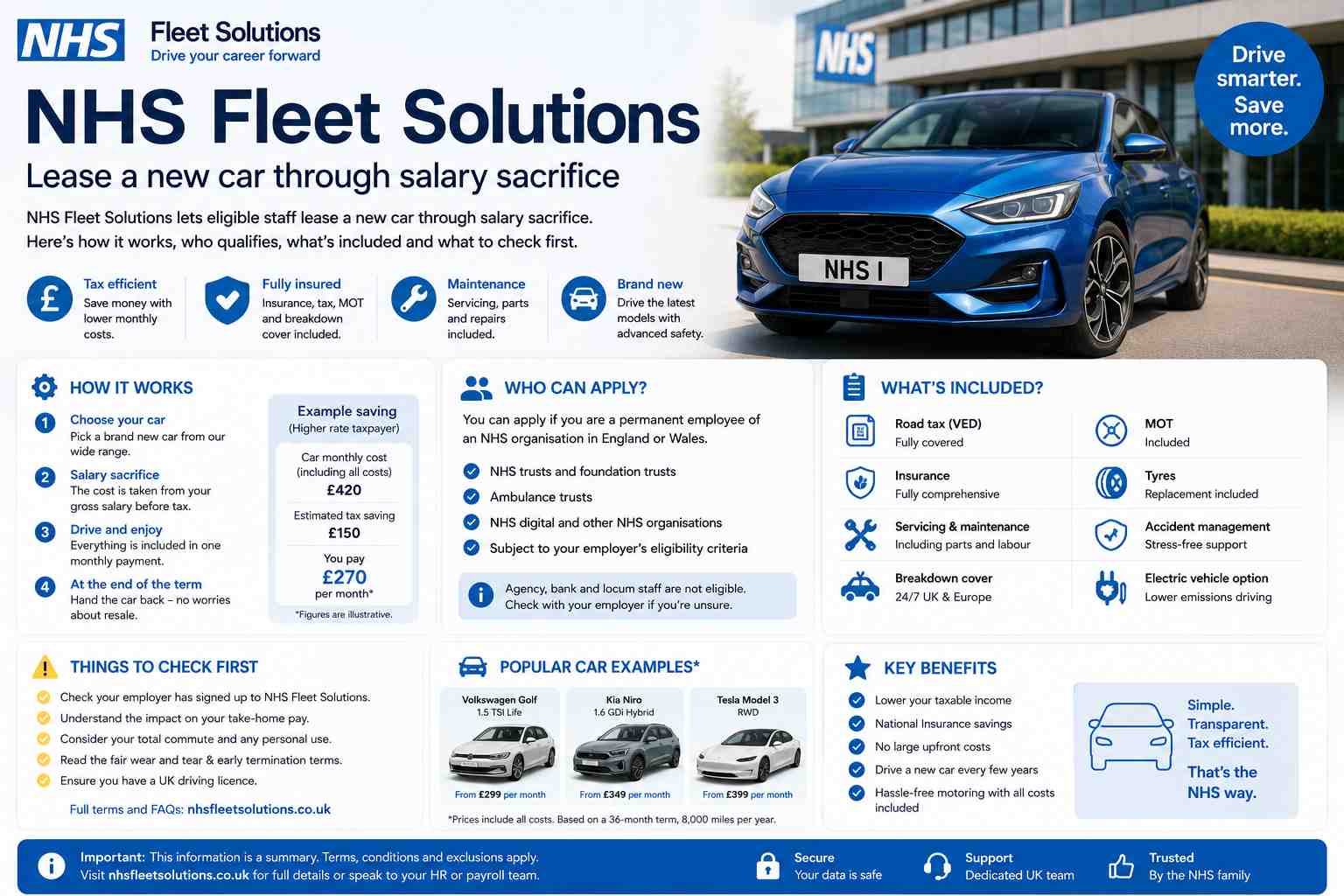
If you’ve seen NHS Fleet Solutions mentioned on your trust’s staff benefits page and you’re wondering what it actually is, here’s the answer: it’s a salary sacrifice car leasing scheme, run by Northumbria Healthcare NHS Foundation Trust, that lets eligible NHS and public sector employees lease a brand-new car with insurance, servicing, road tax and breakdown cover bundled into one monthly payment taken from gross salary. NHS Fleet Solutions describes itself as the UK’s original public sector salary sacrifice scheme, having been running the arrangement for over 20 years and processed over 120,000 vehicle orders.
This guide covers how the scheme actually works, who’s eligible, what’s included in the monthly cost, how the tax savings work, electric vehicle options, and the things people most often get caught out by, including Benefit in Kind tax and what happens if your circumstances change during the lease. There’s an FAQ at the end covering the questions people ask most often before signing up.
What Is NHS Fleet Solutions?
NHS Fleet Solutions is a salary sacrifice car scheme for public sector staff. It’s operated by Northumbria Healthcare NHS Foundation Trust rather than a private leasing company, and any surplus income the scheme generates stays within the public sector rather than going to shareholders.
The scheme isn’t limited to NHS staff. It’s also open to employees of participating police forces, local councils, universities and academy schools, provided your own employer has registered with the scheme. If your employer hasn’t signed up, you won’t be able to access it, even if you work in the NHS.
Fleet Solutions also runs a separate home electronics salary sacrifice scheme, supplied in association with Currys, which works on the same before-tax deduction principle but for items like laptops and appliances rather than cars.
How NHS Fleet Solutions Works
The process starts with choosing a car, then setting up the salary sacrifice arrangement before the vehicle is delivered.
- You select a car from the range available through the scheme, typically for a two or three-year lease term
- Your employer amends your contract so a fixed amount is deducted from your gross salary each month, before income tax and National Insurance are calculated
- The car is delivered, and the monthly deduction covers the lease plus the bundled extras for the length of the agreement
- At the end of the lease, you return the car, provided it meets the required condition and hasn’t exceeded the agreed mileage, with no further charge
Because the deduction comes out of gross pay rather than take-home pay, you pay less income tax and National Insurance overall, which is where the bulk of the saving comes from. In exchange, HMRC treats the car as a Benefit in Kind, which is taxed separately, and that’s covered in more detail below.
What’s Included in the Monthly Cost
The exact package can vary depending on the vehicle and your employer’s specific arrangement with the scheme, but most NHS Fleet Solutions leases bundle the following into a single monthly payment:
- Fully comprehensive insurance cover, arranged through the scheme
- Routine servicing and maintenance
- Road tax for the length of the lease
- Breakdown cover
- Tyre replacement, in many cases
That’s a meaningfully different cost structure to owning a car outright, where you’d budget separately for insurance, servicing, tax and repairs. If you plan to use the car for business mileage beyond ordinary commuting, you’ll need to tell NHS Fleet Solutions before signing up, since business use outside the standard terms may require different insurance arrangements.
NHS Fleet Solutions Eligibility: Who Can Apply
Eligibility rules vary a little by trust or organisation, but the general requirements are consistent across the scheme:
- You need to be a permanent employee of an organisation registered with NHS Fleet Solutions
- You’ll usually need to have passed your probationary period before applying
- You need a valid UK driving licence
- Your salary needs to be high enough that the deduction doesn’t take your pay below the National Minimum Wage or National Living Wage floor, since salary sacrifice arrangements can’t legally reduce your pay below that level
Fixed-term contracts can be a sticking point. Some organisations won’t approve a salary sacrifice car for a role expected to last less than 12 months, since the lease term is typically two or three years and needs to outlast your contract for the numbers to work sensibly. If you’re unsure whether your role or contract type qualifies, check with your trust’s staff benefits team before applying, since it’s their eligibility criteria that ultimately apply, not a blanket national rule.
NHS Fleet Solutions Tax and Benefit in Kind: What You Actually Pay
This is the part people find most confusing, so it’s worth spelling out clearly. Salary sacrifice reduces your taxable salary, which lowers your income tax and National Insurance. In return, HMRC treats the car itself as a Benefit in Kind (BiK), a non-cash perk that’s taxed separately from your salary.
The BiK charge is calculated using the manufacturer’s list price of the car and a percentage set by HMRC based on the vehicle’s CO2 emissions. Electric and low-emission vehicles typically attract a much lower BiK percentage than petrol or diesel cars, which is a major reason electric vehicles have become popular through salary sacrifice schemes specifically. The exact percentage rates change periodically, so check the current rates on GOV.UK before you commit to a specific car, rather than relying on a figure from an older article.
Lowering your gross salary can also affect other things tied to it. Statutory Sick Pay, some other state benefits, and pension contributions calculated on your revised salary can all be affected, since they’re often based on your pay after the sacrifice rather than your original salary. Ask your payroll or HR team for the specific impact on your circumstances before signing anything, since this varies by individual and by employer’s pension scheme rules.
NHS Fleet Electric and Hybrid Vehicle Options
Full electric and hybrid vehicles are available for selection through the scheme, and they’re often the most financially attractive option once tax is factored in. Because electric vehicles carry a lower BiK rate than petrol or diesel equivalents, the monthly deduction from your gross salary and the associated BiK tax combined can work out cheaper for an EV than for a comparably priced conventional car.
That said, an electric vehicle isn’t automatically the right choice for everyone. If you don’t have reliable access to home or workplace charging, or you regularly drive long distances without convenient charging stops, a hybrid or conventional vehicle might suit your situation better despite the tax difference. Weigh the BiK saving against your actual driving pattern before choosing, rather than picking a car purely because it’s the cheapest option on paper.
What Happens If Your Circumstances Change Mid-Lease
This is one of the gaps that catches people out, and it’s worth covering properly since it’s rarely explained clearly upfront. A salary sacrifice car lease is normally a two or three-year commitment, and life doesn’t always cooperate with that timeline.
If you leave your job, go on extended leave, or your role changes significantly, you may be liable for the remaining costs of the lease or an early termination charge. Some schemes allow the car to transfer if you move to another participating employer, but this isn’t guaranteed and depends on both organisations’ arrangements with NHS Fleet Solutions.
Check the early termination terms in your specific contract before signing, not just the general scheme literature, since exact penalty structures vary. If your income drops significantly, whether through reduced hours, a change of role or a career break, your salary sacrifice payments could also push your revised pay below the minimum wage threshold, which would mean the scheme has to adjust or end the arrangement.
NHS Fleet Solutions Reviews: What Users Actually Say
Public sector staff who’ve used the scheme generally report a smooth ordering and delivery process, with the biggest recurring complaint being long telephone waiting times when trying to contact NHS Fleet Solutions directly for support or changes to an existing lease. Several reviewers mention the mobile app for managing the vehicle as functional but limited on detailed vehicle information, meaning some people did their own research separately before choosing a model.
Where issues have come up, they’ve mostly been administrative rather than about the vehicles themselves: details like insurance not including a named second driver correctly at first, which reviewers say was generally resolved with a single phone call once through. If you’re weighing up the scheme based on service quality, check recent reviews close to your application date, since staffing and response times can shift over time.
Common Mistakes to Avoid
A handful of avoidable mistakes come up repeatedly among people applying for salary sacrifice car schemes:
- Not checking the mileage allowance carefully, since going over your contracted mileage can mean charges at the end of the lease
- Assuming the scheme is open to any NHS worker, when actually your specific employer needs to be registered with NHS Fleet Solutions first
- Choosing a car based on the headline monthly cost without factoring in the separate Benefit in Kind tax charge
- Not asking how the reduced salary affects pension contributions, sick pay or other salary-linked benefits before signing
- Forgetting to declare planned business mileage, which can affect the insurance arrangement included in the package
FAQ
Q: What is NHS Fleet Solutions?
NHS Fleet Solutions is a salary sacrifice car leasing scheme for NHS and public sector employees, run by Northumbria Healthcare NHS Foundation Trust. You lease a new car for two or three years, with a fixed amount deducted from your gross salary that typically includes insurance, servicing, road tax and breakdown cover.
Q: Who is eligible for NHS Fleet Solutions?
You generally need to be a permanent employee of an organisation registered with the scheme, have passed your probationary period, hold a valid UK driving licence, and earn enough that the salary deduction doesn’t take your pay below the National Minimum Wage. Exact criteria can vary slightly by trust or employer.
Q: Is NHS Fleet Solutions worth it?
It depends on your salary, tax position and how much you’d otherwise spend running a car. Many staff save money overall because the deduction comes from gross pay, but the car is taxed as a Benefit in Kind, so the actual saving varies. It tends to suit people who want predictable monthly motoring costs with less admin, more than those chasing the cheapest possible outcome.
Q: What happens if I leave my job during the lease?
You may become liable for the remaining lease costs or an early termination charge, since the scheme is tied to your employment. Some arrangements allow the lease to transfer if you move to another participating employer, but this isn’t automatic and depends on both organisations.
Q: Does NHS Fleet Solutions include insurance?
Yes, fully comprehensive insurance is typically included in the monthly cost. If you plan to use the car for business purposes beyond your employer’s standard cover, you’ll need to inform NHS Fleet Solutions in advance, since this can require different insurance arrangements.
Q: Can I get an electric car through NHS Fleet Solutions?
Yes, full electric and hybrid vehicles are available through the scheme. They often work out more cost-effective than petrol or diesel cars once you factor in the lower Benefit in Kind tax rate that applies to lower-emission vehicles.
Q: How is NHS Fleet Solutions different from a normal car lease?
The key difference is the salary sacrifice structure: payments come from your gross salary before tax and National Insurance rather than from your take-home pay, which is where most of the saving comes from. In exchange, the car counts as a taxable Benefit in Kind, which a standard personal lease doesn’t involve.
Q: Does salary sacrifice affect my pension?
It can. Because your official salary is reduced under the arrangement, pension contributions calculated as a percentage of salary may also reduce, depending on your specific pension scheme’s rules. Check with your HR or payroll team for how it applies to your pension before signing up.