 Haris
Haris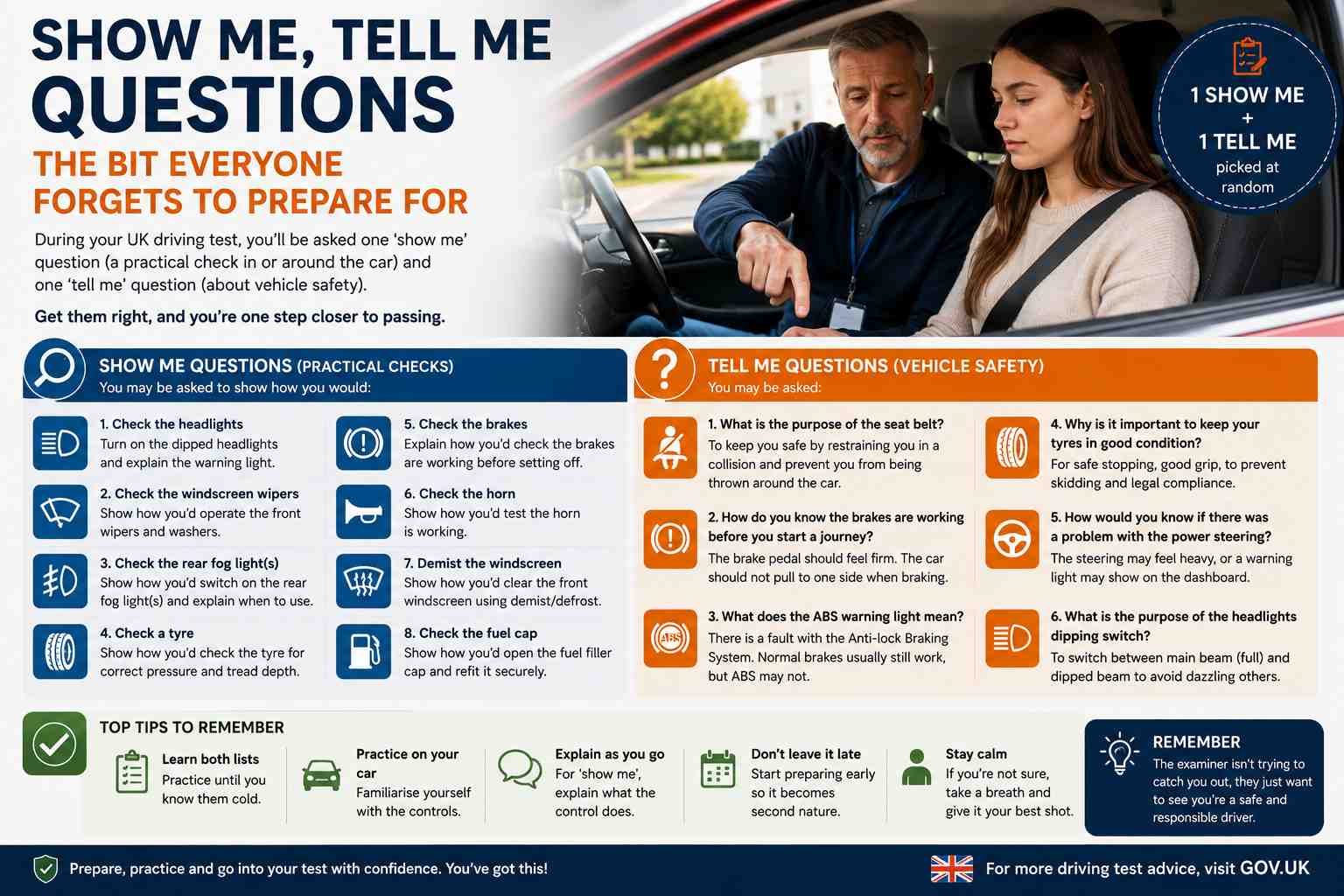
Ask any driving instructor which part of the test learners under-prepare for and most won’t say the parallel park or the roundabouts. They’ll say the show me tell me questions, the two-minute exchange at the start and middle of your test that people somehow treat as an afterthought.
It’s a strange thing to neglect, because unlike everything else on test day, this part isn’t really about driving skill at all. It’s just knowledge. You either know where the dipstick is or you don’t. There’s no nerves-related excuse for getting it wrong, which is probably why examiners don’t go easy on it.
So let’s actually sort this out properly instead of skimming it the night before your test.
Why These Questions Exist At All
Somebody, somewhere, decided that being able to steer a car competently wasn’t quite enough. You also need to know, in a basic practical sense, whether the car you’re driving is safe. Makes sense when you think about it. Passing your test means you’re now allowed to drive unsupervised, and unsupervised means nobody’s there to notice your tyres are bald or your brake fluid’s low.
The DVSA calls them “show me, tell me” questions, and the format is simple: one question asked while you’re sat in the car park before you’ve moved, where you explain a safety check out loud, and one question asked while you’re actually driving, where you physically demonstrate something. Two questions total, drawn from a published bank of 21.
The Tell Me Side: Eleven Questions You Answer From Your Seat
Most of the tell me questions don’t require you to move at all. You just explain the process.
Brakes come up a lot. The examiner might ask how you’d check they’re working before setting off, and the answer they’re listening for is specific: no sponginess, no slack, tested as you pull away, and the car shouldn’t pull to one side. Say those elements and you’re fine. Miss the “shouldn’t pull to one side” bit and some examiners will mark it wrong, even though you got the spirit of the answer right.
Tyre pressure is another regular one. Where would you find the recommended pressures, and how would you check them? Manufacturer’s guide (usually a sticker inside the door frame or in the handbook), a proper pressure gauge, check when the tyres are cold rather than after a long drive, don’t forget the spare exists, put the valve caps back on.
Then there’s the head restraint question, which nobody ever thinks about until they’re asked. The rigid part should sit at least as high as your eyes, ideally close to the top of your ears, and as near to the back of your head as’s comfortable without being uncomfortable. Most people have genuinely never adjusted theirs on purpose in their life.
Tyre tread comes up constantly too. At least 1.6mm across the central three-quarters of the tyre, and around the whole way round, not just one spot. No cuts, no bulges. This is the one where examiners seem to want the specific number, not just “check if it looks worn.”
The rest of the tell me questions cover headlights and tail lights (explain the switch, no need to walk around and check), the anti-lock braking system (warning light illuminates if there’s a fault), the indicators, the brake lights (use reflections in nearby windows, or ask someone to check), and power steering, which trips people up simply because it’s not something anyone thinks about day to day. The answer: gentle pressure on the wheel as the engine starts gives a slight, noticeable movement, or you’ll feel it working the moment you turn the wheel after moving off.
Rear fog lights and main beam round out the list, both fairly intuitive once you’ve thought about them for thirty seconds.
The Bonnet-Up Three
Three of the fourteen tell me questions are different. For these, you actually get out, open the bonnet, and point at things while explaining.
Oil level: find the dipstick, describe checking it against the minimum and maximum markers. Coolant: identify the high and low markings on the header tank or radiator filler cap, describe topping up correctly. Brake fluid: find the reservoir, check against the high and low lines.
None of this is complicated. What catches people out is genuinely not knowing where these components sit under their own instructor’s bonnet, because most learners have never actually looked.
The Seven Show Me Questions
While you’re driving. That’s the whole distinguishing feature, and it’s also where the real risk hides.
Washing and cleaning the front and rear windscreen, switching on dipped headlights, setting the rear demister, sounding the horn, demisting the front windscreen, opening and closing a side window. Seven actions, all things you’d genuinely do in normal driving without thinking twice.
The problem isn’t knowing what to do. It’s knowing exactly where the button is in an unfamiliar car, quickly enough that you don’t spend five seconds staring at the dashboard while drifting slightly out of your lane.
Here’s the Actual Danger, Which Most Guides Skip
A wrong answer, on its own, costs you one driving fault. A minor. Most tests tolerate up to fifteen minors before failing you, so genuinely, don’t panic if you blank on one.
But the show me question carries a second, sneakier risk. If your driving becomes dangerous, even for a moment, while you’re hunting for a switch, that’s not a minor anymore. That’s a serious fault, and a serious fault ends the test on the spot regardless of whether you eventually found the demister button.
Which means the actual skill being tested during the show me question isn’t your knowledge of car controls at all. It’s whether you can operate something without losing focus on the road. Worth remembering, because it changes how you should prepare.
What Actually Helps
Forget flashcards for a second and go sit in the car. The specific car, the one you’ll be tested in. Touch every control on the show me list yourself, more than once, until your hand goes to the right place without you having to look.
For the tell me answers, say them out loud to another person, not just silently in your head. There’s a real gap between recognising a correct answer on a page and producing it cleanly when an examiner is sitting beside you and the clock is, in a sense, running.
And if your instructor’s car has slightly unusual control positions compared to a typical model, flag that to yourself specifically. That’s exactly the kind of detail that trips people up on the day.
Frequently Asked Questions
How many of the 21 questions will I actually get asked?
Two. One tell me question before you start driving, one show me question while you’re on the move. The full list of 21 exists so you can’t predict which pair you’ll get, which is exactly why learning all of them properly beats gambling on a shortlist.
Does one wrong answer fail my test?
No, not on its own. It’s recorded as a single driving fault, and most tests allow up to fifteen minors overall. What actually fails you is dangerous driving during the show me question, not the wrong words during the tell me question.
Which questions require opening the bonnet?
Three: checking the engine oil, the coolant level, and the brake fluid level. The other eleven tell me questions are answered from your seat without leaving the car.
Will the show me tell me questions be different in every car?
The questions stay the same, but where the controls actually are will vary. It’s worth practising in the exact vehicle you’re testing in rather than assuming everything’s in the same place as a car you’ve driven before.
Are these questions part of the theory test?
No, they only come up during the practical test itself. Your theory revision covers the reasoning behind vehicle safety, but the specific show me tell me questions are a practical-test-only feature.
Is the question list the same across the whole UK?
Not quite. GOV.UK’s official list applies to England, Scotland, and Wales. Northern Ireland tests through the DVA rather than the DVSA and has its own separate publication covering the equivalent questions.