 Haris
Haris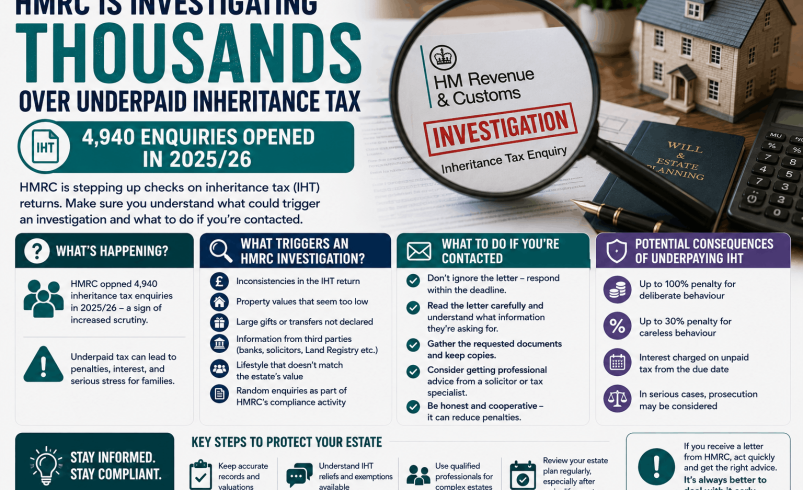
HMRC is investigating thousands of bereaved families over underpaid inheritance tax, with the number of formal enquiries hitting a six-year high in 2025/26. Data obtained by accountancy firm Price Bailey through a Freedom of Information request shows that HMRC opened 4,940 formal inheritance tax enquiries in the 2025/26 tax year, an 18% rise on the previous year and the highest figure since 2019/20.
Since 2022, HMRC has opened more than 14,000 investigations into underpaid inheritance tax. The crackdown is being driven by frozen thresholds that are pulling more estates into the tax net, record receipts, and increasingly sophisticated data-matching tools that identify discrepancies in estate returns.
This article explains what is triggering investigations, how HMRC runs its compliance checks, what happens if your family receives an opening letter, and what you can do now to reduce the risk of scrutiny.
The Scale of HMRC’s Inheritance Tax Investigations
The numbers behind this crackdown are significant. In the year to April 2025, HMRC recovered £246 million in additional inheritance tax through compliance activity, according to a Freedom of Information request by TWM Solicitors. That same year (2024/25), 3,977 formal investigations were opened, up from 3,793 the year before.
The pace intensified further in 2025/26. HMRC’s risk assessors referred 4,965 IHT returns to its compliance team, the highest level in five years. Of the 4,940 families formally investigated in that year, around 40% had their inheritance tax bill adjusted. That proportion has actually fallen from 45% in 2024/25, suggesting HMRC is casting a wider net rather than only pursuing clear-cut cases.
Between April 2025 and January 2026, HMRC collected a record £7.1 billion in inheritance tax receipts, £100 million higher than the same period the previous year. The Office for Budget Responsibility forecasts that IHT receipts will reach approximately £13.5 billion by 2029/30, nearly double the 2022/23 figure, as frozen thresholds and rising asset values push more estates over the threshold.
Nikita Cooper of Price Bailey said: “HMRC is coming under increasing pressure to clamp down on non-compliance and boost the tax take. IHT was historically a very small component of HMRC’s overall revenues, but many more estates are being caught in the tax net every year, so it is becoming a higher priority.”
Why More Estates Are Being Investigated Now
Three things are happening at once, and they compound each other.
Frozen Thresholds Are Pulling More Estates In
The standard nil-rate band, the amount you can pass on before inheritance tax applies, has been fixed at £325,000 since 2009. It was originally scheduled to be unfrozen in 2028, then 2030, and in the November 2025 Budget it was frozen until at least April 2031. The residence nil-rate band, an additional £175,000 available when a main home passes to direct descendants, is also frozen to the same date.
For a single person, the maximum tax-free allowance is £500,000 (combining both bands when a home is left to children or grandchildren). Married couples and civil partners can combine unused allowances on second death, potentially protecting up to £1 million.
In practice, house price inflation over 17 years of a frozen threshold means that estates which would never have triggered an IHT liability in 2009 now routinely do. In 2022/23, the most recent year for which complete data is available, 31,500 estates paid inheritance tax, representing 4.62% of all deaths in the UK. That figure is expected to approach 9% of all deaths by 2030/31, driven by fiscal drag and the upcoming pension changes.
[Table: Current inheritance tax thresholds 2026/27]
| Allowance | Amount | Who gets it |
| Nil-rate band (NRB) | £325,000 | Everyone |
| Residence nil-rate band (RNRB) | £175,000 | When main home left to direct descendants |
| Combined maximum (single) | £500,000 | When both bands apply |
| Combined maximum (couple) | £1,000,000 | On second death, with transfers |
| IHT rate above threshold | 40% | Standard rate |
| Reduced rate if 10%+ to charity | 36% | When qualifying charitable gift made |
All thresholds frozen until 5 April 2031. Check gov.uk/inheritance-tax for any future updates.
HMRC Is Using Sophisticated Data-Matching Tools
HMRC no longer relies solely on what executors report. It now cross-references estate returns against multiple external data sources to spot discrepancies. These include:
- Land Registry sold price data and property records (to challenge property undervaluations)
- The Trust Registration Service (to identify unregistered trusts and undisclosed assets)
- Google Street View and Google Maps (to assess property condition and value)
- Bank and financial institution data (to detect undisclosed gifts or hidden assets)
- Contents insurance records (to identify high-value items not declared in the estate)
- Previous income tax returns (to flag lifestyle inconsistencies with declared estate values)
TWM Solicitors, which analysed HMRC’s published figures, noted that the taxman is using artificial intelligence and data-matching tools to identify inconsistencies in IHT returns before opening a formal enquiry.
Gifts with Reservation of Benefit Are Being Flagged
Between 2021 and 2026, HMRC flagged around 2,500 gifts totalling approximately £840 million on the grounds that they involved “reservation of benefit”. These are gifts where the donor transferred an asset, typically a property, to a family member but continued to benefit from it (for example, by still living in it rent-free). The anti-avoidance rules treat such gifts as still forming part of the taxable estate. HMRC estimated the total tax bill from these cases at around £336 million.
What Triggers an HMRC Inheritance Tax Investigation
HMRC applies a risk-based filtering process when reviewing estate returns. Not every IHT400 form is scrutinised at the same level of detail, but certain patterns consistently trigger closer examination.
Property undervaluation is the single most common trigger. HMRC has easy access to Land Registry sold price data and uses it to compare declared property values against recent comparable sales in the same area. If an estate-agent valuation or informal estimate is used instead of a formal RICS valuation, and it comes in below comparable market values, the return is likely to be flagged. In 2024/25, HMRC questioned approximately 7,500 probate cases specifically on property valuations, resulting in 1,500 estates being reassessed as undervalued.
Undisclosed gifts in the seven years before death are the second major trigger. Any cash transfer, property transfer, or other gift made within seven years of death should be declared on the IHT400. HMRC analyses bank statements carefully, and large outflows that are not explained by known living costs attract attention. If the seven-year lookback reveals substantial undisclosed gifts, HMRC may expand the enquiry further.
Other common triggers include:
- Life insurance policies that were not written in trust, which means the payout forms part of the taxable estate and can be cross-referenced against known policy records
- Undeclared valuable personal possessions such as jewellery, artwork, or antiques, where the declared value sits far below what contents insurance records suggest
- Business Property Relief or Agricultural Property Relief claims that appear poorly documented or excessive
- Sudden wealth transfers or major changes to estate structure in the months immediately before death
How an HMRC Inheritance Tax Investigation Works
HMRC does not typically give advance warning that it is reviewing an estate. The first formal signal is an opening letter, sent to the executor or personal representative, stating that HMRC is conducting a compliance check. The letter usually specifies what records it wants to see and provides a deadline for the response.
Common document requests include bank statements covering several years before death, professional property valuations, evidence of gifts made in the seven years before death, documentation supporting any relief claims, and valuations of personal property such as jewellery or collections.
A typical investigation lasts between six and twelve months, though complex estates can take several years to resolve. If HMRC concludes that more tax is owed, it will raise an assessment for the additional amount. Interest accrues from the original payment deadline (six months after the end of the month of death) until the outstanding amount is paid. The late payment interest rate currently stands at around 8.25%, tracking the Bank of England base rate plus 2.5%. Check the current rate at gov.uk/hmrc-interest-rates-late-payment-repayment before making any calculations.
How Far Back Can HMRC Investigate?
HMRC’s lookback period depends on the nature of the issue. For careless errors, it can generally open enquiries going back four years. For deliberate non-compliance, it can investigate up to 20 years, though the standard focus on gifts typically covers the seven years before death. If HMRC believes there is deliberate evasion, it can request documents and correspondence covering a much longer period.
What Penalties Apply?
If HMRC finds that extra tax is owed, penalties depend on whether the underpayment was accidental, careless, or deliberate. Penalties for careless errors range from 0% to 30% of the additional tax owed, and those for deliberate errors can reach 100%. An additional penalty applies if the relevant information was concealed. Co-operating fully with HMRC’s enquiry, and making voluntary disclosures before being formally contacted, is consistently cited by tax professionals as the most effective way to reduce penalty exposure.
The Up Coming Changes That Will Increase Investigations Further
Two major policy changes mean the number of HMRC investigations into underpaid inheritance tax is likely to keep rising.
From April 2026, Agricultural Property Relief and Business Property Relief were changed so that 100% relief only applies to the first £2.5 million of combined qualifying assets per person (transferable between spouses and civil partners, so £5 million per couple). Assets above that level attract only 50% relief, giving an effective IHT rate of 20% on the excess. Farmers and family business owners who planned around the pre-2026 rules need professional advice on how these changes affect their position.
From April 2027, most unspent defined contribution pension funds and death benefits will be drawn into the inheritance tax net. Pensions have historically passed outside estates for IHT purposes, making them a highly tax-efficient asset to hold. That changes in April 2027. The Office for Budget Responsibility estimates around 10,500 estates will face IHT for the first time as a direct result of this change, and existing pension planning strategies will need to be reviewed.
Both changes increase the risk of honest errors by executors unfamiliar with new rules, which in turn increases the likelihood of investigations.
What to Do If HMRC Investigates Your Family’s Estate
Receiving an opening letter from HMRC’s compliance team is serious, but it does not mean an error has been made. Around 60% of investigated cases in 2025/26 resulted in no change to the IHT bill. The important thing is to respond carefully and promptly.
Get professional representation as soon as you receive the opening letter. A solicitor or chartered tax adviser with IHT experience will handle communications with HMRC on your behalf, ensure requests are responded to correctly, and advise on penalty reduction strategies. Do not respond to the letter without taking advice first.
Gather documents covering the areas HMRC has requested. This typically means bank statements, property valuations, gift records, and documentation supporting any reliefs claimed. Complete records, provided promptly, tend to resolve enquiries faster.
Co-operate fully. HMRC has extensive investigatory powers including the ability to issue formal information notices under Schedule 36 Finance Act 2008. Delaying or being unresponsive extends the investigation and can increase penalties.
Consider a voluntary disclosure if you are aware of a potential error in an estate you are administering. HMRC looks more favourably on cases where errors are disclosed voluntarily rather than discovered through its own investigation, and penalties are typically lower as a result.
If you are acting as an executor and you discover that IHT was underpaid on a previous estate, you should take advice on making a voluntary disclosure. Contact details for HMRC’s Inheritance Tax team are at gov.uk/government/organisations/hm-revenue-customs/contact/inheritance-tax-enquiries.
How to Reduce the Risk of an Investigation
The most effective protection against an HMRC investigation is getting the estate return right in the first place. Several specific actions consistently reduce risk.
Commission a professional RICS valuation for all property. An informal estimate from an estate agent is not sufficient and is one of the most common triggers for challenge. A formal open market valuation from a registered valuer is the standard HMRC expects.
Declare all gifts made in the seven years before death. Even gifts you believe were exempt should be declared and documented. The seven-year rule for potentially exempt transfers requires full disclosure. Keep records of all gifts made, including dates, amounts, and recipients.
Understand gifts with reservation of benefit. If you have given away an asset but continued to benefit from it, it almost certainly remains part of your taxable estate regardless of when the transfer was made. Common examples include giving a property to children but still living in it rent-free.
Write life insurance policies in trust. A policy that pays out to your estate rather than directly to beneficiaries increases the taxable value of the estate. Writing the policy in trust takes the payout outside the estate and avoids this problem.
Keep clear records during your lifetime. Executors can only report what they know about. Good financial record-keeping, including gift logs, investment valuations, and insurance policy details, makes their job easier and reduces the chance of errors.
HMRC Inheritance Tax Investigations: FAQs
Q: Why is HMRC investigating thousands over underpaid inheritance tax?
HMRC opened 4,940 formal IHT enquiries in 2025/26, a six-year high. The rise is driven by frozen thresholds pulling more estates into the tax net, rising asset values, record IHT receipts, and HMRC’s use of AI and data-matching tools to identify discrepancies in estate returns.
Q: What triggers an HMRC inheritance tax investigation?
The main triggers are property undervaluation (checked against Land Registry data), undisclosed gifts in the seven years before death, gifts where the donor retained a benefit (gifts with reservation of benefit), life insurance not written in trust, undeclared valuables, and poorly documented relief claims for Business Property Relief or Agricultural Property Relief.
Q: How does HMRC find out about undeclared gifts or assets?
HMRC analyses bank statements, Land Registry data, Trust Registration Service records, insurance documents, and income tax returns. It also uses AI and data-matching tools and has been reported to use Google Maps and Street View to assess property values. Since 2026, it also has access to pension records for estates where the April 2027 pension changes apply.
Q: How far back can HMRC investigate an estate?
For careless errors, typically up to four years. For deliberate non-compliance, HMRC can investigate up to 20 years. The standard seven-year lookback applies to gifts made before death under the potentially exempt transfer rules.
Q: How long does an HMRC inheritance tax investigation take?
A typical investigation lasts six to twelve months. Complex cases involving large estates, multiple assets, or disputed valuations can take several years to resolve.
Q: What are the penalties for underpaid inheritance tax?
Penalties depend on whether the error was accidental, careless, or deliberate. For careless errors, penalties range from 0% to 30% of the additional tax owed. Deliberate errors can attract penalties of up to 100% of the additional tax. Interest also accrues from the original payment deadline at approximately 8.25% (check the current rate at gov.uk/hmrc-interest-rates-late-payment-repayment).
Q: What should I do if HMRC sends an opening letter about inheritance tax?
Get professional advice from a solicitor or chartered tax adviser with IHT experience before responding. Gather all requested documents, co-operate fully and promptly, and do not delay or ignore the letter. Full co-operation and accurate information tend to result in faster resolution and lower penalties.
Q: Can pensions be investigated for inheritance tax from 2027?
From April 2027, most unspent defined contribution pension funds become part of the taxable estate for IHT purposes. Executors of estates settled after that date will need to include pension values in IHT returns. Families with significant pension assets should seek advice before the change takes effect.