 Haris
Haris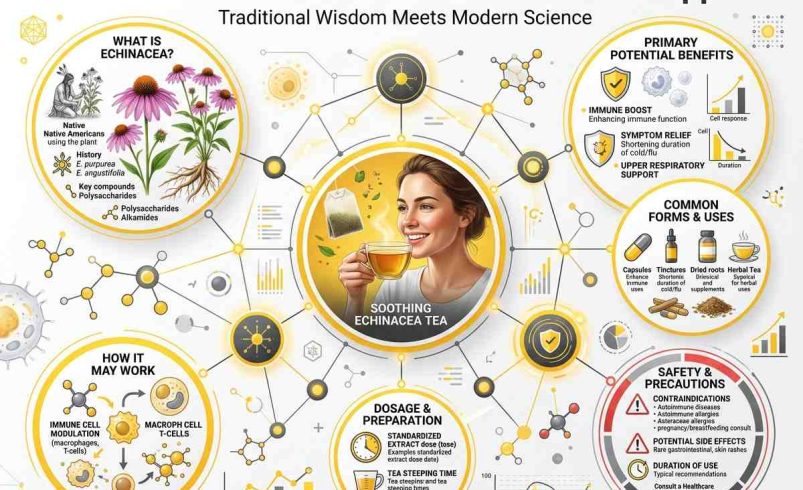
You’ve seen echinacea on the shelves at Holland & Barrett or heard it mentioned as a natural way to fight off a cold. Echinacea is a group of flowering plants native to North America, commonly used as a herbal remedy for upper respiratory infections like the common cold and flu. It’s one of the most popular herbal supplements in the world, but the evidence for its effectiveness is mixed.
This guide covers what echinacea is, how it works, what the research actually says, and how to use it safely. We’ll also look at how echinacea is regulated in the UK and what the NHS recommends. Whether you’re considering taking it for the first time or just want to know if it’s worth the money, you’ll find what you need here.
What Is Echinacea?
Echinacea is a genus of flowering plants in the daisy family, Asteraceae. It is native to North America and is commonly known as purple coneflower. The most commonly used species are Echinacea purpurea, Echinacea angustifolia, and Echinacea pallida.
The roots and aboveground parts of the plant are harvested and used medicinally. Echinacea contains a range of biologically active compounds, including caffeic acid glycoside and chicoric acid, which are thought to stimulate the immune system. It also has anti-inflammatory properties.
The plant has a long history of traditional use. Native American tribes used echinacea leaves and roots to treat toothaches, snakebites, insect bites, and skin wounds. Today, it is primarily used to prevent or treat viral infections in the upper respiratory tract, such as the common cold.
How Does Echinacea Work?
Echinacea is said to stimulate the immune system. When taken at the start of a cold, it is thought to shorten the duration of cold symptoms. Some people also apply it as a cream or ointment to treat skin disorders and promote wound healing.
Proponents claim that echinacea has antioxidant and anti-inflammatory effects, and that it may help prevent cancer and other diseases. However, these claims are not supported by rigorous scientific studies.
In vitro studies have shown that echinacea can modulate immune-related signalling pathways and cytokine expression. It has also been studied for its potential antibacterial and antiviral properties.
What Does the Research Say?
The evidence for echinacea’s effectiveness is inconsistent. The main reason for this inconsistency is the variability of plant preparations – different species, plant parts, and extraction methods can produce very different products.
A 2014 Cochrane review of 24 studies involving 4,631 participants evaluated a variety of echinacea products for preventing and treating colds. The review found no benefit for prevention, although a post-hoc pooling of prevention studies suggested a 10 to 20% relative risk reduction. The authors concluded that some products had weak benefit.
A subsequent meta-analysis found a significant effect on prevention but no impact on symptom duration, with no safety risk identified. However, the studies included were heterogeneous, meaning they varied widely in their methods and products.
A randomised trial involving 200 healthy children found that echinacea use prevented respiratory infections and reduced antibiotic prescriptions by 76.3%. However, more research is needed to confirm these findings.
The NHS does not recommend echinacea for preventing or treating colds. According to the health service, “There’s little evidence that supplements such as vitamin C, echinacea or garlic prevent colds or help you get better more quickly.”
Echinacea for Colds and Flu
Despite the mixed evidence, many people continue to use echinacea for colds and flu. Some studies have shown a small benefit – for example, some research suggests it may decrease the duration of cold symptoms by about half a day.
Echinacea is most effective when taken at the first sign of a cold. Some experts recommend starting it as soon as you feel symptoms coming on. However, the evidence for its effectiveness in treating an existing cold is weaker than for prevention.
A 2021 study reported that echinacea used in children prevented respiratory infections and reduced antibiotic prescriptions by over 75%. However, the European Medicines Agency (EMA) recommends against using echinacea in children under 12.
For adults, echinacea is probably safe for short-term use, but whether it actually boosts the immune system and prevents viral infections remains unknown.
How to Take Echinacea (Dosage and Forms)
Echinacea comes in many forms, including fresh, freeze-dried, dried, alcohol-based extract, liquid, tincture, tea, capsules, and salve. The right dosage depends on the form and the specific product.
For encapsulated echinacea, typical oral doses range from 300 mg three times a day (900 mg daily) to 500 mg three times a day (1,500 mg daily). Tinctures of an ethanolic extract of the aerial parts are often used at a concentration of 2.5 mL three times a day, or up to 10 mL daily.
Some products recommend taking a higher dose at the onset of symptoms – for example, 3–4 mL of a liquid preparation or 300 mg of a powdered form every two hours for the first day, then three times per day for 7 to 10 days.
Always follow the dosage instructions on the product label. Do not exceed the recommended dose. Most brands recommend taking echinacea with food or a large glass of water, not on an empty stomach. Do not take echinacea for more than a few weeks, as long-term safety has not been thoroughly studied.
Key dosage guidelines:
- Capsules/tablets: 300–500 mg, 2–3 times daily
- Tinctures: 2.5 mL, 3 times daily (or as directed)
- At onset of symptoms: higher dose for first day, then reduce
- Do not use for more than 10–14 days continuously
[Table: Comparison of echinacea species and their common uses]
| Species | Plant Part Used | Common Uses | Key Compounds |
| Echinacea purpurea | Aerial parts, root | Immune support, colds | Alkylamides, caffeic acid derivatives |
| Echinacea angustifolia | Root | Immune support, infections | Alkylamides, polysaccharides |
| Echinacea pallida | Root | Immune support | Polysaccharides, echinacoside |
Side Effects and Safety
Echinacea is generally well tolerated, but it can cause side effects in some people. These include dizziness, fatigue, headache, and digestive upset like nausea and stomach pain.
People with allergies to plants in the daisy family – including ragweed, chrysanthemum, marigold, and daisies – may have allergic reactions when taking echinacea. Serious allergic reactions, such as rash, swelling, and difficulty breathing, are rare but possible.
Echinacea taken for longer than 8 weeks may interact with medications that can cause liver damage, thereby increasing the risk of liver damage. It may also negate the beneficial effects of immunosuppressants, which are used to prevent rejection of organ transplants.
Echinacea may increase blood levels of caffeine by as much as 30%. This is worth bearing in mind if you drink a lot of coffee or tea while taking it.
No dangerous side effects have been identified with short-term use, but some people should avoid it altogether.
Who Should Not Take Echinacea?
Echinacea is not safe for everyone. You should avoid it if you:
- Are pregnant or breastfeeding
- Have a progressive systemic disease, such as tuberculosis, lupus, rheumatoid arthritis, or multiple sclerosis
- Have HIV or AIDS
- Are allergic to plants in the sunflower or daisy family
- Are undergoing therapy for cancer
- Have recently had eye surgery or have a history of dry eye
- Are taking immunosuppressant medicines
People with autoimmune diseases, those who have received organ transplants, or those with an impaired immune system should consult their doctor before taking echinacea.
There are no known food or medicine interactions with echinacea, but it’s always wise to check with a healthcare professional if you take other medications.
Echinacea in the UK: Regulation and Availability
In the UK, echinacea products are available as foods, supplements, and traditional herbal medicinal products with a Traditional Herbal Registration (THR) from the MHRA. THR-licensed products have been approved for the relief of common cold symptoms and influenza-type infections.
The THR scheme allows herbal products to be registered if they have been in medicinal use for at least 30 years, including 15 years within the EU. These products do not need to prove their effectiveness through clinical trials – they are based on traditional use only.
Examples of THR-licensed echinacea products in the UK include Echinaforce tablets, drops, and hot drink sachets. These products carry warnings advising against use in certain populations.
Echinacea is widely available in UK pharmacies, health food shops, and supermarkets. Brands like A.Vogel, Holland & Barrett, and Lamberts all offer echinacea products. Prices typically range from around £8 to £12 for a month’s supply.
The NHS does not recommend echinacea, and it is not available on prescription. Some NHS-prescribable echinacea products exist, but these are limited.
Frequently Asked Questions
Q: What is echinacea good for?
Echinacea is primarily used to prevent or treat the common cold and other upper respiratory infections. Some people also use it for wound healing and as an anti-inflammatory, but the evidence for these uses is limited.
Q: Does echinacea actually work for colds?
The evidence is mixed. Some studies show a small benefit – reducing cold duration by about half a day – while others show no effect. The NHS does not recommend it due to a lack of strong evidence.
Q: Can I take echinacea every day?
Echinacea is probably safe for short-term use, but it is not recommended for long-term daily use. Most experts advise taking it only when you feel a cold coming on, and for no more than 10–14 days at a time.
Q: What are the side effects of echinacea?
Common side effects include dizziness, fatigue, headache, nausea, and stomach upset. People allergic to daisy-family plants may experience allergic reactions. Serious side effects are rare.
Q: Is echinacea safe during pregnancy?
No. Echinacea is not recommended during pregnancy or breastfeeding. The safety has not been established, and it is advised to avoid it.
Q: Can children take echinacea?
The European Medicines Agency recommends against using echinacea in children under 12. Some products are licensed for children over 12, but you should always consult a doctor first.
Q: What is the best form of echinacea to take?
There is no single best form. Capsules, tablets, tinctures, and teas are all available. The most important thing is to choose a product from a reputable brand and follow the dosage instructions.
Q: Does echinacea interact with other medications?
Echinacea may interact with immunosuppressants and medications that affect the liver. It may also increase caffeine levels. Always check with a pharmacist or doctor if you take other medicines.
Q: Is echinacea available on the NHS?
Echinacea is not routinely available on the NHS. Some products may be listed in the NHS drug tariff, but they are not typically prescribed. The NHS does not recommend it for colds.
Q: How quickly does echinacea work?
Echinacea is most effective when taken at the first sign of a cold. Some studies suggest it may reduce cold duration by about half a day, but results vary widely between products and individuals.