

What Is a Reusable Straw Made Of? Materials Compared
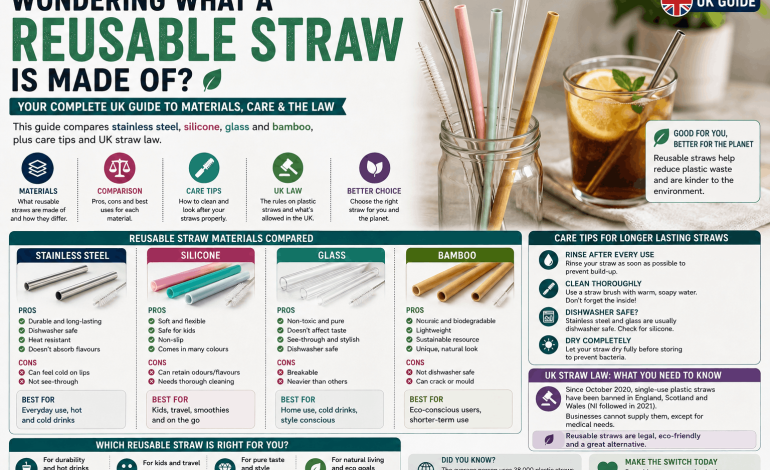

If you’ve picked up a reusable straw and wondered what it’s actually made from, the answer is almost always one of four materials: stainless steel, silicone, glass or bamboo. A reusable straw is simply a drinking straw designed to be washed and used repeatedly rather than thrown away after one drink, and each of these four materials handles that job differently.
This guide walks through what each material is, how it performs in everyday use, and which one suits different situations, from morning smoothies to cocktails at a party. It also covers how to clean a reusable straw properly and why so many UK households picked one up in the first place, since single-use plastic straws are now restricted by law.
What Is a Reusable Straw Made Of
Four materials cover almost every reusable straw on the UK market, and each one behaves quite differently once it’s in your glass.
Stainless steel
Stainless steel is the most common reusable straw material, valued for how long it lasts. It has no taste or odour of its own, doesn’t leach chemicals into drinks, and can genuinely last for years with basic care. The trade-off is rigidity: a metal straw won’t bend to fit an odd-shaped cup, and it can feel unexpectedly cold against your teeth with an iced drink.
Silicone
Silicone straws are soft and flexible, which makes them a common choice for children or anyone who prefers a gentler feel against their teeth. They’re food-grade and heat-resistant, so they cope well with warm drinks as well as cold ones, though the softer material can pick up staining or odour from strongly coloured drinks like berry smoothies over time.
Glass
Glass straws are entirely taste-neutral, which some coffee and cocktail drinkers prefer over metal or silicone. They’re straightforward to clean, since you can usually see straight through them to check they’re spotless, but they’re also the most fragile option here, more likely to chip or break than any of the alternatives, particularly around young children or a crowded dishwasher.
Bamboo
Bamboo straws are cut and shaped from natural bamboo, making them the most visibly “natural” option and often the cheapest to buy in a set. They’re generally marketed as biodegradable, though how compostable a specific product actually is depends on whether any coatings or additives have been used in manufacturing. Bamboo also tends to have the shortest useful lifespan of the four materials, since the material can wear, stain or develop a musty smell faster with regular washing.
[Image: four reusable straws made of stainless steel, silicone, glass and bamboo laid side by side]
Comparing Reusable Straw Materials
Choosing between these four options usually comes down to a straightforward trade-off between durability, comfort and cost. The table below summarises how they compare across the factors that matter most in daily use.
[Table: comparison of reusable straw materials showing durability, feel, cleaning and typical use case]
| Material | Durability | Feel | Cleaning | Best for |
| Stainless steel | Longest lasting, resists bending | Rigid, can feel cold | Dishwasher safe, use a brush for the inside | Everyday use, cold drinks |
| Silicone | Durable, but can stain over time | Soft and flexible | Dishwasher safe, easy to squeeze clean | Children, sensitive teeth |
| Glass | Fragile, prone to chipping | Rigid, taste-neutral | Easy to see if clean, handle with care | Hot drinks, cocktails |
| Bamboo | Shortest lifespan of the four | Light, natural texture | Hand wash only, dry fully to avoid mould | Occasional or lower-impact use |
Why Reusable Straws Became Common in the UK
Reusable straws became far more visible in the UK after single-use plastic straws were restricted by law. In England, the Environmental Protection (Plastic Straws, Cotton Buds and Stirrers) (England) Regulations 2020 made it an offence to supply single-use plastic straws to an end user from 1 October 2020, with limited exemptions for registered pharmacies, catering establishments supplying straws on request with food or drink for immediate consumption, and medical or accessibility purposes.
Scotland followed with its own single-use plastics ban under the Single-Use Plastic Products (Scotland) Regulations 2021, which came into force on 1 June 2022 and covers straws alongside a wider list of single-use plastic items. Wales introduced comparable restrictions through the Environmental Protection (Single-use Plastic Products) (Wales) Act 2023, while Northern Ireland’s approach has followed a separate timeline linked to its post-Brexit trading arrangements. Check the current guidance on GOV.UK if you’re a business supplying straws, since the exemptions and enforcement details vary by nation.
How to Clean and Care for a Reusable Straw
Cleaning a reusable straw properly matters more than most people expect, since a narrow tube is an easy place for residue to build up unnoticed. A dedicated cleaning brush, usually included with most straw sets, is the single most useful tool here, since it reaches the inside surface in a way that rinsing under a tap alone can’t manage.
For everyday cleaning, most stainless steel and silicone straws are dishwasher safe, so placing them in a cutlery basket alongside your usual load works fine. Glass straws can usually go in the dishwasher too, though hand washing reduces the risk of chipping against other items. Bamboo straws are the exception: they should be hand washed only, and dried fully before storing, since trapped moisture is what causes mould or a musty smell to develop.
Choosing the Right Reusable Straw for You
The right material depends more on your daily habits than on any single “best” option. If you want something that will last years without much thought, stainless steel is the straightforward choice, and a basic set with a cleaning brush typically costs £3 to £10 from UK retailers including Amazon, IKEA and most supermarkets.
If you’re buying for children, or you simply find rigid straws uncomfortable, silicone is worth the slightly shorter lifespan for the added comfort. Glass suits people who care most about taste neutrality, such as coffee or cocktail drinkers, provided you’re prepared to handle it carefully. Bamboo makes sense if lower environmental impact from the material itself matters more to you than longevity, though it needs the most careful drying and storage of the four.
Reusable Straws and Accessibility
It’s worth noting that reusable straws don’t suit everyone, and UK law reflects that directly. The exemptions built into England’s plastic straw ban specifically allow catering establishments to keep single-use plastic straws available on request for customers who need them for medical or accessibility reasons, without requiring proof of a condition. Rigid metal or glass straws can pose a safety risk for some people with conditions affecting motor control, so single-use plastic remains a legitimate and lawful option in these situations rather than something to be phased out entirely.
FAQ
Q: What is a reusable straw made of? Reusable straws are typically made from stainless steel, silicone, glass or bamboo. Stainless steel is the most common due to its durability, while silicone suits comfort, glass suits taste neutrality, and bamboo suits lower environmental impact from the material itself.
Q: Are reusable straws dishwasher safe? Stainless steel, silicone and most glass straws are dishwasher safe, usually placed in a cutlery basket to avoid damage. Bamboo straws should always be hand washed, since the material doesn’t cope well with prolonged moisture or high heat.
Q: Why are plastic straws banned in the UK? Single-use plastic straws were restricted in England from 1 October 2020 under the Environmental Protection (Plastic Straws, Cotton Buds and Stirrers) (England) Regulations 2020, aimed at reducing plastic pollution. Scotland, Wales and Northern Ireland have introduced their own similar restrictions on different timelines.
Q: Can I still get a plastic straw if I need one for medical reasons? Yes, UK regulations include exemptions allowing catering establishments to provide single-use plastic straws on request for medical or accessibility needs. No proof of a medical condition is required to ask for one.
Q: Which reusable straw material lasts longest? Stainless steel generally lasts the longest of the four common materials, resisting bending and wear over years of regular use. Bamboo tends to have the shortest lifespan, since the natural material wears and can develop odour faster with repeated washing.
Q: Are silicone straws safe for children? Yes, silicone is a common choice for children specifically because it’s soft, flexible and less likely to cause injury than a rigid metal or glass straw. It’s also heat-resistant and food-grade, making it suitable for both hot and cold drinks.
Q: How much does a reusable straw cost in the UK? A basic set of two to five stainless steel or silicone straws with a cleaning brush typically costs £3 to £10 from UK retailers such as Amazon or IKEA. Glass and bamboo sets fall within a similar range, though individual glass straws can cost more.