 Haris
Haris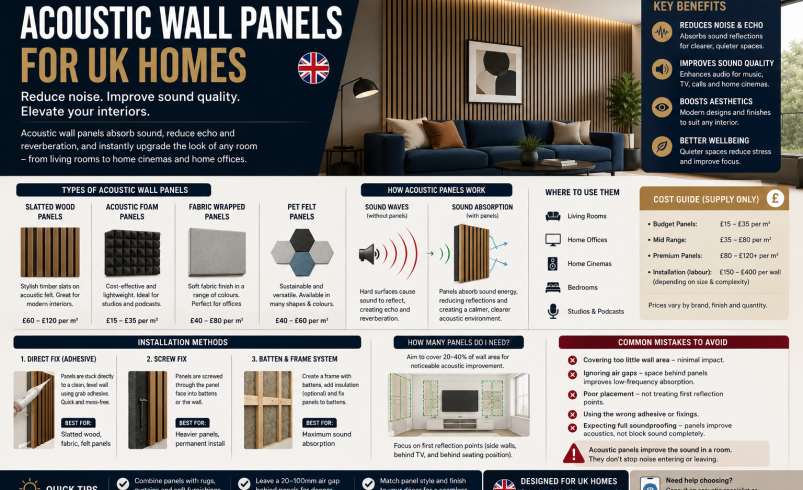
You are likely searching for acoustic wall panels because you need to reduce echo in a room or stop noise travelling through a party wall. These panels absorb sound waves to decrease reverberation time and can provide additional mass to dampen airborne noise transmission. This guide explains exactly which panel type suits your specific UK property, from Victorian terraces to new-build apartments.
We cover the critical difference between sound absorption and soundproofing, as confusing these terms leads to expensive failures. You will find current pricing, installation steps for both adhesive and batten methods, and fire safety ratings required for UK building regulations. Read on to select the right product and avoid the most common retrofitting errors.
Sound Absorption Versus Soundproofing
Acoustic wall panels primarily function as sound absorbers rather than sound insulators. They reduce echo and reverberation within a room by converting sound energy into heat through friction within porous materials. This improves speech clarity and makes spaces feel calmer but does not inherently stop noise entering or leaving the room.
True soundproofing requires mass, decoupling, and airtight sealing to block transmission paths. Some acoustic panels include dense backing layers or integrate with resilient bar systems to address transmission loss. Always verify whether a product’s stated performance refers to Noise Reduction Coefficient (NRC) for absorption or Sound Transmission Class (STC/Rw) for insulation before purchasing.
Performance Metrics Explained
The Noise Reduction Coefficient measures sound absorption on a scale from 0 to 1. A rating of 0.85 NRC means the material absorbs 85% of incident sound energy at tested frequencies. Most decorative wood slat panels achieve 0.7 to 0.9 NRC when installed over mineral wool backing, while foam-only products often rate lower at mid-frequencies.
Weighted Sound Reduction Index (Rw) quantifies transmission loss in decibels. Standard plasterboard partitions typically achieve Rw 35-40 dB, whereas specialist acoustic panel systems can reach Rw 50-55 dB when correctly detailed. Manufacturers must test complete system assemblies rather than individual components to claim valid Rw values under BS EN ISO 10140 standards.
Types of Acoustic Wall Panels Available in the UK
Wood slat panels dominate the current UK market due to their dual aesthetic and acoustic function. These consist of MDF or oak veneer slats spaced 10-20mm apart on recycled polyester felt backing. The gaps allow sound penetration into the absorptive backing layer while the slats diffuse higher frequencies to prevent flutter echo.
Fabric-wrapped glass fibre or mineral wool panels offer superior broadband absorption for home cinemas and studios. These hide high-performance core materials behind acoustically transparent textiles in custom colours. Perforated gypsum or metal panels provide durable, wipeable surfaces for kitchens and bathrooms where fabric or wood would degrade from moisture and cleaning chemicals.
Fire Safety and Building Regulations Compliance
UK Building Regulations Approved Document B mandates specific fire classifications for wall linings depending on room use and escape routes. Residential circulation areas typically require Class C-s3,d2 or better under BS EN 13501-1 testing. Many cheap imported panels lack verified UKCA marking and fail mandatory fire performance requirements for rented properties or HMOs.
Always request full test certificates from suppliers rather than accepting generic claims. Valid certificates specify exact product construction including adhesives and backing materials used during testing. Substituting components on-site invalidates certification and creates liability issues for landlords and contractors. Check local authority guidance for Scotland, Wales, and Northern Ireland as requirements vary slightly from England.
Installation Methods for Different Wall Substrates
Direct adhesive bonding suits solid masonry walls in good condition and offers minimal thickness buildup. Use solvent-free grab adhesive rated for the panel weight and substrate porosity. Apply adhesive in continuous vertical ribbons rather than dabs to maintain consistent contact and prevent drumming resonances that compromise acoustic performance.
Batten mounting creates an air cavity that enhances low-frequency absorption significantly. Fix treated timber battens at 400-600mm centres perpendicular to panel orientation using appropriate fixings for the wall type. Fill the cavity with 50-100mm mineral wool insulation to maximise bass trapping and thermal performance simultaneously. This method accommodates uneven walls better than direct bonding.
Preparing Surfaces and Managing Services
Existing walls must be clean, dry, and structurally sound before any installation begins. Remove loose plaster, fill cracks, and treat mould or damp issues first as trapped moisture causes adhesive failure and rot. Test for asbestos in pre-2000 properties before drilling or sanding surfaces. Relocate sockets and switches to maintain flush finishes and electrical safety compliance.
Plan cable routing before fixing panels to avoid surface-mounted trunking that ruins aesthetics. Use shallow back boxes or create service voids behind batten frameworks for new wiring. Ensure all penetrations through acoustic layers are sealed with intumescent mastic to maintain fire compartmentation and acoustic integrity. Unsealed gaps reduce system performance by 5-10 dB in practice.
Cost Breakdown and Budget Planning for UK Projects
Material costs for acoustic wall panels range from £40 to £120 per m² depending on finish quality and acoustic specification. Budget options use printed paper veneers on particleboard cores, while premium products feature real oak or walnut veneers on moisture-resistant MDF. Fabric-wrapped professional panels typically cost £80-£150 per m² including custom sizing.
Installation labour adds £30-£60 per m² for competent tradespeople familiar with acoustic detailing. Complex geometries, high ceilings, or out-of-hours work increase rates substantially. Factor in waste allowance of 10-15% for cutting around openings and pattern matching. Adhesives, fixings, and sealants add £5-£10 per m² to total project costs.
Hidden Costs and Value Engineering Options
Delivery charges for large-format panels often exceed £100 for palletised shipments to residential addresses. Remote locations and upper-floor deliveries without lift access incur surcharges. Order samples first to verify colour and texture accuracy as screen representations frequently mislead. Return shipping for unwanted full-size panels is rarely economical.
Value engineering involves strategic placement rather than covering entire walls. Focus treatment on primary reflection points and first-order bounce zones for maximum benefit at minimum cost. Combine premium panels in visible areas with budget alternatives behind furniture or above head height. Retain existing skirting and cornices where possible to reduce making-good expenses.
Mistakes That Compromise Acoustic Performance
Overlooking flanking paths renders expensive panel installations ineffective against noise transmission. Sound travels through floor joists, ceiling cavities, and structural connections bypassing treated walls entirely. Address perimeter seals, service penetrations, and adjacent surfaces before investing in wall treatments. Partial solutions deliver partial results regardless of panel quality.
Incorrect spacing or orientation undermines designed acoustic behaviour. Slat panels installed horizontally rather than vertically lose diffusion characteristics and may resonate sympathetically. Exceeding manufacturer-recommended fixing centres causes bowing and detachment over time. Follow installation instructions precisely as deviations void warranties and performance guarantees.
Maintenance and Long-Term Durability Concerns
Dust accumulation in fabric and textured surfaces gradually reduces absorption efficiency. Vacuum regularly using soft brush attachments to preserve pore openness without damaging fibres. Wood slat panels require occasional re-oiling or waxing to maintain moisture resistance and appearance. Avoid silicone-based cleaners that clog acoustic pores and attract dirt.
UV exposure fades natural wood veneers and some fabrics unevenly over years. Rotate removable panels periodically if possible or specify UV-stable finishes for sun-facing walls. Monitor humidity levels as sustained conditions above 65% RH cause swelling and delamination in wood-based products. Install vapour barriers behind panels in high-moisture environments like bathrooms or pool enclosures.
Frequently Asked Questions About Acoustic Wall Panels
Q: Do acoustic wall panels stop neighbour noise coming through party walls?
Standard acoustic panels alone do not stop neighbour noise as they absorb internal reverberation rather than block transmission. Effective party wall treatment requires adding mass, decoupling layers, and sealing all gaps. Panels can form part of a composite system but are insufficient as standalone soundproofing solutions.
Q: Can I install acoustic panels myself or do I need professionals?
DIY installation is feasible for straightforward rectangular walls using adhesive methods. Batten systems, complex geometries, or fire-critical applications benefit from experienced installers familiar with acoustic detailing. Incorrect installation compromises performance and may violate building regulations. Assess your skill level honestly before committing to self-installation.
Q: Are acoustic wall panels suitable for bathrooms and kitchens?
Only moisture-resistant variants specifically rated for wet environments should be used in bathrooms and kitchens. Standard wood slat and fabric panels swell, delaminate, or harbour mould when exposed to steam and splashes. Specify PVC, perforated metal, or sealed composite panels with appropriate IP ratings for hygiene and durability.
Q: How much wall coverage do I actually need for noticeable improvement?
Treating 25-30% of wall surface area typically delivers perceptible reverberation reduction in domestic rooms. Coverage below 15% produces marginal subjective benefit despite measurable changes. Focus placement on primary reflection points opposite sound sources rather than uniform distribution. Room volume and existing furnishings also influence required coverage percentage.
Q: What maintenance do acoustic panels require long-term?
Vacuum fabric panels monthly and wipe hard surfaces with damp cloths quarterly to prevent dust clogging acoustic pores. Re-oil wood veneers annually or biannually depending on wear and environmental conditions. Inspect fixings and seals every few years for loosening or degradation. Replace damaged sections promptly to maintain consistent performance and appearance.
Q: Do acoustic panels meet UK fire safety standards for rentals?
Many panels meet Class C-s3,d2 or better under BS EN 13501-1 but verification is mandatory for rental compliance. Request current UKCA-marked test certificates covering exact product configuration including adhesives. Generic certifications or outdated CE marks may not satisfy local authority requirements. Landlords bear legal responsibility for verifying fire performance documentation.
Q: Will acoustic panels affect my room’s temperature or insulation?
Panels with mineral wool backing provide modest thermal insulation benefits typically adding R-value 0.5-1.0 m²K/W. Air cavities behind batten-mounted systems enhance this effect further. However, acoustic panels are not substitutes for proper thermal insulation in external walls. Internal party wall applications see negligible thermal impact either positive or negative.
Q: Can I paint or customise acoustic panels after installation?
Painting fabric or open-pore wood panels seals acoustic surfaces and destroys absorption performance. Only smooth, non-porous panel types accept paint without functional compromise. Customisation should occur pre-installation through manufacturer options for colour, size, or finish. Post-hoc modifications risk voiding warranties and negating acoustic properties entirely.