
 Haris
Haris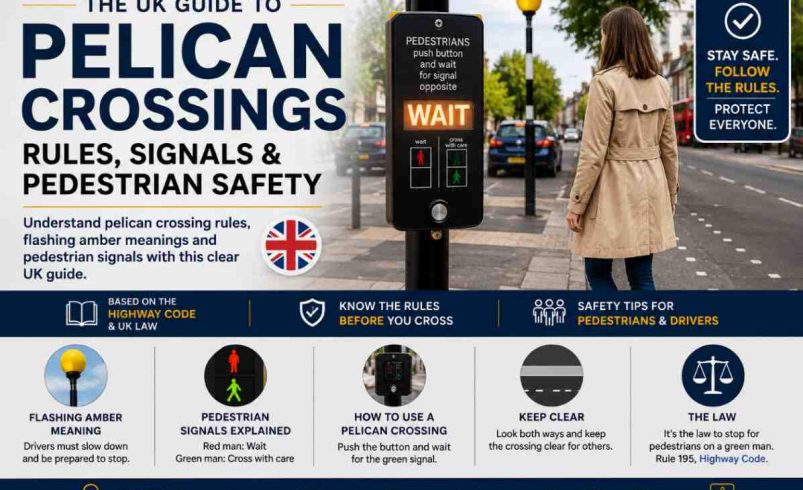
What does a flashing amber light mean at a pelican crossing, and who has right of way? A pelican crossing is a signal-controlled pedestrian crossing where you must give way to anyone still on the road during the flashing amber phase. Drivers must stop at red and may only proceed during flashing amber if the crossing is completely clear of pedestrians. Pedestrians should never start crossing when the green figure flashes but can finish safely if already on the road. This guide explains the exact legal sequence, how pelican crossings differ from newer puffin systems, and what both drivers and walkers need to know to stay compliant with the Highway Code.
How a Pelican Crossing Works for Drivers
The traffic light sequence at a pelican crossing follows a fixed timer rather than intelligent sensors. When a pedestrian presses the button, the lights change from green to amber, then to red for a set period to allow people to cross. After the red phase ends, the signal switches to flashing amber before returning to green. This flashing amber phase is unique to pelican crossings and does not appear at puffin or toucan crossings.
Legal Requirements During Flashing Amber
Highway Code Rule 196 states that you MUST give way to any pedestrians on the crossing when the amber light is flashing. If no pedestrians remain on the road surface, you may proceed with caution without waiting for the green light. Failing to yield during this phase is an endorsable offence typically carrying 3 penalty points and a £100 fixed penalty notice [FACT UNVERIFIED — CHECK BEFORE PUBLISHING]. The law treats the entire crossing as one continuous zone even if a central refuge island exists, meaning you must wait for pedestrians crossing from both sides.
Pedestrian Signals and Safe Crossing Procedure
For pedestrians, a pelican crossing displays red and green man signals on the far side of the road opposite the call button. You should press the button and wait for the steady green figure to illuminate before stepping onto the road. Always check that traffic has actually stopped before crossing, as some drivers may fail to comply with the red signal. Rule 22 of the Highway Code explicitly warns against starting to cross when the green figure begins to flash.
Understanding the Flashing Green Man Phase
The flashing green man indicates that the signal is about to change and new pedestrians should not begin crossing. If you are already on the road when the flashing starts, you should have sufficient time to reach the opposite pavement safely. Unlike puffin crossings, pelican systems do not use sensors to extend crossing time for slower pedestrians. This fixed timing means elderly or mobility-impaired users may find the clearance interval insufficient on wider roads.
Key Differences Between Pelican and Puffin Crossings
Puffin crossings have largely replaced pelican installations since 2016 due to superior safety features and traffic flow efficiency. The most visible difference is signal placement: puffin crossings show the red and green man above the push-button box on the pedestrian’s side, while pelican signals face pedestrians from across the road. Puffin crossings also lack the flashing amber phase entirely, using a standard red-amber-green sequence identical to regular traffic lights.
Sensor Technology Versus Fixed Timers
Puffin crossings use infrared sensors mounted on the signal head to detect pedestrian presence in real time. These sensors cancel unnecessary requests if someone presses the button then walks away, reducing vehicle delay. They also automatically extend the red phase if pedestrians are still detected on the crossing, up to a pre-set maximum duration. Pelican crossings operate purely on fixed timers regardless of actual pedestrian movement, which can cause unnecessary traffic stops or inadequate crossing time.
[Table: Pelican vs Puffin Crossing Comparison]
| Feature | Pelican Crossing | Puffin Crossing |
| Signal Location | Far side of road | Above push-button (near side) |
| Flashing Amber Phase | Yes | No |
| Control Method | Fixed timer | On-crossing sensors |
| Pedestrian Detection | None | Infrared sensors |
| Request Cancellation | Not possible | Automatic if user leaves |
| Installation Status | Being phased out since 2016 | Current UK standard |
Common Misunderstandings and Safety Risks
Many drivers incorrectly believe they must wait for green even when the crossing is clear during flashing amber. This misconception causes unnecessary congestion and frustration, though proceeding cautiously when clear is perfectly legal. Conversely, some drivers treat flashing amber as permission to proceed regardless of pedestrian presence, which violates Rule 196 and risks prosecution. Pedestrians sometimes misinterpret the flashing green man as a “hurry up” signal rather than a warning not to start crossing.
Central Islands and Staggered Crossings
Rule 197 clarifies that pelican crossings going straight across the road count as one crossing even with a central island. Drivers must therefore wait for pedestrians traversing both halves before moving off during flashing amber. However, staggered crossings with offset islands are treated as two separate crossings, each with independent signals. Misjudging this distinction is a frequent cause of near-misses at complex junctions.
Frequently Asked Questions About Pelican Crossings
Q: What does the flashing amber light mean at a pelican crossing?
The flashing amber light means you MUST give way to any pedestrians still on the crossing. If the crossing is completely clear, you may proceed with caution without waiting for green. You cannot proceed if anyone remains on the road surface, even if they appear to be moving slowly. This phase exists solely to allow stragglers to finish crossing safely.
Q: Can I cross on a flashing green man at a pelican crossing?
No, you should not start crossing when the green figure begins to flash. The flashing green man warns that the signal is ending and traffic will soon resume. If you are already on the road when it flashes, continue to the other side without stopping. Only step off the kerb during the steady green figure phase.
Q: Are pelican crossings being phased out in the UK?
Yes, pelican crossings began being phased out in Great Britain from 2016 onwards. New installations must be puffin crossings, which offer sensor-based safety improvements. Existing pelican crossings remain legal and operational until replaced during routine maintenance or roadworks. Scotland and Northern Ireland may have different replacement timelines [FACT UNVERIFIED — CHECK BEFORE PUBLISHING].
Q: What is the penalty for not stopping at a pelican crossing?
Failing to comply with a red or flashing amber signal at a pelican crossing is typically dealt with by a fixed penalty notice. This usually carries 3 penalty points and a £100 fine, though courts can impose higher penalties for dangerous driving [FACT UNVERIFIED — CHECK BEFORE PUBLISHING]. Prosecution is more likely if your failure to stop causes injury or significant danger to pedestrians.
Q: How is a pelican crossing different from a zebra crossing?
A pelican crossing uses traffic lights activated by a push-button, while a zebra crossing relies on driver courtesy and black-and-white stripes. Vehicles MUST stop at red on a pelican but only need to give way once a pedestrian steps onto a zebra. Pelican crossings have defined signal phases, whereas zebra crossings require constant vigilance from both parties. Zebra crossings also lack the flashing amber phase entirely.
Q: Do I have to press the button at a pelican crossing?
Yes, you must press the control button to activate the traffic signals at a pelican crossing. The lights will not change automatically based on pedestrian detection like they do at puffin crossings. Pressing the button multiple times does not speed up the sequence. Always wait for the steady green figure before crossing, even if traffic appears stationary.
Q: Can cyclists use a pelican crossing?
Cyclists should dismount and walk their bikes across a pelican crossing unless specific cycle signage indicates otherwise. Riding across on the green man is technically permitted but discouraged due to conflict risk with pedestrians. Toucan crossings are specifically designed for shared cyclist-pedestrian use and should be preferred where available. Check local signage for site-specific cycling permissions.
Q: Why is it called a pelican crossing?
The name “pelican” is an acronym derived from PEdestrian LIght CONtrolled crossing. It was the first definitive light-controlled pedestrian crossing system introduced in the UK. Similar naming conventions apply to puffin (Pedestrian User-Friendly INtelligent) and toucan (Two CAN cross) crossings. These mnemonic names help distinguish between different crossing types in official documentation.