 Haris
Haris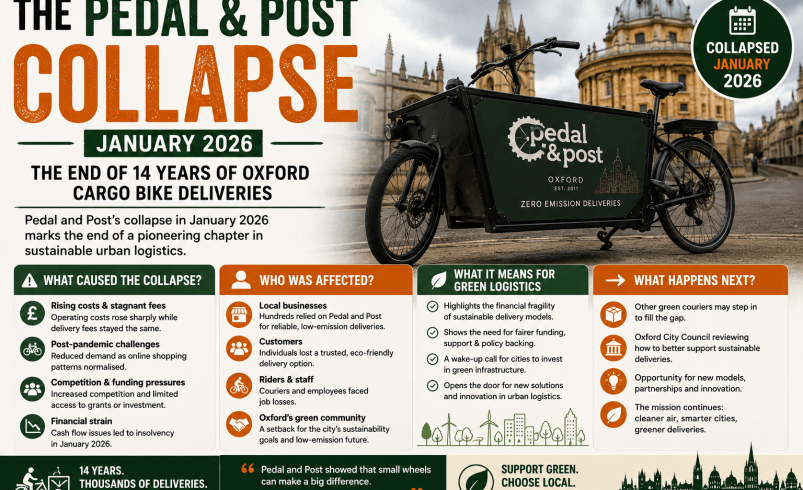
The Pedal & Post shuts down story marks the abrupt end to one of the UK’s most recognised eco-courier businesses after 14 years of operation. The Oxford-based cargo bike delivery company entered voluntary liquidation on 20 February 2026, leaving 60 people out of work and investors unlikely to see any return on their money. It’s the latest example of an Oxford cycle courier business fails headline, and it’s prompted comparisons with other operators in the space, including London-based Pedal Me (sometimes written PedalMe), the cargo bike outfit known for its base near Pedal Me Waterloo, which remains active and is often mentioned in the same breath given the shared “pedal” branding and sector.
The direct trigger for the Pedal & Post company closure was a 30-day contract termination notice from micromobility company Voi. That single decision removed around 25% of Pedal & Post’s revenue and roughly 36% of its profit margins, which the business could not replace fast enough to survive.
This article covers the timeline of events, what caused the collapse, the financial damage left behind, what happened to affected Evri deliveries, and what the closure means for the broader UK cargo bike sector.
What Was Pedal & Post?
Pedal & Post was founded in Oxford in 2013 by Chris Benton. The company set out to replace diesel van deliveries with e-cargo bikes, trikes, and electric vans for urban last-mile logistics. At its peak it was completing more than 1,000 deliveries a day in Oxford, and its own data indicated that its fleet saved approximately 100,000 van miles per year in the city.
The business was genuinely pioneering. It partnered with Oxford University Hospitals NHS Foundation Trust, where its cargo bikes were used to deliver chemotherapy drugs between hospital sites, cutting NHS delivery times for those drugs by half. Other clients included Evri, six Oxford University colleges, Blackwell’s bookshops, and Wolfson College.
Worth noting: while Pedal & Post operated primarily out of Oxford (with a later London push), it’s a distinct company from Pedal Me, the London cargo bike and courier cooperative built around its Pedal Me Waterloo hub. The two are unrelated businesses that simply share a similar name and a similar mission: get vans off city streets.
In 2023, at the time of its crowdfunding campaign, Pedal & Post was valued at £2 million and was delivering across Oxford with 23 employees, with ambitions to grow to 8,000 deliveries a day.
The Timeline of the Collapse
2013: Chris Benton founds Pedal & Post in Oxford.
2022: The company participates in Oxford’s first cargo bike trial.
April to May 2023: Pedal & Post launches a crowdfunding campaign on Ethex, targeting £500,000 to expand into Reading and scale up in Oxford. The campaign raises the full amount.
Summer 2025: The company expands into London, aiming to complete 100,000 zero-emission deliveries per year in the capital.
End of January 2026: Voi serves a 30-day contract termination notice on Pedal & Post, described by Benton as “not performance related.” Staff and shareholders are informed on 26 January.
27 January 2026: Pedal & Post announces on social media that both its Oxford and London sites have closed.
Early February 2026: Evri customers in Oxford begin reporting missing or undelivered parcels after the company ceases trading without notice.
20 February 2026: Formal creditors’ voluntary liquidation commences, with joint liquidators appointed from Walsall firm BK Plus.
Why Did Pedal & Post Collapse?
The immediate cause was the loss of the Voi contract, worth around 25% of revenue and roughly 36% of profit margins, since micromobility work was particularly high-margin compared to parcel delivery. Without it, the business couldn’t demonstrate financial viability to investors or lenders.
Benton was direct about the structural fragility this exposed, telling Zag Daily: “With simple, small businesses that are reliant on five to six major clients, it happens sometimes that you lose one and can’t sustain moving forward.”
Being an ethical employer in a sector that often relies on self-employed gig workers is expensive. Pedal & Post paid staff on contracted terms rather than purely self-employed arrangements, raising labour costs relative to competitors. Lower vehicle costs from cargo bikes helped offset this, but the margin for error was thin, and a single large contract loss removed the cushion entirely.
The Financial Damage Left Behind
Total debt at the point of collapse was approximately £300,000, including unpaid employee redundancy claims, VAT owed to HMRC, and personal loans from the founder himself. Benton had injected £30,000 of his own money into the business in its final period.
The £500,000 raised through the 2023 Ethex crowdfunding campaign is also gone. Benton told investors: “I fully recognise how hard this will be to hear and I am deeply sorry to be sharing this update in these circumstances.” Richard Lofthouse, a long-time backer, said: “I’m shocked by the announcement. The business was created to reduce van movements in the city and had successfully delivered many thousands of parcels.”
What Happened to Evri Deliveries in Oxford?
Pedal & Post had served as Evri’s e-cargo bike delivery partner within Oxford’s Clean Air Zone. When it ceased trading without notice, Evri was left with no partner to handle that portion of local deliveries, and parcels sat at depots for over a week in some cases.
Carol Leonard, a resident in Grandpont, Oxford, had parcels ordered on 29 and 31 January not delivered until 10 February. An Evri spokesperson confirmed the cause: “We were disappointed to learn that our e-cargo bike delivery partner in Oxford ceased trading without notice, which caused some temporary disruption for a small number of customers in the local area. We have quickly re-organised deliveries in the area.”
What This Means for UK Cargo Bike Delivery
The collapse didn’t happen in isolation. In January 2025, Zedify (Outspoken Logistics) went into administration after failing to raise new funding despite roughly £9 million in prior investment, making over 100 workers redundant. Two cargo bike operators failing within a year raises real questions about the model’s viability at scale, though it’s worth stressing that companies like Pedal Me in London, still operating out of its Pedal Me Waterloo base, show the sector isn’t collapsing wholesale, even as smaller regional players like Pedal & Post struggle.
Benton drew a distinction between his company’s failure and the sector’s future: “Our closure isn’t a reflection on cargo bike use or logistics.” He pointed to major carriers now investing in bike-based urban delivery at scale, a different commercial environment from the one Pedal & Post and Zedify operated in.
FAQs
Q: Why did Pedal & Post collapse?
It entered voluntary liquidation in January 2026 after losing its Voi contract, worth around 25% of revenue and 36% of profits, and couldn’t replace that income fast enough.
Q: Is Pedal & Post the same company as Pedal Me?
No. They’re entirely separate businesses. Pedal & Post was based in Oxford; Pedal Me operates out of London, with its well-known Pedal Me Waterloo hub. The similar names are coincidental, both share a cargo-bike-for-cities mission but have no corporate connection.
Q: How many jobs were lost?
Around 60 people, across employed and self-employed roles in Oxford and London.
Q: Will investors get their money back?
Very unlikely, given roughly £300,000 in total debt and the order of priority in creditors’ voluntary liquidation.
Q: Does this mean cargo bike delivery is finished in the UK?
No. Operators like Pedal Me continue to run, and major parcel carriers are investing further into bike-based urban delivery. The independent, ethical-employer model Pedal & Post represented has proved fragile, not the sector as a whole.