Hydrangea Care UK: Planting, Pruning and Colour Guide
- August 18, 2026
- 0
If you’ve just bought a hydrangea, or you’re trying to work out why last year’s didn’t flower, the questions usually come down to three things: when to prune,
If you’ve just bought a hydrangea, or you’re trying to work out why last year’s didn’t flower, the questions usually come down to three things: when to prune,
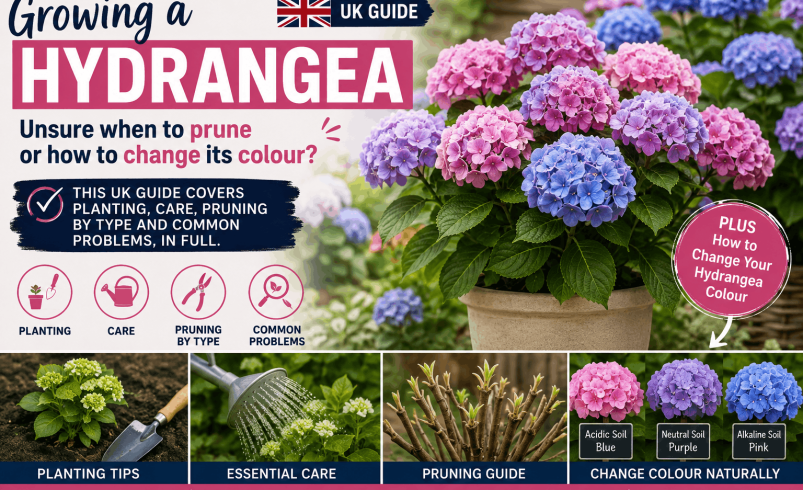
If you’ve just bought a hydrangea, or you’re trying to work out why last year’s didn’t flower, the questions usually come down to three things: when to prune, how much water it needs, and whether you can change the colour. Most hydrangeas need only light, well-timed pruning, they like consistently moist soil in light shade, and colour change only works on certain types, and only when the soil pH is right.
This guide covers hydrangea types, where to plant one, pruning by type, changing flower colour, watering and feeding, and the problems that come up most often, with an FAQ at the end for anything left over.
Getting this right matters more than almost anything else in this guide, since the type determines when and how you prune, and whether colour change is even possible.
If you’re not sure which you have, check the plant label if you kept it, or compare flower shape and leaf type against the list above. [Image: side-by-side photo comparing mophead, lacecap and paniculata hydrangea flowers — use royalty-free image from Unsplash or Pexels]
Hydrangeas generally do best in light shade, though a sunnier spot works fine as long as the soil doesn’t dry out in summer. Full sun all day tends to scorch the leaves and stress the plant, particularly on mophead types.
Spring and autumn are the best times to plant, giving roots time to establish before either summer heat or winter cold sets in. Water in thoroughly after planting and keep the soil consistently damp for the following few weeks while the plant settles.
Spacing depends on the cultivar’s eventual size, typically ranging from 90cm to 2.4m, so check the plant label before deciding how many to buy. Choose a spot away from frost pockets and exposed corners, since late spring frosts are one of the most common reasons UK hydrangeas lose their flower buds.
For containers, more compact cultivars work well. If your garden soil is alkaline and you want to keep blue flowers, growing in a pot with ericaceous compost gives you far more control over pH than trying to amend open ground. [Table: comparison of hydrangea types by flower shape, typical size range and preferred light]
The single most important thing to know before you pick up secateurs is whether your hydrangea flowers on old wood or new wood. Cut the wrong stems off an old-wood type in winter, and you remove the buds that would have flowered that summer.
| Type | Flowers on | When to prune | How |
| Mophead and lacecap (H. macrophylla) | Old wood | Early spring | Deadhead to the first strong pair of buds; remove one or two oldest stems at the base |
| Climbing (H. petiolaris) | Old wood | After flowering, in summer | Cut back over-long shoots; leave most of the top growth unpruned |
| Paniculata | New wood | Late winter to early spring | Cut back hard to a low framework for larger flowerheads |
| Arborescens (‘Annabelle’) | New wood | Late winter to early spring | Cut back hard, similar to paniculata |
| Oakleaf and H. aspera | Mostly old wood | Spring | Minimal pruning; remove dead, damaged or straggly stems only |
For mophead hydrangeas, it’s worth leaving the faded flowerheads on the plant over winter rather than deadheading straight away. They give some frost protection to the tender buds underneath, and you can cut them back to the first healthy pair of buds once the worst frosts have passed in early spring.
Lacecaps are hardier and can be cut back after flowering, removing the head down to the second pair of leaves to stop the plant wasting energy on seed production. On any hydrangea, avoid drastic pruning in one go. Reducing an overgrown plant in stages over three or four years keeps more of next year’s flowers than cutting it all back at once.
Colour change only works on mophead and lacecap types (Hydrangea macrophylla), along with Hydrangea involucrata and Hydrangea serrata. Paniculata, arborescens and oakleaf hydrangeas stay white or their natural shade regardless of soil pH, so no amount of treatment will turn them blue or pink.
The colour comes down to aluminium availability in the soil, which is controlled by pH. In acid soil, with high available aluminium, flowers turn blue. In lightly acid to neutral soil, they’re often mauve, and in alkaline soil, where aluminium becomes unavailable to the plant, they turn pink.
To test where you’re starting from, use a soil pH testing kit, widely available from garden centres. If your soil is naturally alkaline and you want blue flowers, proprietary “hydrangea blueing compounds” containing aluminium sulphate can help, applied according to the manufacturer’s instructions rather than guesswork, since over-application can damage roots.
Where you can’t shift open ground reliably, particularly on chalky or heavy clay soil, growing in a container with ericaceous compost gives far more consistent results. Bear in mind that colour change isn’t instant: it affects the next flush of buds rather than flowers already open, so patience matters more than a single treatment.
Hydrangeas are thirsty plants, and the name itself points to why: it comes from the Greek for “water vessel”. Newly planted hydrangeas need regular watering through their first growing season while roots establish, particularly during dry spells in spring and summer.
Established plants cope better with short dry periods but still perform best in soil that doesn’t fully dry out. Mulching with organic matter such as leaf mould or garden compost each year helps retain moisture and cuts down how often you need to water by hand.
Feed in spring with a balanced, slow-release fertiliser to support flowering through summer. If you’re deliberately trying to keep blue flowers, avoid high-phosphorus feeds, since phosphorus can lock aluminium out of reach of the roots and push colour back towards pink.
Most hydrangea problems in UK gardens trace back to one of three causes: incorrect pruning timing, watering issues, or fungal disease in damp, crowded conditions.
Q: When should I prune my hydrangea? It depends on the type. Mophead, lacecap and climbing hydrangeas flower on old wood and are pruned lightly in early spring, or straight after flowering for climbers. Paniculata and arborescens types flower on new wood and are cut back hard in late winter to early spring.
Q: Why did my hydrangea not flower this year? The most likely cause is pruning at the wrong time and removing the previous year’s growth on an old-wood type. Late frost damage to exposed buds is the other common reason, particularly on mopheads in an exposed spot.
Q: How do I make my hydrangea blue? Lower the soil pH so aluminium becomes available to the roots, either by using a proprietary hydrangea blueing compound containing aluminium sulphate or by growing in a pot with ericaceous compost. This only works on mophead, lacecap and a small number of related species.
Q: Can I turn a pink hydrangea blue? Yes, if it’s a mophead or lacecap type growing in soil that can be made more acidic. Results take time, since colour change affects new buds rather than flowers already open, and heavy clay or chalky soils are harder to shift than light, sandy ones.
Q: Do all hydrangeas change colour? No. Only Hydrangea macrophylla, along with Hydrangea involucrata and Hydrangea serrata, respond to soil pH. Paniculata, arborescens and oakleaf hydrangeas stay white or their natural colour whatever the soil conditions.
Q: How much water does a hydrangea need? More than most garden shrubs, particularly in the first growing season after planting and during dry spells. Established plants tolerate short dry periods better but flower best when the soil stays consistently, not waterlogged, damp.
Q: Should hydrangeas be planted in sun or shade? Light shade suits most hydrangeas best, though a sunnier position is fine if the soil doesn’t dry out in summer. Full sun all day tends to scorch leaves and cause wilting, especially on mophead types.
Q: What’s wrong with the white powder on my hydrangea leaves? That’s almost certainly powdery mildew, a common fungal disease that thrives in shady, crowded conditions with poor air circulation. Improve spacing and airflow, water at the base rather than over the leaves, and remove badly affected foliage.
Q: When is the best time to plant a hydrangea in the UK? Spring or autumn, giving the roots time to settle in before summer heat or winter cold. Container-grown plants can technically go in any time the ground isn’t frozen or waterlogged, but spring and autumn planting still gives the best results.
Q: Can hydrangeas grow in pots? Yes, particularly compact cultivars bred for container growing. Pots also give you much more control over soil pH if you’re trying to keep flowers blue, since ericaceous compost is easier to manage than open garden soil.