Canon G7X: Specs, Price and Which Version to Buy Now
- August 18, 2026
- 0
Searching for the Canon G7X usually means one of two things: you’re trying to buy one and can’t find it in stock, or you’re comparing the original, Mark
Searching for the Canon G7X usually means one of two things: you’re trying to buy one and can’t find it in stock, or you’re comparing the original, Mark
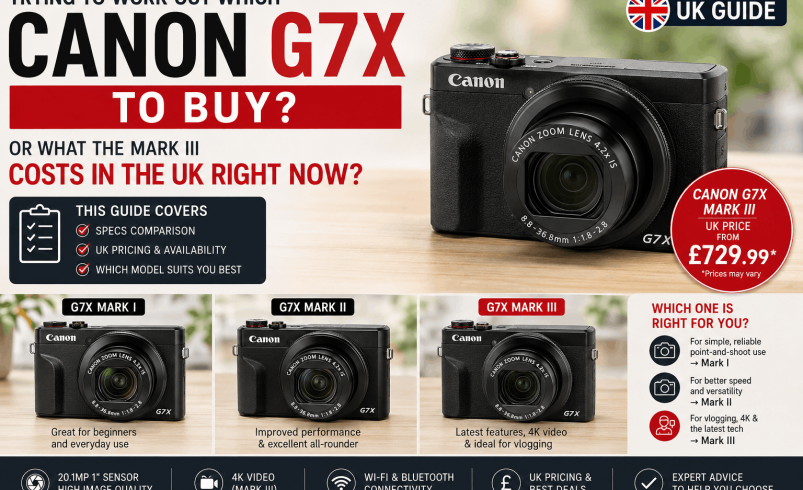
Searching for the Canon G7X usually means one of two things: you’re trying to buy one and can’t find it in stock, or you’re comparing the original, Mark II and Mark III and want to know which is worth the money. The current model, the G7X Mark III, costs £859.99 direct from Canon UK, though it’s frequently out of stock, and the older Mark II and original G7X are now secondhand-only options for most buyers.
This guide covers the specs of each version, current UK pricing, why the Mark III keeps selling out, and how the compact Canon G7X stands up against its main rivals, finishing with an FAQ for anything left unanswered.
Three versions exist: the original G7X from 2014, the Mark II from 2016, and the Mark III from 2019. Canon hasn’t announced a Mark IV, so the Mark III remains the current model.
For most buyers today, the Mark III is the sensible choice. It’s the only version with 4K video, Bluetooth and a microphone input, and Canon still officially lists it as an active product, meaning support and spare parts remain available.
The Mark II is worth considering only if you find one at a genuinely lower price than a Mark III and don’t need 4K or external audio. The original G7X is now largely a collector’s or budget secondhand option rather than a serious buy for new content creation. [Image: photo of Canon PowerShot G7X Mark III in hand, showing the flip-up screen — use royalty-free image from Unsplash or Pexels]
The Mark III is built around a 20.1-megapixel 1-inch stacked CMOS sensor paired with Canon’s DIGIC 8 processor, driving a 24-100mm equivalent f/1.8-2.8 lens with 4.2x optical zoom. That fast, bright aperture range is the main reason this camera still holds up against smartphones and cheaper compacts in low light.
Video is where the Mark III pulled ahead of its predecessor. It shoots 4K UHD at 30p, with a slight sensor crop, and Full HD at up to 120fps for slow motion, and it can live-stream directly to YouTube over Wi-Fi. A 3-inch touchscreen tilts a full 180 degrees for selfie and vlogging angles, and there’s a mic input for external audio, something the Mark II never had.
| Spec | Canon G7X Mark III |
| Sensor | 20.1MP 1-inch stacked CMOS |
| Processor | DIGIC 8 |
| Lens | 24-100mm equivalent, f/1.8-2.8, 4.2x optical zoom |
| Video | 4K UHD 30p (cropped), Full HD up to 120p |
| Screen | 3-inch touchscreen, tilts 180° |
| Connectivity | Wi-Fi, Bluetooth, mic input, USB-C |
| Battery life | Approx. 265 shots (CIPA), 320 in Eco mode, 300 min video playback |
| Weight | 304g including battery and card |
Burst shooting reaches up to 20fps in electronic shutter mode for JPEG, dropping to around 8fps with continuous autofocus enabled, and a dedicated RAW burst mode captures up to 30fps for short sequences. These figures come from Canon’s own published specifications, so treat any figure you see elsewhere with more caution.
Canon’s own UK store lists the G7X Mark III at £859.99, though at the time of writing it’s showing as out of stock online, which has been a recurring issue rather than a one-off. Other UK retailers have listed it anywhere from around £699 to £900 depending on stock levels and whether it’s a standard or special edition finish.
The Mark II shows an unusual pattern: some UK price comparison listings put it at £890, higher than the newer Mark III. This isn’t a pricing error. Both models have suffered supply shortages as compact camera demand has surged again, and older secondhand Mark II bodies have occasionally sold for more than their original retail price as a result.
The original G7X from 2014 is now secondhand-only and sells for well under either newer model in similar condition, though exact pricing varies a lot by seller and condition. Because all three models fluctuate with stock levels, check current listings directly with Canon UK or a trusted retailer before budgeting a fixed figure.
This is the question most guides skip, and it’s the one people searching for the G7X right now actually want answered. Compact cameras like the G7X saw a sharp resurgence in popularity as social media creators moved away from smartphone footage, and Canon’s production capacity hadn’t scaled for that level of demand.
Canon’s own support team has confirmed through its community forums that the Mark III remains an active product and that they’ve periodically run extra production to meet the ongoing demand, rather than treating it as discontinued. Even so, stock at major retailers, including Canon’s own UK store, has been inconsistent through 2025 and into 2026, with restocks often selling out within hours.
If you want one at close to RRP rather than an inflated marketplace price, the most reliable approach is to check Canon UK’s stock directly and sign up for back-in-stock alerts at major UK photography retailers, rather than relying on a single seller.
The Sony RX100 series and the Sony ZV-1 are the closest direct competitors to the G7X line, all built around a similar 1-inch sensor format in a pocketable body. Each brand takes a slightly different approach: Canon has leaned into vlogging-friendly features on the Mark III, including the flip screen, mic input and live streaming, while Sony’s range spans from stills-focused RX100 models to the video-first ZV-1.
Neither system is objectively better across the board, and the right choice depends on whether photo quality, video features, zoom range or price matters most to you. If you’re already invested in Canon lenses, accessories or the Canon Camera Connect app ecosystem, that’s often a stronger deciding factor than a spec sheet comparison. [Table: comparison of Canon G7X Mark III against Sony RX100 VII and Sony ZV-1, showing sensor, lens, video specs and UK price]
For anyone prioritising video quality, low-light performance and portability over a phone, yes, the Mark III still holds up well against current alternatives in its price bracket. The main compromise remains its modest 4.2x zoom range compared with superzoom compacts, which trade lens speed for much longer reach.
If your priority is a compact travel camera for photography rather than video, it’s worth comparing against Canon’s other current PowerShot models before committing, since the G7X line is optimised specifically for the vlogging and content-creator use case. For underwater photography, the G7X series has a long-standing reputation, and Canon-compatible underwater housings are made specifically for the Mark III’s body, a niche use case that’s genuinely well supported.
Q: Is the Canon G7X still worth buying in 2026? Yes, if video quality, a bright lens and a flip screen for vlogging matter to you. Its main limitation is a modest 4.2x zoom range, so photographers wanting a longer reach should look at superzoom compacts instead.
Q: Why is the Canon G7X Mark III always out of stock? Demand for compact cameras surged as content creators moved away from phone footage, and Canon’s production hadn’t scaled to match. Canon has confirmed the model remains active and periodically increases production, but stock at UK retailers, including Canon’s own store, remains inconsistent.
Q: What’s the difference between the G7X Mark II and Mark III? The Mark III adds 4K video, Bluetooth, a microphone input and live streaming to YouTube, none of which the Mark II has. Both share the same 1-inch sensor, lens specification and optical zoom range, so photo quality is broadly similar between them.
Q: How much does the Canon G7X Mark III cost in the UK? Canon UK lists it at £859.99, though it’s frequently out of stock. Other UK retailers have priced it from around £699 to £900 depending on stock and edition, so check current listings rather than relying on a fixed figure.
Q: Does the Canon G7X Mark III have 4K video? Yes, it records 4K UHD at 30p with a slight sensor crop, along with Full HD at up to 120fps for slow motion. This is the biggest video upgrade over the Mark II, which is limited to 1080p.
Q: Can I use an external microphone with the Canon G7X Mark III? Yes, it has a dedicated mic input, which the Mark II lacks entirely. This makes a real difference for vlogging and interview-style recording where built-in mic audio isn’t good enough.
Q: Is there a Canon G7X Mark IV? No, Canon hasn’t announced a Mark IV as of this guide’s last update. The Mark III, released in 2019, remains the current model in the line.
Q: How long does the Canon G7X Mark III battery last? Canon’s official CIPA rating is approximately 265 shots per charge, rising to around 320 in Eco mode, or about 300 minutes of continuous video playback. Real-world use, especially heavy video recording, will usually fall short of these lab figures.
Q: Is the Canon G7X good for underwater photography? It has a long-standing reputation for this, and dedicated underwater housings are made specifically for the Mark III’s body. Its compact size, fast lens and manual exposure controls make it a popular choice among underwater and travel photographers.
Q: What’s the difference between the Canon G7X and the Sony RX100? Both use a similar 1-inch sensor format in a pocketable body, but Canon’s G7X Mark III leans more towards vlogging with its mic input and flip screen, while Sony’s RX100 range spans stills-focused and video-first models. Neither is universally better, so the right pick depends on your priorities and existing camera ecosystem.