Is Hesgoal Illegal? The Real Risk and Legal Alternatives
- August 18, 2026
- 0
Is Hesgoal illegal? Yes. Hesgoal and its many mirror sites stream football and other sports without holding any broadcasting rights, which makes both running the site and, in
Is Hesgoal illegal? Yes. Hesgoal and its many mirror sites stream football and other sports without holding any broadcasting rights, which makes both running the site and, in
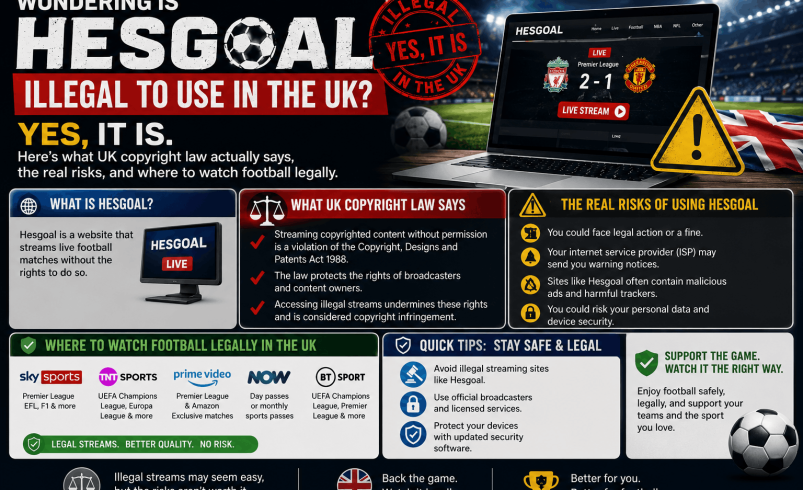
Is Hesgoal illegal? Yes. Hesgoal and its many mirror sites stream football and other sports without holding any broadcasting rights, which makes both running the site and, in some circumstances, watching it a breach of UK copyright law. This isn’t a grey area or a matter of opinion; it’s settled by the same law that covers pirated films, music and TV.
This piece explains what the law actually says, why Hesgoal-branded sites keep disappearing and reappearing, what the real risks are beyond a possible knock on the door, and where to watch football legally in the UK without paying for services you don’t need.
Hesgoal isn’t a single company or a single website; it’s a brand name that’s been reused across dozens of mirror domains and copycat sites for years. The original site, which launched in the late 2010s, built a large following by streaming Premier League, Champions League and other football without paying for any of the broadcasting rights involved.
Since then, domains using the Hesgoal name have been repeatedly taken down and replaced, and there’s no reliable way to know whether any current site using the name is connected to the original operators. What every version shares is the same core problem: none of them hold a licence to broadcast the football they’re streaming.
Yes. Under the Copyright, Designs and Patents Act 1988, communicating copyrighted content to the public without the rights holder’s permission is a criminal offence, and this is exactly what sites like Hesgoal do when they stream Premier League or Champions League football they don’t hold rights to. The Digital Economy Act 2017 raised the maximum penalty for this kind of online copyright infringement from 2 years to 10 years’ imprisonment, bringing it in line with physical piracy offences.
That maximum sentence targets people running or profiting from infringing sites, not casual viewers, and in practice UK enforcement against individual users watching an illegal stream is rare compared with action against the sites themselves. Even so, streaming from an unlicensed source is still an infringement of copyright, and the legal risk doesn’t disappear just because prosecutions of individual viewers are uncommon.
[Table: comparison of legal risk by activity, showing running a streaming site, uploading a stream, and watching a stream]
UK rights holders don’t rely only on criminal law. Since 2017, the Premier League has held a High Court blocking order each season under Section 97A of the Copyright, Designs and Patents Act 1988, requiring major UK ISPs including Sky, BT, Virgin Media, TalkTalk and EE to block servers streaming its matches without permission. The order works in real time, only taking effect while a match is being broadcast, and the list of blocked servers is refreshed every match week rather than staying fixed.
Rights holders have also pursued Hesgoal-branded sites directly. Legal filings and DMCA subpoenas have targeted the infrastructure providers behind various Hesgoal domains, including Cloudflare, in attempts to identify and shut down the people operating them. This is a large part of why Hesgoal mirrors keep disappearing and reappearing under slightly different domain names rather than settling on one permanent address.
Beyond the legal exposure, Hesgoal-style sites carry practical risks that have nothing to do with copyright law directly. Malicious pop-ups, fake “play” buttons and redirects are common on these sites, since the ad networks willing to work with unlicensed streaming pages tend to be far less selective about what they serve than mainstream advertisers.
Even setting aside the legal and security risks, unlicensed streams are usually a worse viewing experience than a paid alternative. Buffering, sudden drops mid-match, low resolution and streams that vanish entirely during a big game are common complaints, since these sites have no obligation to maintain any particular level of service.
Licensed broadcasters, by contrast, have direct contracts with the leagues involved and infrastructure built specifically to handle high-demand live events without falling over. That reliability is part of what you’re actually paying for with a legal subscription, not just the legal right to watch.
Every major competition shown on Hesgoal-style sites has a legitimate UK broadcaster with the actual rights to it. The main options are as follows.
| Competition | Legal UK broadcaster | Typical monthly cost |
| Most Premier League matches | Sky Sports (via Sky or NOW) | Roughly £30 to £45 depending on package |
| Champions League, Europa League, some Premier League | TNT Sports (via Discovery+ or Sky) | Roughly £30 a month |
| Selected fixtures and highlights | BBC iPlayer, ITVX | Free with a valid TV Licence |
| Selected fixtures | Amazon Prime Video | Included with a Prime subscription |
Prices for sports subscriptions change often and vary by provider, bundle and contract length, so treat the figures above as a general guide and check the current price directly on sky.com, discoveryplus.com or the relevant provider’s official site before subscribing. NOW offers a day-pass style Sports Membership if you only want to watch a single match rather than commit to a monthly subscription, which can work out cheaper for occasional viewers.
[Image: photo of someone watching a football match on a smart TV via a legal streaming app, use royalty-free image from Unsplash or Pexels]
If the full Sky Sports and TNT Sports combination feels expensive, there are ways to reduce the cost without breaking the law. Pausing a NOW TV membership during international breaks, when there’s no domestic football to watch, is one straightforward saving many fans overlook.
Watching at a pub or a supporters’ club is another legitimate option, since venues pay for a commercial licence that covers public screenings. This route also avoids any individual subscription cost entirely for anyone who’s happy to watch away from home.
Q: Is it illegal to watch Hesgoal in the UK? Watching content streamed without a licence is an infringement of UK copyright law, though in practice, enforcement action against individual viewers is far less common than action against the sites themselves. The Digital Economy Act 2017 set a maximum sentence of 10 years for online copyright infringement, which primarily targets people running or profiting from illegal streams rather than casual viewers.
Q: Has Hesgoal been shut down? The original Hesgoal site has faced repeated legal pressure, including DMCA subpoenas targeting its infrastructure providers, and has gone offline multiple times. New sites keep appearing under the same or similar names, but there’s no reliable way to confirm whether current Hesgoal-branded domains are run by the same people as the original.
Q: Can I get in trouble just for watching, not hosting, illegal streams? Watching an unlicensed stream is technically a copyright infringement, but UK enforcement has focused overwhelmingly on the operators of illegal streaming sites and devices rather than individual viewers. That said, “unlikely to be prosecuted” isn’t the same as “legal,” and the security risks from the site itself remain regardless of enforcement odds.
Q: What’s the cheapest legal way to watch Premier League football? NOW’s Sports Membership gives access to Sky Sports without a long-term contract, and pausing it during weeks without matches you care about can cut the cost further. Free-to-air coverage on BBC and ITV, plus occasional Amazon Prime Video fixtures, can also cover some matches at no extra cost if you already have those subscriptions.
Q: Are streaming devices with Hesgoal or similar apps pre-installed illegal to sell? Yes, selling devices specifically configured to access unlicensed streams is treated as facilitating copyright infringement under UK law, and sellers have faced prosecution and prison sentences for this. Buying such a device doesn’t automatically make the buyer liable in the same way, but Q: Why do illegal streaming sites keep coming back after being shut down? Operators can register a new domain quickly and cheaply, and the advertising revenue these sites generate can outweigh the legal risk for the people running them. Rights holders including the Premier League actively pursue new domains through court orders and subpoenas, but the process of identifying and blocking each new mirror takes time.
Q: Is using a VPN to access Hesgoal legal? A VPN itself is legal to use in the UK for privacy and security purposes, but it doesn’t change the legality of the content you’re accessing through it. Using a VPN to access an unlicensed stream doesn’t make that stream legal; it just makes using it to access illegal streams carries the same risks as visiting a site like Hesgoal directly.