DWP Payment Early Bank Holiday Weekend: What to Know
- August 18, 2026
- 0
If your DWP payment lands early over a bank holiday weekend, it’s because your normal payment date falls on a day when banks and government offices are closed,
If your DWP payment lands early over a bank holiday weekend, it’s because your normal payment date falls on a day when banks and government offices are closed,

If your DWP payment lands early over a bank holiday weekend, it’s because your normal payment date falls on a day when banks and government offices are closed, not because anything’s gone wrong. The Department for Work and Pensions moves the payment forward to the last working day before the bank holiday, and the amount you receive doesn’t change at all.
This piece explains exactly why this happens, which benefits it applies to, when the next bank holiday actually falls, and how to budget for the longer gap that follows an early payment.
Benefit payments are sent through the BACS banking system, which doesn’t process transfers on weekends or bank holidays because banks themselves are closed. Rather than delay your payment until the next working day after the holiday, the DWP shifts it earlier, to the last working day before the bank holiday, so you’re not left waiting past your usual date.
This is a longstanding, automatic rule rather than a new policy or a one-off gesture. It applies every time a scheduled benefit payment date coincides with a bank holiday or a weekend, anywhere in the UK, and it happens without you needing to contact the DWP or request anything.
The early payment rule applies to the full range of benefits and pensions paid directly into a bank, building society or credit union account. This includes the following.
Child Benefit and Tax Credits, administered by HMRC rather than DWP, follow a similar early-payment principle in most cases, though Northern Ireland has at least one instance where a Child Benefit date moves later rather than earlier around a regional holiday. If you’re unsure which rule applies to your specific benefit and region, GOV.UK’s payment date pages for each benefit confirm the exact adjusted date rather than leaving you to work it out from a general rule.
[Table: benefit payment frequency comparison showing Universal Credit, State Pension, PIP, and JSA payment cycles]
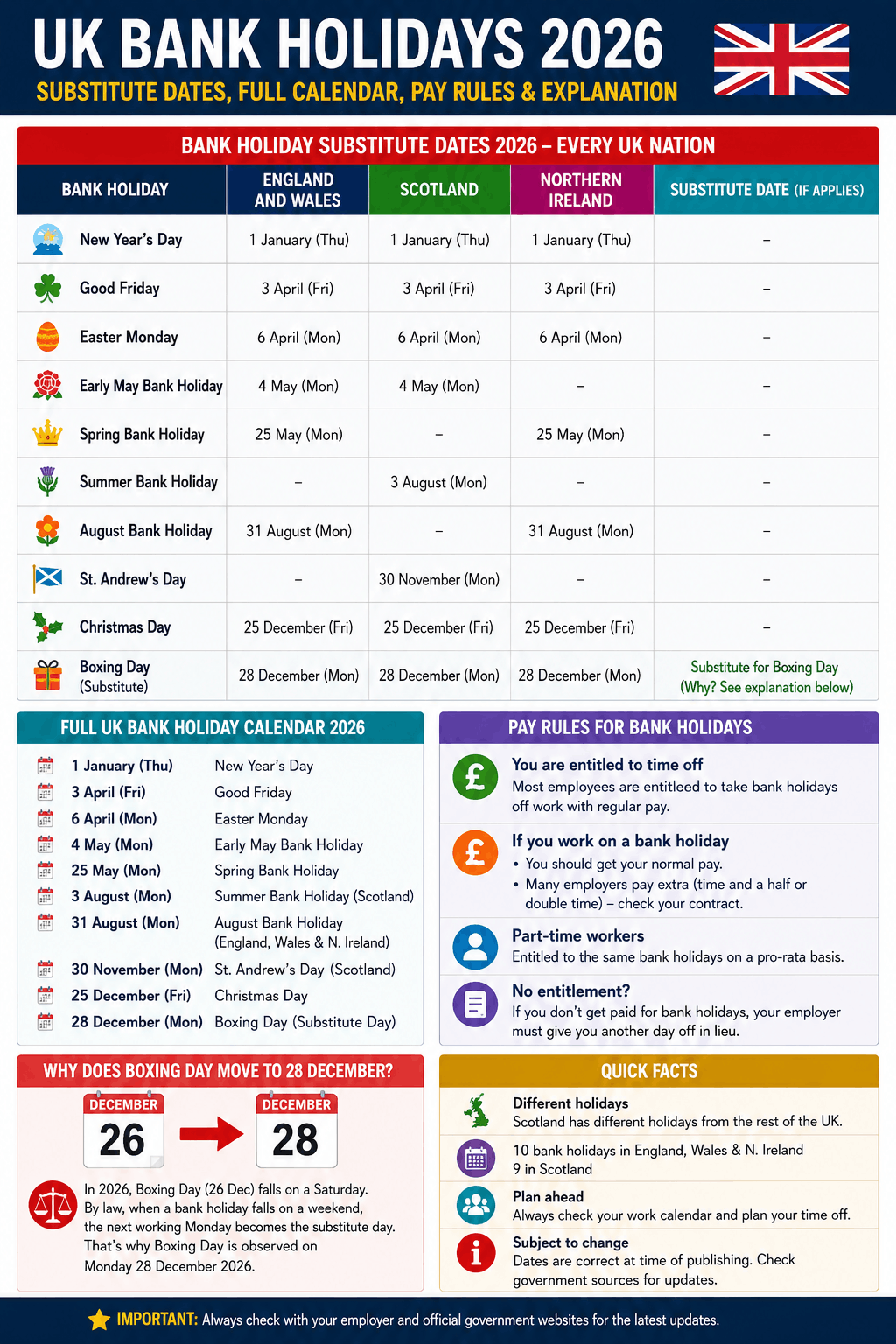
Scotland’s Summer Bank Holiday, on the first Monday of August, fell on 3 August 2026, so that one has already passed. The next bank holiday still ahead for the rest of the UK is the Summer Bank Holiday on Monday 31 August 2026, observed in England, Wales and Northern Ireland on the last Monday of August rather than the first.
Anyone with a benefit payment normally due on Monday 31 August should expect it on Friday 28 August 2026 instead, three days earlier than usual. This is the pattern to expect for any bank holiday: the payment moves to the last working day before it, which is typically the preceding Friday when the holiday itself falls on a Monday.
| Nation | Bank holiday | Date |
| England, Wales, Northern Ireland | Summer Bank Holiday | Monday 31 August 2026 |
| England, Wales, Scotland, Northern Ireland | Christmas Day | Friday 25 December 2026 |
| England, Wales, Scotland, Northern Ireland | Boxing Day (substitute day) | Monday 28 December 2026 |
Boxing Day itself falls on a Saturday in 2026, so the bank holiday is observed on the following Monday, 28 December, as a substitute day rather than on the calendar date. Christmas Day falls on a Friday, which means it doesn’t clash with a weekend and so doesn’t need a substitute date of its own.
[Image: screenshot of the GOV.UK bank holidays calendar page]
How far ahead your payment moves depends entirely on which day of the week the bank holiday falls on and where your payment date sits relative to it. A payment due on a bank holiday Monday typically arrives on the Friday before, three days early, while a payment due on a Tuesday bank holiday could move back further if a weekend sits in between as well.
There’s no fixed number of days that applies across every case; it’s simply whichever working day comes immediately before the closure. Checking your specific benefit’s payment calendar on GOV.UK is the only way to confirm the exact date for your situation rather than assuming a standard three-day shift applies every time.
Receiving your DWP payment early doesn’t add extra money to your account and doesn’t shift your entire payment schedule going forward. Your following payment still arrives on your normal, unadjusted date, which means the gap between this early payment and the next one is longer than your usual cycle.
For someone paid every four weeks, an early payment ahead of a bank holiday can stretch that particular gap to nearly five weeks before the next payment lands. This is the single most common source of confusion around bank holiday payments: people assume they’ve somehow gained extra money, when in fact they’ve simply been paid the same amount slightly ahead of schedule.
Treat an early payment as your normal amount arriving a few days ahead, not as a bonus to spend differently. Setting aside the portion that covers the extra days before your next payment, rather than spending the full amount as if it’s a typical payment cycle, avoids a shortfall in the final stretch before the next payment lands.
Direct debits and standing orders set up around your usual payment date can also cause confusion during this period. Bills timed to come out a few days after your normal payday might now be collected before your early payment even reflects in your available balance, so it’s worth checking your direct debit dates against the adjusted payment date rather than assuming they’ll line up as usual.
If your payment hasn’t reached your account by the adjusted date, check your bank’s own processing times first, since some banks post BACS payments slightly later in the day than others even on the correct date. If it’s genuinely missing once the working day has passed, contact the office that handles your specific benefit directly rather than a general DWP number, since payment queries are usually routed by benefit type.
Have your National Insurance number ready before you call, since this speeds up identifying your claim regardless of which benefit you’re asking about.
Universal Credit is paid monthly based on your individual assessment period, which means your specific payment date is tied to when you first claimed rather than a fixed calendar date shared with everyone else. This makes it slightly less predictable than benefits with a shared payment day, since two claimants can have entirely different dates depending on when their assessment period started.
The same early payment rule still applies regardless of your personal assessment period. If your Universal Credit payment date happens to fall on a bank holiday or a weekend, it moves to the last working day before it, exactly as it would for any other affected benefit, with your following assessment period and payment date continuing on your usual monthly cycle afterward.
Q: Why is my DWP payment early this bank holiday weekend? Your payment is early because your normal payment date falls on a day when the BACS banking system doesn’t process transfers, either a bank holiday or a weekend. The DWP automatically moves it to the last working day before that closure so you’re not left waiting past your usual date.
Q: Does an early DWP payment mean I’m getting extra money? No, an early payment is your normal entitlement arriving ahead of schedule, not an additional payment. Your following payment date doesn’t change, which creates a longer than usual gap until your next payment lands.
Q: When is the next bank holiday in the UK? As of early August 2026, Scotland’s Summer Bank Holiday on 3 August has already passed, and the next bank holiday for England, Wales and Northern Ireland is the Summer Bank Holiday on Monday 31 August 2026. After that, the next UK-wide bank holiday is Christmas Day on Friday 25 December 2026.
Q: Do I need to apply for my DWP payment to be paid early? No, the adjustment happens automatically for every affected claimant without any application or request needed. GOV.UK’s payment calendars for each benefit show the adjusted dates directly, so you can check yours without contacting the DWP.
Q: Does Universal Credit move early for bank holidays the same way as other benefits? Yes, Universal Credit follows the same rule as other DWP benefits: if your assessment period’s payment date falls on a bank holiday or weekend, it moves to the last working day before it. Your following assessment period and payment date then continue on your normal monthly cycle.
Q: What happens if my rent or bills are due around an early bank holiday payment? Direct debits and standing orders typically still process on their originally scheduled date, which may now fall before or shortly after your early payment lands rather than in its usual position relative to your payday. Checking your bill dates against your adjusted payment date ahead of time avoids a gap where a bill is collected before the funds are available.
Q: Are Scotland and Northern Ireland’s bank holiday payment dates different from England and Wales? Yes, Scotland and Northern Ireland observe some additional regional bank holidays beyond the ones shared with England and Wales, including Scotland’s earlier Summer Bank Holiday date and Northern Ireland’s Battle of the Boyne holiday in July. Any DWP payment due on one of these regional dates moves early using the same rule, even where England and Wales aren’t affected that day.