
 Haris
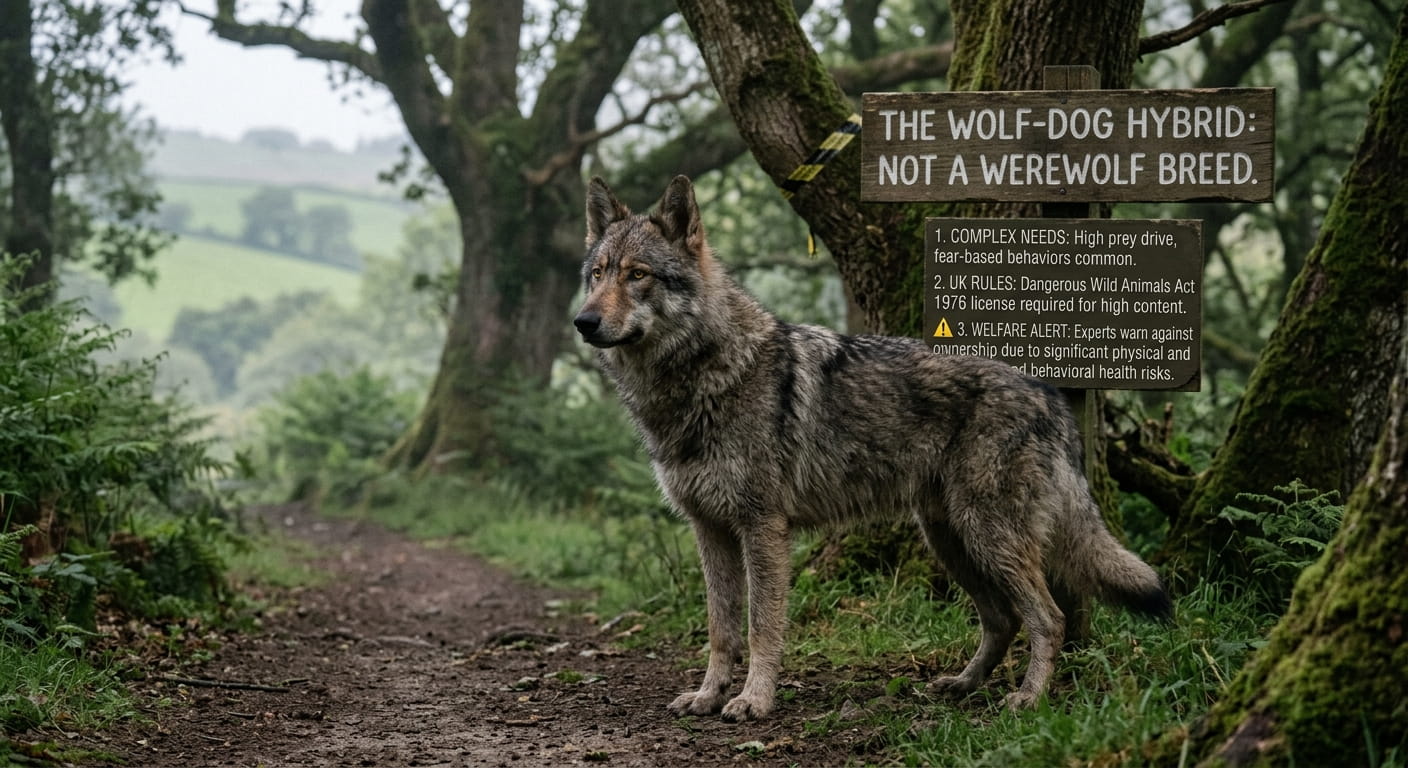
A werewolf dog is not a recognised breed. The phrase is used in two main ways: informally, to describe dogs that look wolf-like, and more seriously, to refer to wolf-dog hybrids, animals with recent wolf ancestry. In the UK, the legal status of these animals depends on how many generations they are from a wolf, and the welfare concerns are substantial. This article explains what people mean by “werewolf dog”, what UK law says, and why the label deserves more caution than excitement.
What People Mean by “Werewolf Dog”
The term is not scientific. It appears mostly in three contexts.
First, it is a casual description of domestic breeds with wolfish features. The Czechoslovakian Vlcak, the Saarloos Wolfdog, and the Lycan Shepherd are examples of breeds or designer crosses that people call “werewolf dogs” because of their appearance . These are fully domestic dogs, bred over generations, and are not wolves.
Second, it refers to genuine wolf-dog hybrids, sometimes called wolfdogs. These are animals with a wolf parent or grandparent, or with recent wolf ancestry in their line . A DNA test on three animals at a Wiltshire sanctuary, reported by the BBC in January 2026, found them to be 49.1 per cent grey wolf and 50.9 per cent Czechoslovakian Vlcak . That is the kind of animal the term most accurately describes.
Third, it is used as marketing. Breeders and sellers sometimes lean on the “werewolf” image to make a dog seem exotic, rare, or powerful. The Pet Advertising Advisory Group, a UK body that monitors pet sales, has raised concerns that wolf hybrids “could be purchased for the wrong reasons or by persons unaware of their typically more complex welfare needs” .
The UK Legal Position: It Depends on Generations
This is the part that matters most for anyone in the UK considering one of these animals.
The Dangerous Wild Animals Act 1976 controls the keeping of certain wild species, including wolves. It also covers hybrids where at least one parent is a listed species . In practice, this means a wolf-dog hybrid with a direct wolf parent or grandparent falls under the Act.
The BBC, citing the PDSA, reported in January 2026 that in the UK, wolf-dogs are legal to own as long as they are three generations away from the original parent wolf. First and second generation wolf-dogs that have one direct wolf parent require a licence to own and are classed as exotic animals .
The Pet Advertising Advisory Group states the position slightly differently, referring to hybrids “up to the F2 generation” requiring a licence to own and sell . The precise boundary matters if you are buying or selling, and it is worth checking with your local authority before any transaction.
Why the Generation Rule Is Problematic
Gary Barrington, of the Wolves of Wiltshire sanctuary, told the BBC that the law was “a bit of a problem” because it focuses on generations rather than the percentage of wolf DNA. He warned that irresponsible breeders were producing animals with high wolf DNA content that are “perfectly legal on paper” .
That is a significant loophole. An animal several generations removed from a wolf might still carry a high proportion of wolf genetics through backbreeding, but the law looks at the family tree, not a DNA test. A buyer relying on the generation rule alone could end up with an animal far more wolf-like in behaviour than expected.
Why Wolf-Dog Hybrids Are Not Like Other Dogs
The welfare case against keeping wolf-dogs as pets is not about breed prejudice. It is about what the animals need.
Wolves are wild animals. Domestication took thousands of years, and a hybrid does not simply inherit the domesticated traits of its dog parent. The Calgary Humane Society, in a position paper, states that interbreeding “negates 12,000 years of domestication, resulting in offspring that are difficult to train, do not kennel well and show a high incidence of both predatory and aggressive behaviour” .
Practical problems include:
- Escape behaviour. The Saarloos Wolfdog, a breed with wolf ancestry, is described as capable of climbing two-metre fences and digging under barriers unless they are sunk at least half a metre into the ground .
- Socialisation difficulties. Wolf-dogs are often shy or fearful rather than aggressive, but fear-based behaviour is harder to manage and can escalate. The BBC report noted that the Wiltshire animals needed “highly experienced handlers who have not only worked with dogs, but also wolves” .
- Unsuitability as family pets. The same BBC report stated plainly that wolf-dogs “did not make suitable family pets” .
A Scottish SPCA case from March 2026 illustrates the consequences when things go wrong. Graham McQuet, of Grangemouth, was banned from keeping animals for five years and fined £2,075 after failing to meet the needs of six wolfdogs. One animal died of malnutrition, another had an untreated wound from a shock collar, and the surviving animals were described by the sanctuary that took them in as “unsocialised, terrified, injured and in poor body condition” . The wolfdogs in that case had up to 98 per cent wolf DNA and had been imported from Russia and Eastern Europe .
If You Are Looking for a Wolf-Like Dog
The safer path is a domestic breed or cross that has been bred for companion life, not an animal with recent wolf ancestry.
The Czechoslovakian Vlcak is a recognised breed with a wolf-like appearance, though it is still demanding and not suited to inexperienced owners. The Saarloos Wolfdog is similar: it is a domestic breed with wolf ancestry, but sources consistently warn that it needs experienced handling and is not a beginner’s dog . The Lycan Shepherd is a newer designer cross of German Shepherd, Belgian Malinois and Blue Bay Shepherd lines, and is not recognised by major kennel clubs .
None of these are “werewolf dogs” in any literal sense. They are dogs. The distinction matters because the legal and welfare implications of owning a genuine wolf hybrid are entirely different.
A Note on the Word “Werewolf”
It is worth separating the folklore from the animal. A werewolf is a creature of myth, a human who transforms into a wolf. No dog is a werewolf. Using the term for a pet is a shorthand for appearance, not a description of what the animal is. When a seller uses “werewolf dog” as a selling point, treat it as a marketing phrase rather than a breed label, and ask for the animal’s actual lineage and any relevant paperwork.
Frequently Asked Questions
What is a werewolf dog?
“Werewolf dog” is an informal term, not a breed. It usually describes dogs that look wolf-like, such as the Czechoslovakian Vlcak, or genuine wolf-dog hybrids with recent wolf ancestry. In the UK, the legal status of a wolf hybrid depends on its generations from a wolf, and first or second generation animals typically require a Dangerous Wild Animals Act licence.
Are wolf-dog hybrids legal in the UK?
Wolf-dogs three or more generations from a wolf are generally legal to own without a Dangerous Wild Animals Act licence, according to the PDSA as reported by the BBC in January 2026 . First and second generation hybrids with a direct wolf parent require a licence from the local authority. The generation rule has been criticised because it does not account for wolf DNA percentage .
Do wolf-dogs make good pets?
No. Wolf-dogs are not domesticated in the way dogs are, and reputable animal welfare organisations consistently advise against keeping them as pets. The Calgary Humane Society states that hybrids show a high incidence of predatory and aggressive behaviour and are difficult to train . UK sanctuaries and the BBC have said they are not suitable family pets and need expert handling .
What is the closest dog to a wolf?
The Czechoslovakian Vlcak and the Saarloos Wolfdog are domestic breeds with wolf ancestry and a wolf-like appearance. Neither is a wolf, and both are demanding animals that require experienced owners. Genuine wolf-dog hybrids, which have a recent wolf parent or grandparent, are closer genetically but are not suitable as ordinary pets and may require a licence in the UK.
A Practical Reminder
If you see a dog advertised as a “werewolf dog”, ask what the seller actually means. If they mean a wolf-like domestic breed, check that the breed suits your experience and home. If they mean a wolf hybrid, check the animal’s legal status with your local authority and think hard about whether you can meet its needs. The term sounds dramatic. The reality of owning a wolf hybrid is considerably harder than the word suggests.