 Haris
Haris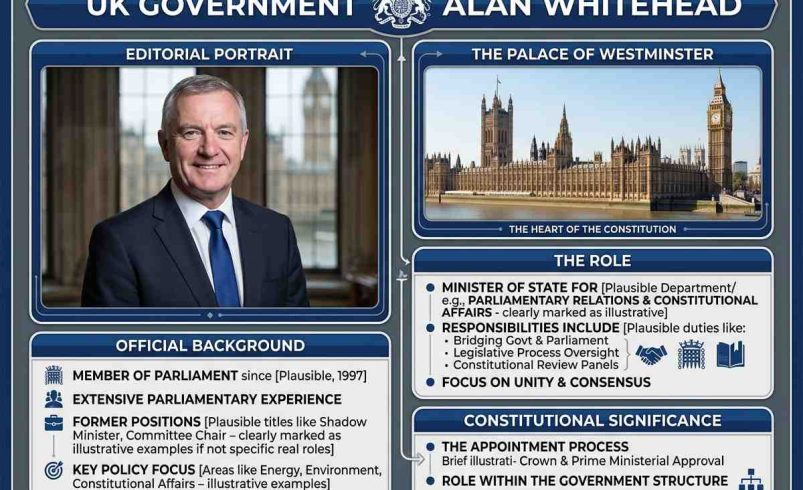
When you search for “king approves alan whitehead appointment”, you want to understand what this formal announcement actually means. The King approved Dr Alan Whitehead CBE’s appointment as Minister of State in the Department for Energy Security and Net Zero on 11 November 2025. This required him to receive a life peerage so he could sit in the House of Lords while holding ministerial office. In this guide, we explain the appointment process, Whitehead’s specific responsibilities, why a peerage was necessary, and what happened during his eight months in government.
The Appointment Explained
The phrase “The King has been pleased to approve” appears in official government announcements whenever a new minister takes office. This is not optional wording. It reflects the constitutional reality that all ministers are formally appointed by the monarch, acting on the advice of the prime minister.
When Did the King Approve Alan Whitehead’s Appointment?
The official announcement came from 10 Downing Street on 11 November 2025. This was the date Whitehead’s appointment as Minister of State became effective. He served in this role until 21 July 2026, when he was removed from the position.
The timing mattered. Whitehead had stood down as MP for Southampton Test at the July 2024 general election after 27 years in the Commons. Without a seat in Parliament, he could not hold ministerial office unless he joined the House of Lords. The peerage nomination announced alongside his ministerial appointment solved this problem.
What Role Did Alan Whitehead Take On?
Whitehead became Minister of State in the Department for Energy Security and Net Zero (DESNZ). This is a mid-tier ministerial position, senior to parliamentary under-secretaries but junior to the secretary of state. At the time of his appointment, Ed Miliband served as Secretary of State for Energy Security and Net Zero.
The DESNZ department handles UK energy security, protects billpayers and drives progress towards net zero emissions. As Minister of State, Whitehead took responsibility for specific policy areas within this broad remit.
Why Alan Whitehead Needed a Peerage
Ministers must be members of either the House of Commons or the House of Lords. Since Whitehead had left the Commons in 2024, he needed to join the Lords to take up his ministerial post. The solution was a life peerage.
What Is a Life Peerage?
A life peerage is an honour that grants someone membership of the House of Lords for their lifetime. Unlike hereditary peerages, life peerages cannot be passed on to children. The Prime Minister nominates individuals for life peerages, and the King formally confers them.
Life peers must be British, Irish or Commonwealth citizens with UK residency. They must pay taxes in the UK and be at least 21 years old. Once created, they receive a Writ of Summons from the Clerk of the Crown, which allows them to take their seat in the House of Lords.
Baron Whitehead of Saint Mary’s
Whitehead was created Baron Whitehead, of Saint Mary’s in the City of Southampton, on 19 November 2025. This was eight days after his ministerial appointment took effect. The title references Saint Mary’s Stadium, home ground of Southampton FC, and acknowledges his long connection to the city where he served as MP and council leader.
His full formal title became The Lord Whitehead CBE. The CBE (Commander of the Order of the British Empire) was an earlier honour he had received for public service.
[Table: Timeline of Alan Whitehead’s appointment showing key dates from November 2025 to July 2026]
| Date | Event |
| 11 November 2025 | Appointment as Minister of State announced and effective |
| 19 November 2025 | Created Baron Whitehead, of Saint Mary’s in the City of Southampton |
| 21 July 2026 | End of tenure; removed from position |
Understanding the Minister of State Role
Not all government ministers hold the same rank. Understanding where Minister of State fits helps explain Whitehead’s actual authority and responsibilities.
Where Does a Minister of State Rank in Government?
The UK government has three main tiers of ministers. Secretaries of State sit at the top, leading entire departments and sitting in Cabinet. Ministers of State form the second tier, taking charge of particular policy areas within their department. Parliamentary Under-Secretaries of State make up the third tier, handling more specific delegated duties.
Whitehead ranked below Ed Miliband (Secretary of State) but above the parliamentary under-secretaries in DESNZ. His position gave him significant policy responsibility within his assigned brief, though ultimate accountability rested with the secretary of state.
How Ministers Are Appointed in the UK
The appointment process follows a set pattern. The Prime Minister decides who should hold each ministerial post. The King then formally appoints them on the prime minister’s advice. Some senior ministers receive seals of office from the King, completing the ceremonial aspect of their appointment.
Ministers can come from either house of Parliament. This flexibility allows prime ministers to bring experienced figures into government even if they do not currently hold an elected seat. Whitehead’s case demonstrates this principle in action.
The legal maximum number of paid ministers is set by the Ministerial and other Salaries Act 1975. This was amended in April 2026 to increase the limit from 109 to 120 paid ministers. As of August 2026, there are 150 ministerial posts held by 125 people, with some individuals holding multiple roles.
Alan Whitehead’s Responsibilities as Minister
The Department for Energy Security and Net Zero published Whitehead’s specific portfolio when he took office. His responsibilities covered both technical energy policy and parliamentary duties.
Biomethane, Tidal and Geothermal Energy
Whitehead held responsibility for three renewable energy technologies: biomethane, tidal energy and geothermal technologies. These are all lower-carbon alternatives to fossil fuels, though each faces different development challenges in the UK.
Biomethane is produced from organic waste through anaerobic digestion. It can be injected into the existing gas grid, making it a practical transition fuel. Tidal energy harnesses the power of ocean tides, offering predictable generation but requiring significant infrastructure investment. Geothermal technology extracts heat from underground sources, providing consistent baseload power.
Whitehead brought relevant experience to these briefs. During his time as Leader of Southampton City Council from 1984 to 1992, he championed innovative energy projects including geothermal heating for the Civic Centre. This made him one of the few UK politicians with hands-on experience delivering geothermal infrastructure.
He also held responsibility for individual planning decisions related to energy projects. This gave him direct input on whether specific developments received approval, a powerful tool for shaping the energy landscape.
House of Lords Business
As a Lords minister, Whitehead handled all departmental business in the House of Lords. This meant answering questions from peers, guiding legislation through the upper chamber, and representing the government’s position on energy matters during debates.
Lords ministers play a crucial role in the legislative process. Bills must pass through both houses of Parliament, and having an informed minister in the Lords ensures the government can defend its policies effectively. Whitehead’s deep knowledge of energy policy made him well-suited to this task.
Lord Vallance of Balham served alongside Whitehead as Minister of State for Science, Innovation, Research and Nuclear. Vallance retained responsibility for nuclear power, fusion, science and innovation for climate and energy, and AI in the energy sector. This division of labour allowed both ministers to focus on their respective specialisms.
[Table: Comparison of DESNZ ministerial responsibilities showing Whitehead’s portfolio versus other ministers]
| Minister | Portfolio |
| Alan Whitehead (Minister of State) | Biomethane, tidal, geothermal energy; planning decisions; Lords business |
| Lord Vallance of Balham (Minister of State) | Nuclear power, fusion, science and innovation for climate and energy, AI in energy sector |
| Ed Miliband (Secretary of State) | Overall DESNZ leadership and cabinet responsibility |
Alan Whitehead’s Background and Experience
Whitehead did not arrive in government as a novice. His career spanned local politics, academia and nearly three decades in Parliament.
Parliamentary Career Before 2025
Alan Patrick Vincent Whitehead was born on 15 September 1950. He studied Politics and Philosophy at the University of Southampton, later earning a PhD in Political Science from the same institution.
He first entered Parliament in 1997 as Labour MP for Southampton Test. He held this seat through seven general elections, stepping down only in May 2024. During his time in the Commons, he built a reputation as an energy specialist.
Whitehead served as Parliamentary Under-Secretary in the Department of Transport, Local Government and Regions from 2001 to 2002. He later joined the Energy and Climate Change Select Committee from 2009 to 2015. From 2016 to 2024, he served as Shadow Minister for Energy Security. This lengthy period in opposition allowed him to develop detailed policy positions without the constraints of government office.
Local Government and Academic Work
Before entering Parliament, Whitehead held several significant roles. He worked as Director of OUTSET charity from 1979 to 1982, then joined BIIT charity where he served as director from 1983 to 1992.
His local political career began when he was elected to Southampton City Council in 1980. He became Leader of the Council in 1984, holding the position until 1992. During this period, he pushed forward the geothermal heating project for Southampton’s Civic Centre, demonstrating early commitment to renewable energy.
In 1992, he became Professor of Public Policy and Administration at Southampton Institute. This academic background informed his approach to policy-making throughout his political career.
After leaving Parliament in 2024, Whitehead joined Energy Systems Catapult as a Non-Executive Director. This role kept him engaged with energy policy during the year between his departure from the Commons and his return to government.
What Happened After July 2026?
Whitehead’s tenure as Minister of State ended on 21 July 2026. This coincided with a broader cabinet reshuffle that saw Miatta Fahnbulleh appointed as the new Secretary of State for Energy Security and Net Zero.
End of Tenure and Succession
Baroness Curran succeeded Whitehead as Minister of State in the Department for Energy Security and Net Zero. She had previously held the role briefly in 2025 before Whitehead’s appointment. Her return marked a restoration of the previous arrangement.
The reasons for Whitehead’s departure were not publicly detailed. Ministerial reshuffles occur regularly as prime ministers adjust their teams to reflect changing priorities or respond to political pressures. Whitehead served for approximately eight months and 10 days in the role.
Despite leaving ministerial office, Whitehead remains a member of the House of Lords as Baron Whitehead. He continues to participate in parliamentary debates and can contribute to energy policy discussions from the backbenches.
Frequently Asked Questions
Q: What does “the King has been pleased to approve” mean?
This is standard constitutional language used in all ministerial appointments. The King formally appoints ministers on the advice of the prime minister. The phrase reflects the monarch’s ceremonial role in the appointment process rather than personal discretion.
Q: Why did Alan Whitehead need a peerage to become a minister?
Ministers must be members of either the House of Commons or the House of Lords. Whitehead had stepped down as an MP in 2024, so he needed to join the Lords to hold ministerial office. A life peerage granted him membership of the House of Lords for life.
Q: What is the difference between a Minister of State and a Secretary of State?
A Secretary of State leads an entire government department and sits in Cabinet. A Minister of State is a junior minister who handles specific policy areas within a department. Secretaries of State hold ultimate accountability, while Ministers of State manage delegated responsibilities.
Q: How long did Alan Whitehead serve as Minister of State?
Whitehead served from 11 November 2025 to 21 July 2026, a period of approximately eight months. He was appointed following the July 2024 general election and left during a cabinet reshuffle in July 2026.
Q: What energy technologies was Alan Whitehead responsible for?
His portfolio included biomethane, tidal energy and geothermal technologies. He also handled individual planning decisions for energy projects and all departmental business in the House of Lords.
Q: Can life peerages be inherited?
No. Life peerages end when the holder dies and cannot be passed to children or other relatives. This distinguishes them from hereditary peerages, which follow family lines. Only life peerages have been created since the Life Peerages Act 1958.
Q: Who replaced Alan Whitehead as Minister of State?
Baroness Curran succeeded Whitehead in the role. She had previously held the position briefly in 2025 before Whitehead’s appointment. Her return followed the July 2026 cabinet reshuffle.
Q: What did Alan Whitehead do before becoming an MP?
He worked in the charity sector as Director of OUTSET and later BIIT. He served on Southampton City Council from 1980 to 1992, becoming Council Leader in 1984. He also became Professor of Public Policy and Administration at Southampton Institute in 1992.