
 Haris
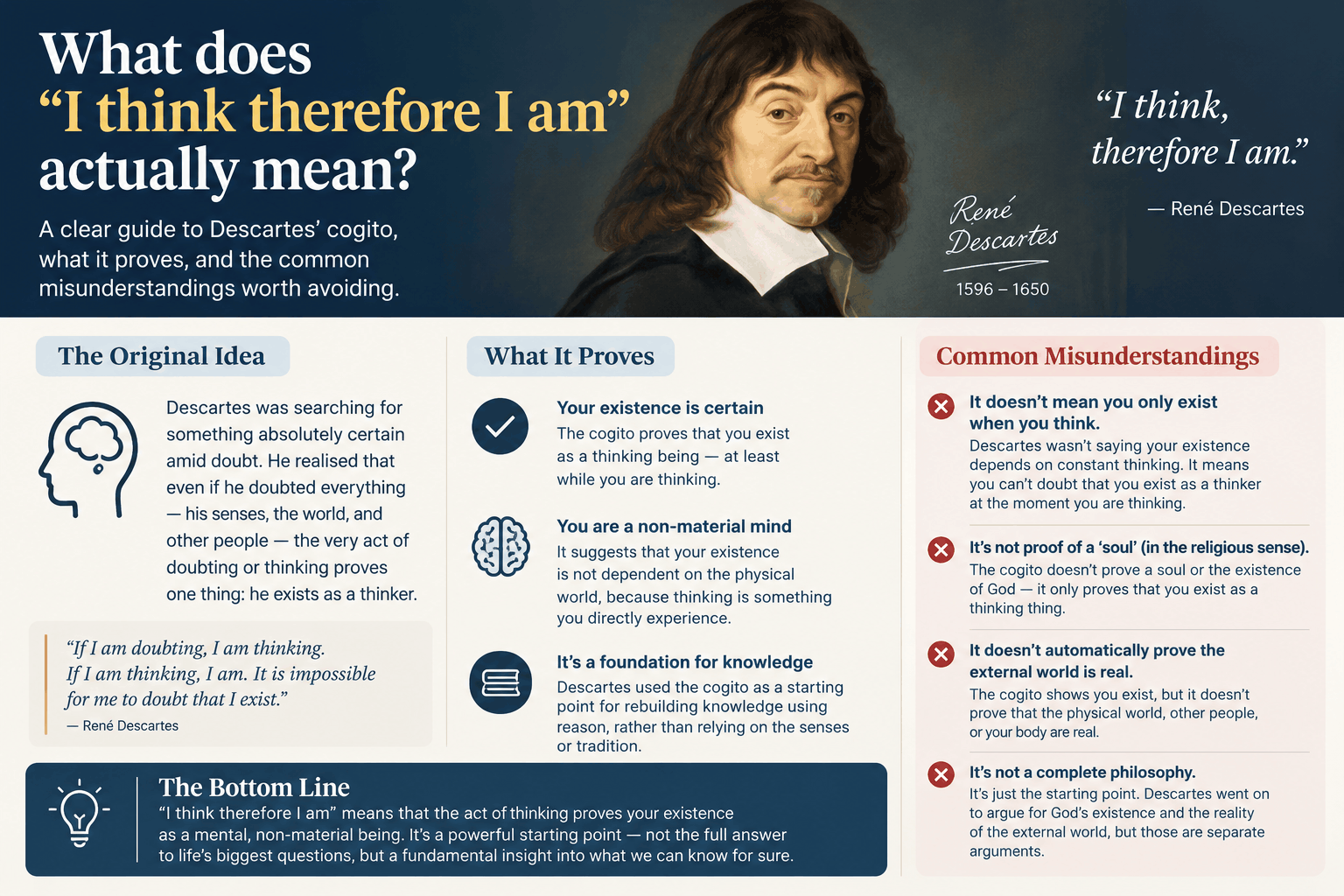
“I think therefore I am” is the English translation of the Latin phrase cogito ergo sum, the foundational principle of René Descartes’ philosophy. It means that the very act of thinking, or even doubting, proves that a thinking entity must exist. You cannot doubt your own existence without existing to do the doubting. This article explains the argument in plain English, separates what Descartes actually claimed from common misunderstandings, and shows why a seventeenth-century French philosopher’s reasoning still surfaces in debates about certainty, artificial intelligence, and consciousness today.
The Argument in Plain English
Descartes was not making a casual observation about self-awareness. He was trying to find something that could not be doubted, a foundation on which to build reliable knowledge.
His method was radical. He would doubt everything that could possibly be doubted, stripping away opinions until only something indubitable remained. The senses can deceive, so he set aside what they tell him. Dreams can feel real, so he questioned whether he was awake. He even imagined a powerful deceiver capable of planting false beliefs in his mind.
The breakthrough came when he noticed that the act of doubting itself could not be doubted. To doubt is to think. And if he is thinking, he must exist, at least as a thinking thing. The Stanford Encyclopedia of Philosophy describes this as the point where Descartes found a principle that survives even the most extreme sceptical scenario .
What “Think” Means Here
Descartes used “think” in a very broad sense. It covers understanding, willing, imagining, and even sensory awareness. In his Principles of Philosophy, he wrote that by “thought” he means everything of which we are aware as happening within us, insofar as we have awareness of it . So doubting, hoping, seeing, and feeling all count as thinking in his framework.
This matters because it widens the base of the argument. You do not need to be engaged in high-level reasoning to prove you exist. The simple fact of being conscious of anything at all is enough.
What Descartes Did Not Claim
Several popular misunderstandings cling to the phrase, and they are worth clearing up.
It Is Not “I Think, Therefore I Am Great” or “I Am Right”
The argument does not claim that whatever you think is true. It does not even claim that your thoughts are accurate. Descartes was acutely aware that people make mistakes in reasoning and that the senses sometimes mislead. The cogito establishes only one thing: that a thinking subject exists. It says nothing about the reliability of that subject’s particular beliefs .
It Is Not a Syllogism
Some critics, including Descartes’ contemporary Pierre Gassendi, objected that the argument was a hidden syllogism: “Whatever thinks exists; I think; therefore I exist.” If it were a syllogism, it would depend on a major premise that itself needs justification, and the whole thing would be less certain than it appears.
Descartes rejected this reading. He insisted that the cogito is not a deduction from premises but a simple, self-evident intuition. The certainty of “I exist” is not inferred from “I think” in the way a conclusion follows from premises. It is grasped immediately, in a single act of awareness .
The Doubting Game and Its Limits
The cogito is best understood as the first move in a larger project. Descartes did not stop at proving his own existence. He went on to argue for the existence of God and the reliability of clear and distinct ideas, hoping to rebuild knowledge on secure foundations.
Whether that larger project succeeds is a separate question. Many philosophers have argued that Descartes could not escape the circle of relying on God to guarantee the very faculties he used to prove God. But the cogito itself has proved remarkably resilient.
The Memory Objection
One persistent criticism is that by the time you say “therefore I am”, the moment of thinking has passed, and you are relying on memory, which could be faulty . Descartes’ response, broadly, was that the certainty is not about a past moment but about the present act of awareness. As long as you are thinking now, the existence claim holds now.
Whether that fully answers the objection is debatable. But it highlights something important: the cogito is not a proof you can put in your pocket and carry around. It is a truth that is evident in the moment of thinking, and its force depends on that immediacy.
Why It Still Matters
The phrase survives not because everyone agrees with Descartes but because it marks a turning point in how philosophy approaches knowledge.
Before Descartes, the question was often “What is the world like?” After Descartes, the question became “What can I know, and how can I know it?” The shift toward the knowing subject, the “I” at the centre of inquiry, shaped modern philosophy. Whether later thinkers accepted, rejected, or tried to dismantle Descartes’ answer, they were responding to the problem he framed.
There is also a practical dimension. The cogito offers a template for thinking about certainty in any field. What is the smallest, most indubitable claim you can make? What survives when everything questionable is set aside? That habit of mind, more than the specific conclusion, is Descartes’ lasting contribution.
A Note on the Phrase Itself
Descartes wrote in French and Latin. The French formulation, je pense donc je suis, appears in the Discourse on the Method, published in 1637. The Latin cogito ergo sum appears in the Principles of Philosophy in 1644. The English “I think therefore I am” is a translation, and like all translations it carries slight shifts in emphasis.
The phrase is sometimes written with commas, sometimes without. There is no single definitive punctuation. What matters is the relationship between the two claims: thinking implies existence.
Frequently Asked Questions
What does “I think therefore I am” mean?
It means that the act of thinking proves your existence. Even if everything else is doubted, the fact that you are doubting or thinking cannot itself be doubted, because doubting requires a thinker. Descartes used this as the foundation for certain knowledge, arguing that it was the one truth that survived radical scepticism.
Did Descartes actually say “I think therefore I am”?
He wrote it in French as je pense donc je suis in the Discourse on the Method (1637) and in Latin as cogito ergo sum in the Principles of Philosophy (1644). The English version is a translation. The idea also appears in his Meditations on First Philosophy, though the exact phrase is not used there in the same form.
Why did Descartes doubt everything?
He wanted to find a foundation for knowledge that could not be shaken by any possible doubt. By setting aside everything that could conceivably be false, including sensory information and mathematical truths under the hypothesis of a deceiving demon, he hoped to find something absolutely certain. The cogito was what remained.
Is “I think therefore I am” a logical argument?
Descartes insisted it was not a syllogism but a self-evident intuition. The certainty of “I exist” is not inferred from a premise but grasped immediately in the act of thinking. Critics have questioned whether this distinction holds, but Descartes’ own view was that the cogito is not a piece of reasoning but a direct insight.