 Haris
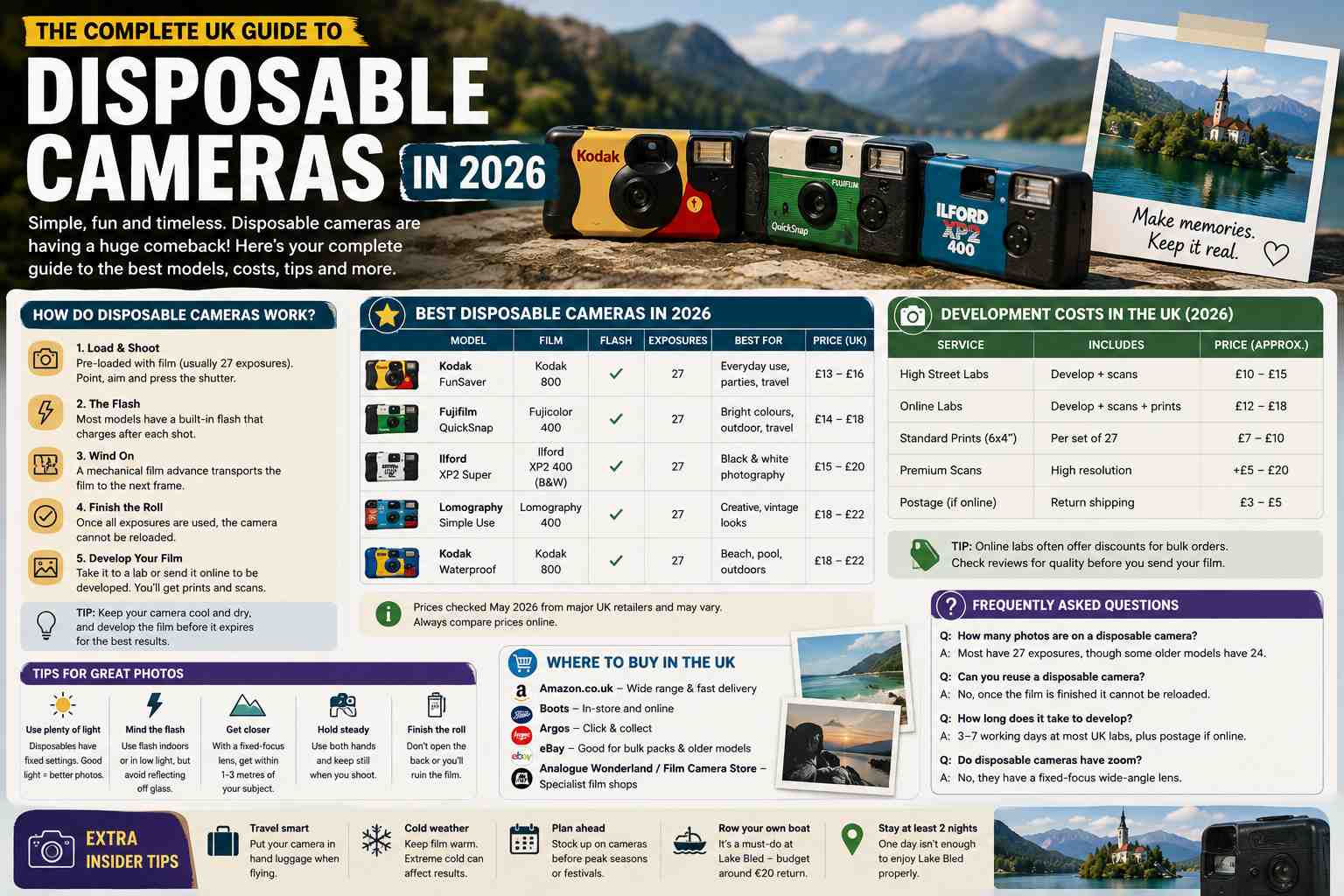
So, you have seen disposable cameras popping up at weddings, festivals, and even in the hands of celebrities, and you are wondering if they are actually worth buying in 2026. The short answer is yes, but you need to know what you are getting into before you start snapping.
Disposable cameras are single-use film cameras that come pre-loaded with 35mm film. In this guide, we will cover the best models available in the UK, how much they cost, how to use them properly, where to get your film developed, and the common mistakes that ruin your photos.
What Is a Disposable Camera?
A disposable camera, also called a single-use camera, is a simple plastic camera pre-loaded with a roll of 35mm film. You do not need to load film, adjust settings, or worry about batteries beyond the built-in flash. Once you have used all the exposures, you send the entire camera to a photo lab for processing.
Fujifilm introduced the QuickSnap in 1986, which became the world’s first widely produced single-use camera. The term “disposable” was quickly changed to “single-use” for a better public image. More than 1.7 billion QuickSnap cameras have been sold worldwide to date.
In recent years, the disposable camera has made a major comeback, particularly with Gen Z and Gen Alpha. Fujifilm says the trend is not a short-term fad but a sustained movement.
Best Disposable Cameras Available in the UK (2026)
The UK market offers several reliable disposable camera options. Here are the best ones available in 2026.
Fujifilm QuickSnap Series
Fujifilm’s QuickSnap is the most recognised disposable camera brand. In 2026, Fujifilm expanded its lineup with two new models to celebrate the 40th anniversary.
QuickSnap V400 is the standard model, pre-loaded with FUJICOLOR 400 ISO film. It offers 27 exposures, a built-in flash with a range of up to 3 metres, and an optical viewfinder. Available at Currys for £17.99.
QuickSnap Active is a waterproof model that can be submerged up to 10 metres (33 feet). It uses ISO 800 colour film and does not have a flash. Available from September 2026 with an SRP of €25.99 (around £22).
QuickSnap Black and White is the first black-and-white disposable from Fujifilm, pre-loaded with ISO 400 film and featuring a built-in flash that can be turned off. Available from September 2026 with an SRP of €23.99 (around £20).
Kodak FunSaver
The Kodak FunSaver is a reliable alternative to Fujifilm. The 2026 Sun Cam edition offers 39 exposures with ISO 800 film, more than most competitors. It has a built-in flash with a range of 1-3 metres. Available from Analogue Wonderland for £20.49.
Praktica Disposable Cameras
Praktica offers affordable disposable cameras available at Currys and Ryman. The N21F models come in packs of two, with 27 exposures and ISO 400 film. Available in colour and black-and-white versions. A pack of two costs £26.99 at Currys.
AgfaPhoto LeBox Flash
The AgfaPhoto LeBox Flash is a budget-friendly option with 27 exposures and ISO 400 film. Available from around £14-£16.
Ilford XP2 Disposable Camera
For black-and-white enthusiasts, the Ilford XP2 disposable offers high-quality monochrome film. Available at Analogue Wonderland for £12.49 (limited edition).
[Table: comparison of disposable cameras available in the UK]
| Model | Film Type | ISO | Exposures | Flash Range | Price (2026) |
| Fujifilm QuickSnap V400 | Colour | 400 | 27 | Up to 3m | £17.99 |
| Fujifilm QuickSnap Active | Colour (waterproof) | 800 | 27 | None | ~£22 |
| Fujifilm QuickSnap B&W | Black & white | 400 | 27 | Up to 3m | ~£20 |
| Kodak FunSaver Sun Cam 2026 | Colour | 800 | 39 | 1-3m | £20.49 |
| Praktica N21F (pack of 2) | Colour/B&W | 400 | 27 | Built-in | £26.99 |
| AgfaPhoto LeBox Flash | Colour | 400 | 27 | ~4m | £14-£16 |
| Ilford XP2 (limited) | Black & white | 400 | 27 | Built-in | £12.49 |
How to Use a Disposable Camera
Using a disposable camera is straightforward, but getting good results requires a few simple techniques.
Step-by-Step Instructions
- Remove the camera from its packaging. It is ready to go with film already loaded.
- Wind the film advance wheel on the top of the camera until it stops. You cannot take a photo until you have advanced the film.
- Look through the viewfinder and compose your shot.
- Press the shutter button firmly but gently. Jabbing it creates motion blur.
- Wind the film advance wheel again before your next shot.
- Continue until the film counter reaches zero. The number of exposures varies by model – typically 27 or 39.
Flash Tips
Most disposable cameras have a manual flash button or a sliding switch. Press it to start charging the flash – you will hear a whine as it charges. Use the flash indoors, at dusk, on cloudy days, or in heavy shade.
The effective flash range is usually 1 to 3 metres (roughly 3 to 10 feet). Stay within this range for properly lit shots. Keep subjects at least 1 metre away. If you are too far away, the flash will not reach.
Photography Tips for Better Results
Get closer – disposable cameras have fixed focus lenses with no zoom. Move closer to your subject instead.
Hold the camera steady – the shutter speed is slow, so any movement creates blur. Brace your arms against your body or a solid surface.
Use natural light when possible – outdoor shots in good light produce the clearest images.
Keep your fingers away from the lens – it sounds obvious, but it is a common mistake.
Aim for high-contrast subjects – the simple lens performs best with clear, well-defined subjects.
Shoot during the day – the fixed aperture and shutter speed are optimised for daylight. Even with flash, night shots can be dark.
Where to Buy Disposable Cameras in the UK
You can buy disposable cameras from several UK retailers.
- Currys – stocks Fujifilm QuickSnap V400 (£17.99) and Praktica models
- Analogue Wonderland – offers Kodak FunSaver (£20.49), Ilford XP2 (£12.49), and AgfaPhoto LeBox
- Amazon UK – sells Praktica, Fotofilm Pro, and other brands
- Ryman – stocks Praktica disposable cameras, including wedding white versions
- Boots – sells disposable cameras in-store and online (check availability)
- Supermarkets – some larger Tesco, Sainsbury’s, and Asda stores stock basic disposable cameras
How to Develop Your Disposable Camera
Once you have finished your roll, you need to get the film developed. You send the whole camera to a lab – the technicians open it by hand to remove the film.
UK Photo Labs for Disposable Camera Development
Film Processing offers development from as little as £4 with a 1-2 day turnaround. They offer process-only, scans, and prints.
AG Photolab provides professional development for colour and black-and-white film. Turnaround times are 1-2 working days for development only.
Boots Photo offers in-store film developing starting from £3.29. You can drop off your disposable camera at participating Boots stores.
Max Spielmann develops disposable cameras and other film formats at locations across the UK.
Liquid Light Lab is a UK film developing and scanning service based in Leamington Spa, handling C-41, ECN-2, and black-and-white processing.
What to Expect
Most labs charge extra for digital scans. A typical development and scan package costs £10-£15. You can choose between standard resolution scans or high-resolution (premium) scans. Prints are available as an additional option.
Disposable Camera Costs: Total Cost of Ownership
The upfront cost of a disposable camera is only part of the story. Here is what you actually pay.
- Camera: £12-£25 depending on the model
- Development: £4-£10 for process-only
- Scans: £5-£15 extra
- Prints: additional cost
A full package (camera + development + scans) typically costs £25-£45. That works out at roughly £1 per photo for a 27-exposure camera, or 60-80p per photo for a 39-exposure model.
Developing two rolls with scanning and shipping can cost around £57.
Disposable Cameras for Weddings and Events
Disposable cameras have become popular at weddings and parties. Guests can snap candid photos, creating a unique, unfiltered record of the day.
Several UK brands offer wedding-specific disposable cameras. Captur Cameras provides full-service wedding disposable camera packages, including digital scans, physical prints, retouching and red eye removal. Praktica and AgfaPhoto offer “wedding edition” cameras with white or themed designs.
For bulk buying, 10-packs are available from around £57-£160 depending on the brand.
Environmental Impact of Disposable Cameras
Disposable cameras are, by design, single-use plastic devices. Fujifilm initially used the term “disposable” but switched to “single-use” for better public perception.
Some brands now offer more sustainable alternatives. Lomography’s Simple Use cameras are reloadable, reducing waste. The Camp Snap is a digital camera that feels like a disposable but does not require film or developing.
If you are concerned about waste, consider a reusable film camera like the Kodak M35 or a reloadable disposable-style camera.
Disposable Camera vs Smartphone: What to Expect
Disposable cameras produce a specific look that smartphones cannot replicate. The colours from actual film give photos a retro aesthetic that digital filters can only approximate.
The experience is also different. With a disposable camera, you cannot see your photos instantly. You have to wait for development, creating “delayed gratification”. Each shot matters more because you only have 27 or 39 exposures.
However, smartphones offer unlimited shots, instant feedback, and higher image quality. Disposable cameras are not about technical perfection – they are about the experience and the unique film aesthetic.
FAQ
Q: How many photos does a disposable camera take?
Most disposable cameras take 27 exposures. Some models like the Kodak FunSaver offer 39 exposures.
Q: Can you get disposable cameras developed at Boots?
Yes. Boots Photo offers film developing services for disposable cameras starting from £3.29. You can drop off your camera at participating stores.
Q: Are disposable cameras waterproof?
Some models are waterproof. The Fujifilm QuickSnap Active can be submerged up to 10 metres (33 feet). Standard disposable cameras are not waterproof.
Q: How much does it cost to develop a disposable camera?
Development starts from as little as £4 for process-only. With scans and prints, expect to pay £10-£20 total.
Q: What is the best disposable camera?
The Fujifilm QuickSnap V400 (£17.99) is the most popular and reliable option. The Kodak FunSaver offers more exposures (39) with ISO 800 film.
Q: Can I reuse a disposable camera?
No, disposable cameras are single-use. The camera is opened by the lab to remove the film, which destroys the camera. Some brands offer reloadable alternatives.
Q: Do disposable cameras have flash?
Most disposable cameras have a built-in flash with a range of 1-3 metres. The flash is usually manual – you press a button to charge it.
Q: Why are disposable cameras popular again?
Gen Z and Gen Alpha have embraced disposable cameras for the “delayed gratification” and the unique, retro look of film photos. It is a way to disconnect from smartphones and social media.
Q: What film does a disposable camera use?
Most disposable cameras use 35mm film, typically ISO 400 or ISO 800. The film is either colour negative (C-41) or black and white.
Q: Where can I buy disposable cameras in the UK?
You can buy them at Currys, Analogue Wonderland, Amazon, Ryman, Boots, and some supermarkets.