



Can Anyone Do a Bro Split? Who It Really Suits Best
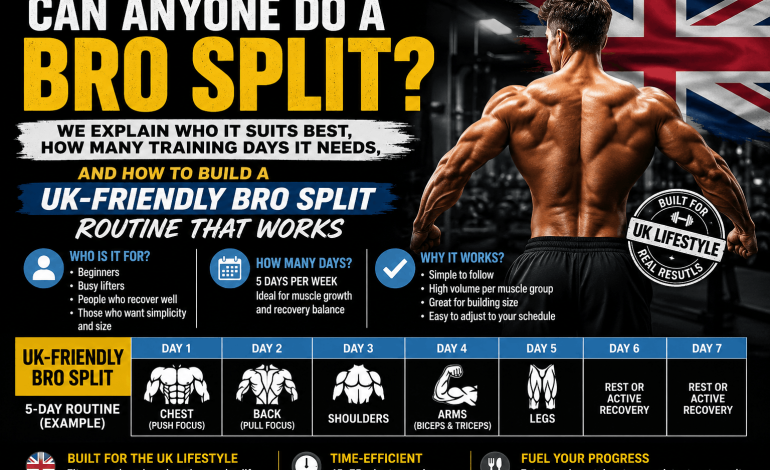

“Can anyone do a bro split?” Technically yes, but it won’t suit everyone equally. A bro split, where you train one muscle group per session, works best for people who can commit to four or five gym days a week and who have at least a few months of consistent training behind them. If you train two or three days a week, or you’re brand new to weights, a full-body or upper/lower routine will usually get you better results for the same effort.
This post walks through who a bro split actually suits, who tends to struggle with it, how it compares with push pull legs and full-body training, and how to build one properly if you decide it’s right for you. You’ll also find a sample routine, a UK-specific look at meeting the NHS activity guidelines on a bro split, and an honest look at gym costs.
What Is a Bro Split, Exactly?
A bro split is a weightlifting routine that dedicates each training day to one, or occasionally two, muscle groups. A typical week might look like Monday for chest, Tuesday for back, Wednesday for legs, Thursday for shoulders and Friday for arms. Each muscle group gets trained once a week, but with more total sets and exercises than it would receive on a split that hits it more often.
The name comes from bodybuilding gym culture, where this style of training has been popular for decades. It’s simple to plan, satisfying to follow and gives you the mental space to focus fully on one area at a time rather than juggling several muscle groups in a single session.
Can Anyone Do a Bro Split? The Short Answer
Yes, in the sense that nothing stops you physically picking up this routine. But a bro split asks for two things many people don’t have: four to five training days a week, and enough training history to recover from a big single-session workload. Without both, you’re likely to make slower progress than you would on a split built for lower weekly frequency.
[Table: bro split requirements vs suitability, showing training days needed, experience level, and who it fits best]
Who a Bro Split Suits Best
Beginners in Their First Year of Training
New lifters often respond well to a bro split because almost any structured resistance training builds strength and muscle during this stage. The simplicity also helps: one muscle group per day is easy to plan, easy to follow and hard to get wrong. Some coaches still prefer full-body training for absolute beginners, since it teaches the main compound lifts more often, but a bro split is far from a bad choice.
Intermediate and Advanced Lifters Who Enjoy High Volume
Lifters with a year or more of consistent training often have the recovery capacity to handle a large volume of sets for one muscle group and then leave it alone for a week. A bro split lets these lifters go harder on compound lifts like the bench press, deadlift and squat once a week each, followed by several accessory exercises without running out of energy partway through.
People Who Train for Enjoyment as Much as Results
A dedicated leg day or chest day gives a clear sense of accomplishment that some people find motivating in a way that mixed full-body sessions don’t. Adherence matters more than theoretical optimisation. A split you’ll actually stick to consistently beats a “better” split you abandon after six weeks.
Who Might Struggle With a Bro Split
People Training Only Two or Three Days a Week
Training a muscle group once a week works reasonably well when you’re in the gym five days a week, because the muscle still gets a full 5 to 7 days to recover before its next session. Cut that to two or three sessions a week and the maths changes: some muscle groups end up trained roughly once a fortnight, which most research on training frequency suggests is less effective for building muscle than hitting each muscle group twice weekly.
Women and Lifters Who Want More Lower-Body Focus
Classic bro split templates were built around bodybuilding routines that historically prioritised upper-body size, so legs sometimes get squeezed into a single session alongside other work. This isn’t a fixed rule. You can restructure a bro split to give legs two dedicated days, or run a split like quads/hamstrings and glutes/back to correct the balance, but it takes deliberate planning rather than following a generic online template.
Anyone Managing an Injury or Limited Recovery Capacity
Older lifters, people returning from injury and anyone under significant life stress often recover more slowly between sessions. A high-volume single session for one muscle group can leave that area sore and under-recovered for several days, which can push into the next scheduled session for a different muscle group and disrupt the whole week.
Bro Split vs Push Pull Legs vs Full Body
| Split | Days per week needed | Frequency per muscle group | Best suited to |
| Bro split | 4 to 5 | Once a week | Consistent gym-goers with training experience |
| Push pull legs (PPL) | 3 to 6 | Once to twice a week | Intermediate lifters wanting flexibility |
| Upper/lower split | 3 to 4 | Twice a week | Busy adults balancing frequency and recovery |
| Full body | 2 to 3 | Two to three times a week | Beginners and people with limited gym days |
Push pull legs groups muscles by movement pattern rather than by body part: push covers chest, shoulders and triceps, pull covers back and biceps, and legs covers the whole lower body. Run it twice through the week and every muscle group gets trained twice, which many lifters find gives a better balance of volume and frequency than a classic bro split without losing much of its structure or simplicity.
How Many Days a Week Does a Bro Split Need?
Most bro split routines are built around five training days, though a three-day version exists for people who want the bro split feel with less weekly commitment. A typical three-day bro split trains two muscle groups per session, for example chest and triceps on day one, back and biceps on day two, and legs and shoulders on day three, repeated once or twice weekly depending on how many gym days are available.
The trade-off is straightforward: fewer days per week means fewer total sessions per muscle group across a month, which usually means slower progress unless volume per session increases to compensate.
A Sample Five-Day Bro Split Routine
[Table: sample 5-day bro split with day, muscle group, and 3 example exercises per day]
- Monday, chest: flat barbell bench press, incline dumbbell press, cable flye
- Tuesday, back: deadlift, lat pulldown, seated cable row
- Wednesday, legs: barbell squat, leg press, walking lunge
- Thursday, shoulders: overhead press, lateral raise, rear delt flye
- Friday, arms: close-grip bench press, barbell curl, tricep pushdown
Aim for 3 to 5 exercises per muscle group and 3 to 4 sets per exercise, working to within one or two reps of failure on your last set. Weekend days are left free for rest, cardio or a sixth training day if a lagging muscle group needs extra attention.
How to Set Up Your Own Bro Split Without the Common Mistakes
Building a bro split that actually works comes down to a handful of decisions, made in order.
- Confirm your weekly training days. Count how many days you can realistically commit to, not how many you’d like to commit to in an ideal week.
- Assign one or two muscle groups per session. Group smaller muscles with the larger ones they assist, such as triceps with chest or biceps with back.
- Set your volume per session. Aim for 10 to 20 total sets per muscle group across the week, split across your 3 to 5 exercises for that day.
- Order exercises from heaviest to lightest. Start each session with the compound lift for that muscle group, then move to isolation work once the heaviest lifting is done.
- Track your numbers and add small increases weekly. Add weight, reps or a set once your current numbers feel comfortable rather than jumping up too quickly.
The most common mistake is cramming ten or more exercises into a single session for one muscle group. Past a certain point, extra sets in one workout add fatigue without adding much extra growth. Spreading that same volume across two sessions a week, even within a bro split framework, tends to work better.
Meeting the UK’s Physical Activity Guidelines on a Bro Split
NHS guidance for adults aged 19 to 64 recommends muscle-strengthening activity that works all the major muscle groups, including the legs, hips, back, abdomen, chest, shoulders and arms, on at least 2 days a week. A standard five-day bro split comfortably clears this bar, since every major muscle group gets trained once during the week and the split is spread across several sessions rather than crammed into one or two days.
If you’re only managing two or three gym days, a bro split can still technically tick the NHS box, since even one session per muscle group counts as muscle-strengthening activity. It just won’t hit each muscle group with the frequency most hypertrophy research points to for faster results. NHS guidance is a minimum for general health, not a target for building muscle, so treat the two figures as separate goals.
Gym Access and Cost in the UK
A bro split needs consistent access to a reasonable range of equipment, which usually means a gym membership rather than a home setup. UK budget gym chains such as PureGym and The Gym Group typically price standard monthly membership somewhere in the £20 to £30 range, with off-peak tiers sometimes available for less and premium tiers with extra perks costing more. [FACT UNVERIFIED — CHECK BEFORE PUBLISHING: confirm current PureGym and The Gym Group pricing directly on their official websites before publishing, as gym pricing changes by location and promotion.]
Day passes are usually available for £8 to £12 at budget chains, which can work out cheaper than a membership if you’re only training once or twice a week, though a five-day bro split will almost always cost less per session with a monthly membership.
[Image: photo of someone using a barbell in a UK gym setting, use royalty-free image from Unsplash or Pexels]
FAQs
Q: Can beginners do a bro split? Yes, beginners can do a bro split and often see solid results from it in their first year of training. Full-body or upper/lower splits are sometimes recommended instead because they let beginners practise compound lifts more often, but a bro split isn’t a poor choice, particularly if you enjoy the structure and can commit to 4 or 5 gym days a week.
Q: Is a bro split good for weight loss? A bro split can support weight loss, but the split itself doesn’t drive fat loss; your calorie intake does. Resistance training of any kind helps preserve muscle while you’re in a calorie deficit, and a bro split is as effective as any other split for that purpose, provided you’re training consistently and eating appropriately.
Q: How many days a week is a bro split? Most bro splits use 5 training days, one per major muscle group, though 3-day versions exist that pair two muscle groups per session. The exact number depends on how many days you can commit to each week and how you choose to group muscle groups together.
Q: Is push pull legs better than a bro split? Push pull legs trains each muscle group up to twice a week when run twice through in a 6-day cycle, which many people find works slightly better for muscle growth than a bro split’s once-weekly frequency. Neither split is universally better; PPL suits people wanting more flexibility with training days, while a bro split suits people who prefer a simpler, single-focus session.
Q: Can you build muscle with a bro split? Yes, a bro split can build muscle effectively, particularly for beginners and lifters who can commit to 4 or 5 training days a week with adequate calories and protein. The key factors are total weekly volume, training close to failure and progressive overload over time, not the split itself.
Q: Is a bro split bad for natural lifters? A bro split isn’t inherently bad for natural lifters, but natural lifters without performance-enhancing drugs generally recover more slowly, so once-weekly frequency per muscle group can be less forgiving of poor programming. Natural lifters who want to reduce this risk can adjust a bro split to train each muscle group twice a week instead of once.
Q: Do bodybuilders still use bro splits? Many bodybuilders, particularly in the advanced and competitive tiers, still use bro split or bro split-style routines, often adapted to include higher frequency for lagging muscle groups. The format remains popular because it allows very high per-session volume, which suits lifters who have the training experience and recovery capacity to use it well.
Q: Can you do a bro split with only 3 days a week? Yes, a 3-day bro split is possible by training two muscle groups per session, for example chest and triceps, back and biceps, and legs and shoulders. It won’t deliver the same weekly frequency as a 5-day version, so most people doing a 3-day bro split repeat the 3-day cycle twice within a fortnight rather than training each muscle group only once every two weeks.