 Haris
Haris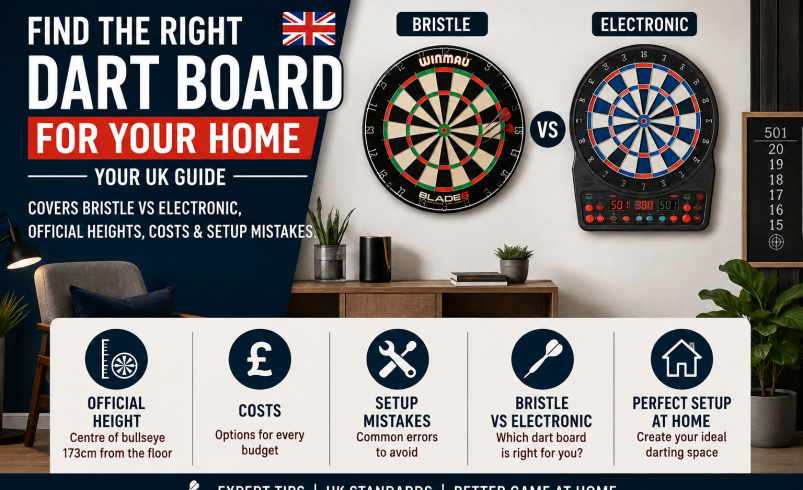
Choosing the correct dart board for your home or pub depends entirely on whether you want traditional steel-tip play or modern soft-tip scoring. A standard bristle dart board remains the gold standard for UK players seeking authentic performance, durability and tournament compatibility at prices ranging from £30 to £150. Electronic alternatives offer automated scoring and safer plastic tips but sacrifice the tactile feedback serious players prefer. This guide explains exactly what to look for when buying a dart board in the UK, breaks down current market pricing by category and details the precise installation measurements required by British Darts Organisation regulations. You will also discover common purchasing errors that waste money and how to maintain your board for maximum lifespan.
Dart Board Types Available in the UK
The UK market splits clearly between traditional bristle boards and electronic models, each serving distinct player needs and environments. Bristle dart boards use compressed sisal fibres that self-heal after dart removal, providing consistent playing surfaces for years of steel-tip use. Electronic boards feature plastic faces with hundreds of sensor holes that register soft-tip impacts and calculate scores automatically through digital displays.
Hybrid options now exist that accept both steel and soft tips, though these remain niche products with limited availability from specialist UK retailers. Magnetic and paper boards serve only as novelty items or children’s toys rather than serious practice equipment. Serious players should focus exclusively on tournament-grade bristle or quality electronic models depending on their preferred game format and venue compatibility.
Bristle Boards for Traditional Steel-Tip Play
Sisal fibre construction defines genuine bristle dart boards suitable for competitive and recreational steel-tip darts. Premium boards use A-grade Kenyan sisal with high density compression for superior dart penetration and reduced bounce-outs. Entry-level models often blend sisal with cheaper fibres or use lower compression, resulting in faster wear and inconsistent scoring zones.
Rotating number rings extend board life significantly by allowing players to move heavily used segments away from primary target areas. Professional tournament boards like the Winmau Blade 6 and Target Aspar feature blade wiring systems thinner than traditional round wires, reducing deflection chances during tight grouping shots. These technical specifications matter enormously for players developing accuracy beyond casual pub standard.
Comparison of Popular UK Bristle Dart Boards
| Model | Price Range | Wiring Type | Rotation Feature | Best For |
| Winmau Blade 6 | £70 to £90 | Blade wire | Yes | Competitive home play |
| Target Aspar | £80 to £100 | Blade wire | Yes | Tournament preparation |
| Unicorn Eclipse Pro | £60 to £80 | Round wire | Yes | Intermediate players |
| Harrows Matchplay | £30 to £45 | Round wire | No | Beginners/budget |
| Nodor Supabull | £50 to £70 | Staple-free bull | Yes | Reduced bounce-outs |
Electronic Boards for Soft-Tip and Home Use
Electronic dart boards dominate the home entertainment segment due to built-in scoring, multiple game variants and safer plastic-tipped darts. Quality models from brands like Gran Board and Phoenix cost between £150 and £400, offering responsive sensors and durable cabinet construction suitable for regular use. Budget electronic boards under £100 frequently suffer from dead sensor zones, loud impact noise and flimsy surrounds that frustrate experienced players.
Soft-tip darts weigh less than steel equivalents, typically 16g to 20g versus 21g to 26g, requiring adjustment to throwing technique for players transitioning between formats. Electronic boards suit families with young children or shared living spaces where wall damage risk concerns outweigh purist preferences. Check power requirements before purchase as some premium models need mains adapters rather than battery operation.
Official Installation Heights and Throwing Distances
Correct dart board installation follows strict measurements defined by the British Darts Organisation for all sanctioned competition play. The centre of the bullseye must sit exactly 173cm (5 feet 8 inches) above floor level, measured vertically from finished floor surface to bull centre point. This height applies universally across steel-tip competitions throughout England, Scotland, Wales and Northern Ireland regardless of venue type.
Throwing distance measures horizontally from the front face of the dart board to the toe line, not from the wall behind it. Steel-tip oche distance is 237cm (7 feet 9¼ inches) while soft-tip electronic boards use 244cm (8 feet). Many UK homeowners install boards at incorrect heights because they measure from carpet pile rather than subfloor or forget to account for board thickness when marking throw lines.
Step-by-Step Installation Process
Follow this sequence to ensure regulation-compliant dart board installation in any UK property.
- Locate stud position using detector tool to secure mounting bracket into solid timber rather than plasterboard alone.
- Mark bullseye centre point at 173cm vertical height using spirit level for accuracy.
- Fix backplate securely, ensuring board sits flush against wall without tilting forward or backward.
- Measure 237cm horizontally from board front face to establish toe line position on floor.
- Apply permanent marker tape or raised oche strip at measured distance for consistent footing reference.
Use appropriate fixings for your wall type because dart boards weigh 4kg to 6kg and generate significant vibration during play. Solid brick walls require masonry plugs while stud partitions need toggle bolts or dedicated cavity anchors rated for dynamic loads. Never rely solely on adhesive pads or picture hooks as these fail under repeated impact stress within weeks of regular use.
Typical Costs and Value Considerations for UK Buyers
Budget expectations should align realistically with intended usage frequency and performance requirements when shopping for a dart board. Entry-level bristle boards costing £30 to £50 serve occasional players adequately but show visible wear within six months of weekly use. Mid-range models between £60 and £90 represent the sweet spot for most UK home players, balancing longevity with reasonable investment.
Professional tournament boards exceed £100 but offer marginal performance gains over quality mid-range options for non-elite players. Electronic board pricing correlates strongly with sensor accuracy and feature set rather than brand prestige alone. Spending below £150 on electronic models typically results in frustrating gameplay experiences that discourage continued participation regardless of marketing claims.
Hidden Costs Beyond the Board Itself
First-time buyers frequently underestimate total setup costs by focusing exclusively on board price while overlooking necessary accessories. Quality steel-tip darts cost £25 to £60 per set and require periodic replacement as points blunt and flights tear. Backboards or surrounds protect walls from stray throws, adding £20 to £50 depending on material and coverage area.
Lighting deserves separate consideration because inadequate illumination causes eye strain and misjudged shots even with perfect board positioning. Dedicated dart board lights range from £30 for basic LED bars to £150 for professional shadow-free systems. Factor in ongoing electricity costs for electronic boards running continuously during extended sessions, particularly relevant given current UK energy prices.
Purchasing Mistakes and How to Avoid Them
Buying based solely on brand recognition leads many UK consumers to overpay for features irrelevant to their actual skill level and usage patterns. Professional endorsement deals inflate prices without necessarily improving suitability for recreational players who never achieve tournament-standard consistency. Test different board types at local pubs or clubs before committing significant funds to understand personal preferences through direct experience.
Ignoring room dimensions causes installation problems that compromise both safety and regulatory compliance. Minimum ceiling height of 240cm prevents ricochets bouncing off overhead surfaces during high throws. Insufficient depth between board and opposite wall creates hazardous rebound zones where missed darts travel unpredictably toward spectators or furniture. Always verify spatial requirements before purchase rather than discovering constraints during installation.
Maintenance Neglect Shortening Board Lifespan
Failing to rotate bristle boards regularly concentrates wear on popular scoring segments, creating uneven surfaces that deflect darts unpredictably. Rotate number ring weekly for heavy users or monthly for casual players to distribute impact damage evenly across entire playing surface. Remove embedded darts promptly because prolonged insertion stretches sisal fibres permanently, leaving holes that never fully close.
Electronic boards require different maintenance focused on sensor calibration and software updates rather than physical rotation. Dust accumulation in sensor holes causes missed registrations and inaccurate scoring that mimics board failure symptoms. Clean electronic faces monthly with compressed air and check manufacturer websites for firmware patches addressing known bugs or improving responsiveness.
Frequently Asked Questions
What size dart board should I buy for home use?
Full-size regulation dart boards measure 45cm diameter and suit most UK homes with adequate wall space. Compact 38cm boards work for smaller rooms but aren’t tournament-legal. Children’s boards come in various sizes but lack proper playing characteristics for skill development. Always choose full-size unless spatial constraints absolutely prevent safe installation.
How long does a bristle dart board last?
Quality sisal boards last two to five years with regular home use and proper rotation maintenance. Heavy daily play reduces lifespan to twelve to eighteen months regardless of board quality. Budget blended-fibre boards deteriorate within six months of consistent use. Signs requiring replacement include persistent bounce-outs, visible segment separation and bullseye deformation.
Can I use steel-tip darts on an electronic board?
No, steel tips damage electronic sensor membranes irreparably and void warranties immediately. Only use manufacturer-approved soft-tip darts weighing 16g to 20g on electronic boards. Some hybrid boards accept both types but clearly label compatible zones. Mixing dart types accidentally remains one of the most common causes of premature electronic board failure among UK buyers.
Do I need planning permission to install a dart board?
Residential installations rarely require planning permission unless property is listed or located in conservation areas with exterior visibility restrictions. Tenants must obtain landlord written consent before drilling into walls or making permanent modifications. Commercial venues may need licensing variations if adding darts extends operating hours or increases noise complaints potential. Check local council guidance for specific circumstances.
Why do my darts keep falling out of the board?
Dart drop-out indicates either worn board surface or inappropriate dart selection for current conditions. New boards sometimes reject darts until sisal fibres settle after initial break-in period lasting ten to twenty hours of play. Blunt points slide out more easily than sharp ones, so regular sharpening or replacement improves retention. Humidity changes affect sisal density seasonally, requiring point adjustments.
Are magnetic dart boards worth buying?
Magnetic boards serve only as novelty items or safe alternatives for very young children unable to handle real darts responsibly. They provide zero transferable skill development for steel-tip or soft-tip progression due to completely different weight distribution and flight mechanics. Adults seeking genuine practice value should invest minimum £30 in entry-level bristle boards instead. Magnetic sets make acceptable gifts but poor training tools.
What lighting works best for dart boards?
Dedicated LED light bars mounted directly above boards eliminate shadows cast by overhead room lighting during evening play. Position lights 30cm to 45cm above the board top edge angled downward at 45 degrees for optimal face illumination without glare. Avoid spotlight bulbs creating hot spots that distort depth perception. Natural daylight from side windows supplements artificial lighting effectively during daytime sessions.