M62 Crash: Live Traffic Updates and Safety Guide
- August 18, 2026
- 0
If you’ve searched “M62 crash”, you’re probably stuck in traffic right now, worried about someone travelling on that road, or trying to work out what’s happened after seeing
If you’ve searched “M62 crash”, you’re probably stuck in traffic right now, worried about someone travelling on that road, or trying to work out what’s happened after seeing
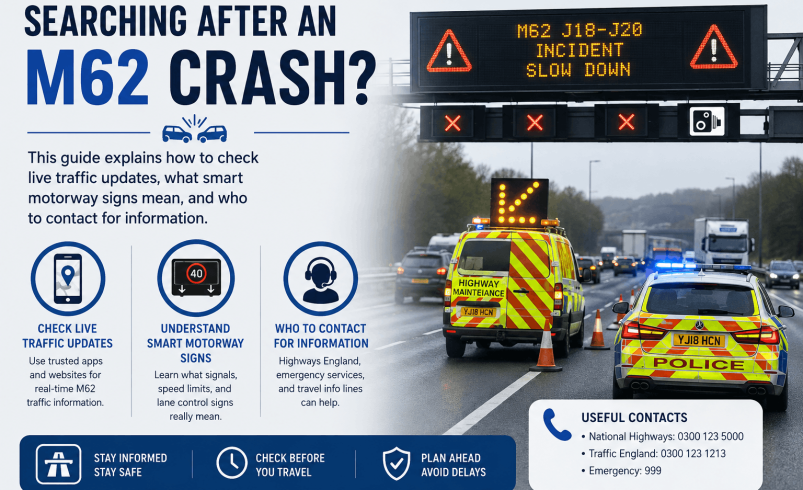
If you’ve searched “M62 crash”, you’re probably stuck in traffic right now, worried about someone travelling on that road, or trying to work out what’s happened after seeing it mentioned online. This article won’t report on one specific incident, because crashes on the M62 are unfortunately common and any single event described here would be out of date within hours. Instead, it explains exactly where to find live, verified information about a crash happening today, why the M62 sees so many serious incidents, what the smart motorway signs actually mean, and what to do whether you’re caught in the tailback or involved in the collision itself.
For anything happening today, you need a source that updates in real time, not a blog post. National Highways runs the official traffic control system for the M62 and publishes live incident data, including which junctions are affected and expected clearance times, through its website and its @NationalHways social media accounts for the relevant region.
Three sources give you the most reliable picture of a crash m62 right now:
Sat nav apps such as Waze and Google Maps often show a hold-up before any official source confirms a crash, since they’re built from other drivers’ live speed and braking data. Treat that as an early warning to find an alternative route, not as confirmation of what’s actually happened.
The M62 runs between Liverpool and Hull, crossing the Pennines at its highest point near junction 22, which makes it the highest motorway in England. That combination of a busy trans-Pennine freight route, high traffic volumes around Manchester and Leeds, and an exposed summit section creates conditions that other motorways don’t have to contend with in the same way.
Large sections of the M62 operate as an all-lane running smart motorway, meaning the traditional hard shoulder has been converted into a running lane. Instead of a hard shoulder, drivers rely on Emergency Refuge Areas (ERAs), orange-surfaced laybys spaced roughly one to one and a half miles apart, each with a blue sign and an SOS phone connected directly to the National Highways control room.
A red X displayed above a lane on the overhead gantries means that lane is closed, usually because of a crash, debris or a stranded vehicle ahead. Driving in a lane marked with a red X is illegal and enforced through camera detection, carrying a fine and penalty points, quite apart from the obvious danger of driving into an active incident scene.
The stretch around junction 22, close to Saddleworth Moor, sits over 1,200 feet above sea level and is exposed to weather that lower-lying motorways rarely see. Snow, ice and high winds can close this section of the M62 with little notice in winter, and National Highways issues separate weather-specific travel advice for the Pennine crossing when conditions turn.
Sitting in a stationary queue behind a crash is frustrating, but a few habits keep you and everyone around you safer while you wait it out.
Once a serious collision is reported, the relevant police force typically closes the carriageway, sometimes in both directions, to allow paramedics access and to preserve the scene for a collision investigation unit. For a fatal or serious injury crash, that investigation process, combined with vehicle recovery, is usually why an M62 closure runs for several hours rather than clearing quickly.
Police forces almost always issue a witness appeal after a serious crash, asking anyone who saw what happened, or who has relevant dashcam footage, to come forward. If you were driving nearby at the time, check the force’s website for the appeal reference and get in touch, even if you think what you saw isn’t significant. Investigators piece together fragments from multiple witnesses to build a full picture of how the collision happened.
[Image: photo of an overhead motorway gantry sign showing a red X lane closure, use royalty-free image from Unsplash or Pexels]
Getting to safety matters more than anything else in the first few seconds after a breakdown or collision on a smart motorway section of the M62.
If you’re unable to reach an ERA and end up stopped in a live lane, National Highways’ stopped-vehicle detection system on smart motorway sections is designed to flag your location so a lane can be closed. Put your hazards on immediately and, if it’s safe to do so, exit the vehicle through the passenger side away from moving traffic.
If you’ve been involved in a collision on the M62, most UK motor insurers want the same core information: the other driver’s details, the location including the junction number, the time, and photos of the scene and vehicle damage if it’s safe to take them. Report the crash to your insurer as soon as possible, even if you don’t intend to claim, since some policies require prompt notification regardless.
For a crash that wasn’t your fault, you can usually claim through the other driver’s insurer, or bring a personal injury claim separately if you’ve been hurt. Personal injury claims in England and Wales generally need to be started within three years of the date of the crash, though this varies for children and in certain other circumstances, so check with a solicitor if you’re unsure which deadline applies to your case.
[Table: What to gather at the scene of an M62 crash, covering other driver’s details, photos, witness contacts and police reference number]
| What to collect | Why it matters |
| Other driver’s name, registration and insurer | Needed to make or defend an insurance claim |
| Photos of vehicle damage and the scene | Provides evidence of how the collision happened |
| Witness names and contact details | Independent accounts help resolve disputed claims |
| Police incident or crime reference number | Required by insurers and useful if a claim is contested |
Precise, current collision figures for a single motorway change year to year and aren’t published as one simple headline number, so treat any specific total you see quoted online with some caution unless it links back to National Highways or the Department for Transport directly. What’s consistent is that the M62 features regularly in regional BBC and police reporting on serious and fatal collisions, reflecting both its heavy freight traffic and the exposed Pennine section.
Check GOV.UK’s road safety statistics releases from the Department for Transport for the most current, verified collision data by road, rather than relying on a fixed number in this article, since official figures are updated periodically and a static page can go out of date quickly.
Q: Is the M62 closed right now? This article can’t tell you that in real time, since conditions change by the hour. Check National Highways’ live traffic page or BBC Travel for your region to see current closures, lane restrictions and estimated reopening times.
Q: What does a red X mean on the M62? A red X displayed above a lane means that lane is closed, usually because of a crash, debris or a stranded vehicle. Driving in a lane marked with a red X is illegal, enforced by camera, and can result in a fine and penalty points.
Q: How long do M62 closures usually last after a serious crash? It depends on the severity and whether a collision investigation unit needs to examine the scene. A serious or fatal crash can close the motorway, sometimes in both directions, for several hours while paramedics, recovery teams and investigators complete their work.
Q: What should I do if I see a crash happen on the M62? Call 999 if it hasn’t already been reported, stay a safe distance back, and don’t get out of your vehicle unless there’s a direct danger like fire. If you have dashcam footage, keep it, since police almost always appeal for witness evidence after a serious collision.
Q: Does the M62 have a hard shoulder? Large sections operate as an all-lane running smart motorway, meaning there’s no continuous hard shoulder. Emergency Refuge Areas replace it at intervals of roughly one to one and a half miles, so know where the nearest one is if you’re driving a section without a hard shoulder.
Q: Who do I contact if I witnessed an M62 crash? Contact the police force covering that stretch: West Yorkshire Police, Greater Manchester Police, Merseyside Police or Humberside Police, depending on the location. Their website will usually list a specific appeal reference number for recent serious collisions.
Q: Can I claim compensation if I wasn’t at fault in an M62 crash? Yes, in most cases you can claim through the at-fault driver’s insurer or bring a personal injury claim if you were hurt. Personal injury claims in England and Wales generally must start within three years of the crash date, though exceptions apply, so check with a solicitor if you’re close to that deadline.
Q: Why does the M62 close so often near junction 22? That stretch crosses the Pennine summit at over 1,200 feet, the highest point on any English motorway, making it more exposed to snow, ice and high winds than most of the network. National Highways issues separate weather advice for this section when conditions deteriorate.