Thai Massage Near Me: A UK Guide to Cost and Booking
- August 18, 2026
- 0
Typing “thai massage near me” into Google usually means you want a session booked today, at a fair price, from somewhere that’s actually properly run. A traditional Thai
Typing “thai massage near me” into Google usually means you want a session booked today, at a fair price, from somewhere that’s actually properly run. A traditional Thai
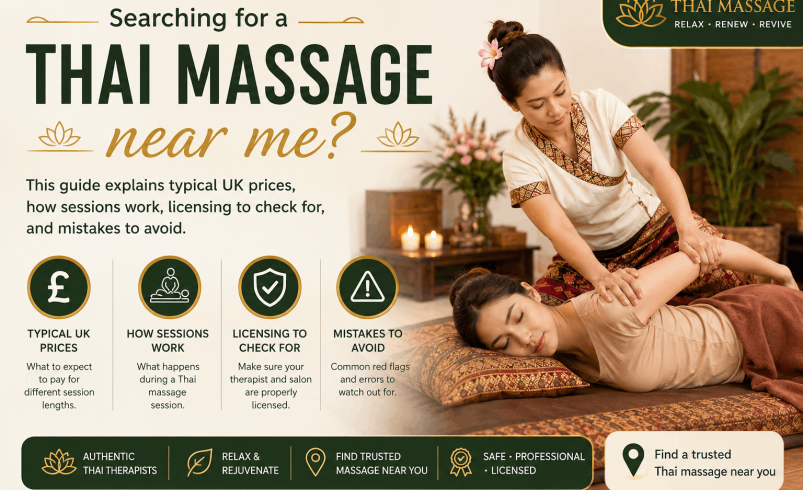
Typing “thai massage near me” into Google usually means you want a session booked today, at a fair price, from somewhere that’s actually properly run. A traditional Thai massage in the UK typically costs £50 to £150 depending on session length and location, and most bookings can be made online or by phone within a day or two. This guide covers what the treatment actually involves, how to book one, what you should expect to pay by session length, the licensing checks worth doing before you hand over any money, and the mistakes that catch out first-time bookers.
Traditional Thai massage, sometimes called Nuad Thai, is a full-body treatment performed on a floor mat rather than a table. It combines acupressure along the body’s energy lines, assisted stretching that looks a lot like passive yoga, and rhythmic compression using the therapist’s hands, forearms, elbows and sometimes feet.
You stay fully clothed throughout, usually in loose cotton trousers and a top provided by the venue. That’s a genuine difference from Swedish or deep tissue massage, where you’re typically undressed under a towel and oil is used directly on the skin. If you’d rather not be moved into stretches or have someone’s bodyweight applied through their forearms, a Thai massage isn’t the right choice, and it’s worth saying so when you book.
Price is the main thing people want confirmed before they book, and it varies more than you’d expect for what looks like the same treatment. UK studios and spas commonly charge in the range below for a solo, non-mobile appointment; mobile therapists who travel to your home tend to sit at the higher end because your location, parking and travel time are factored in.
[Table: Typical UK Thai massage prices by session length and setting, comparing studio, spa and mobile bookings]
| Session length | Typical studio price | Typical mobile price |
| 30 minutes | £30 to £45 | £50 to £65 |
| 60 minutes | £50 to £75 | £74 to £95 |
| 90 minutes | £80 to £105 | £105 to £130 |
| 120 minutes | £100 to £150 | £130 to £170 |
These figures move with location, with London and other major cities sitting toward the top of each range. Always check the venue’s own current price list before booking, since individual studios set their own rates and they change without much notice.
Most Thai massage isn’t a walk-in treatment. Because sessions typically run 60 minutes or longer and involve a therapist working through a full sequence, venues generally want you booked into a specific slot in advance.
You’ve got three realistic routes to book:
Whichever route you use, confirm the exact treatment name when you book. “Thai massage”, “Thai oil massage” and “Thai deep tissue” are different treatments with different techniques, and venues don’t always default to the traditional dry, clothed version unless you ask for it by name.
This is the question most guides skip, and it’s the one that actually protects you. In England, many local councils require premises offering massage to hold a massage and special treatment licence under the London Local Authorities Act 1991, or an equivalent local scheme outside London. The licence covers both the premises and, separately, the individual therapist, who has to be registered with that council and checked for relevant qualifications.
Requirements aren’t consistent nationwide. Some councils license every massage premises in their area; others don’t regulate massage at all, and mobile therapists working from a client’s own home are commonly exempt from premises licensing even where studio-based massage would need one. Where a licence is required, providing or advertising the treatment without one is an offence that can lead to prosecution, so a licensed venue has already been through basic vetting that an unlicensed one hasn’t.
You can usually check licensing directly with the relevant council’s licensing team, since most publish a public register of licensed premises. If a studio is cagey about its licence, insurance, or its therapists’ qualifications when you ask, treat that as a warning sign rather than a technicality.
[Image: photo of a calm, professional massage studio reception area, use royalty-free image from Unsplash or Pexels]
Knowing the sequence in advance takes the guesswork out of a first visit. A typical hour-long session runs through a broad routine, though every therapist adapts it to your body and any areas you flag.
Mild soreness the next day is common, similar to how you’d feel after a first session at the gym. Sharp pain during the treatment itself isn’t normal, and you should say so immediately if it happens.
A few recurring mistakes account for most bad experiences, and nearly all of them are avoidable with a couple of questions before you pay.
Q: How much does a Thai massage cost near me in the UK? Expect roughly £50 to £75 for a standard 60-minute studio session, rising to £100 to £150 for two hours. Mobile therapists who travel to you typically charge more to cover their time and travel, often £74 upwards for an hour. Prices vary by city and venue, so check the current rate directly before booking.
Q: Do you need to book a Thai massage in advance? Yes, in almost all cases. Sessions run 60 minutes or longer and follow a set sequence, so venues need a dedicated appointment slot rather than taking walk-ins. Same-day or next-day slots are often available through booking platforms, but don’t expect to turn up unannounced and be seen.
Q: Is Thai massage the same as a normal massage? No. Traditional Thai massage is performed fully clothed on a floor mat and combines acupressure with assisted stretching, unlike Swedish or deep tissue massage, which is done on a table with oil applied to bare skin. If you’d prefer a table-based, oil massage, ask for that by name rather than assuming Thai massage covers it.
Q: Does a Thai massage place need a licence to operate in the UK? It depends on the local council. Many councils, particularly across London, require a massage and special treatment licence for the premises, plus separate registration for each therapist. Some councils outside London don’t licence massage at all, and mobile therapists working in your own home are commonly exempt from premises licensing.
Q: Is Thai massage painful? It can feel intense in places, particularly during deep pressure work or stretching, but it shouldn’t be sharply painful. Tell your therapist straight away if something hurts rather than tensing through it, since pressure can usually be adjusted immediately.
Q: Can you get a Thai massage while pregnant? Many venues offer a modified pregnancy massage rather than the standard Thai sequence, since deep pressure and certain stretches aren’t suitable during pregnancy. Always disclose that you’re pregnant when you book, not just on arrival, so the venue can confirm whether they offer a suitable treatment.
Q: What should you wear to a Thai massage? Most venues provide loose cotton clothing for you to change into, so you don’t need to bring anything specific. If a venue doesn’t provide clothing, loose, comfortable layers you can move freely in work well.