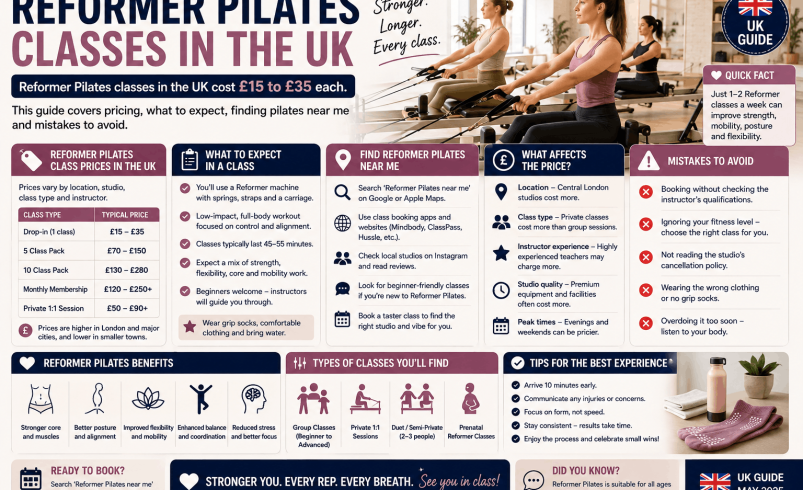
Reformer Pilates is a low-impact workout performed on a spring-loaded machine that adds resistance to controlled, precise movements, and in the UK it typically costs between £15 and £35 for a single group class. This guide covers what actually happens in a class, how much it costs to start and keep going, how to find pilates near me without wasting money on the wrong studio, and the mistakes that put people off after their first session.
You’ll also find a section on how to check whether an instructor is properly qualified, since the UK market has grown fast and not every studio makes this easy to verify. By the end, you’ll know exactly what to book and what to ask before you do.
[Image: reformer pilates machine in a boutique UK studio — use royalty-free image from Unsplash or Pexels]
What Is Reformer Pilates?
Reformer Pilates uses a machine called a reformer: a sliding carriage that moves along rails against adjustable spring resistance. You push, pull and stabilise the carriage through slow, deliberate movements, building core strength, flexibility and balance without the joint impact of running or weight training.
It’s built on the same principles as mat Pilates, developed by Joseph Pilates in the early twentieth century, but the machine changes what’s possible. The springs can support you through a movement or resist you, so the same exercise can be made gentler or far harder depending on the setting. That’s a big part of why it suits such a wide range of fitness levels within a single class.
Classes typically run 45 to 55 minutes and are taught in small groups, usually between four and twelve people, since studios only have a limited number of reformer machines in each room.
Reformer Pilates Cost in the UK: What You’ll Pay
Prices vary a lot depending on where you live and how you book. A single drop-in class in London generally costs £28 to £35, while regional studios outside the capital tend to charge £20 to £28. Buying classes in bulk, or committing to a monthly membership, brings the per-class price down significantly.
| Booking option |
Typical UK price |
Best for |
| Single drop-in class |
£15 to £35 |
Trying a studio before committing |
| Class pack (5 to 10 classes) |
£18 to £28 per class |
Regular attendees who want flexibility |
| Monthly membership (8 to 12 classes) |
£140 to £220 per month |
Those attending two or more times a week |
| Private one-to-one session |
£65 to £120 |
Beginners, rehab, or personalised programming |
[Table: current pricing at three or four named local studios, pulled from their own websites]
Many studios run an introductory offer for new clients, often three classes for around £30 to £50, which is worth using before you commit to a pack or membership. Prices change often as studios adjust their pricing tiers, so check the studio’s own site for its current rates rather than relying on a figure quoted elsewhere, including here.
How to Find Pilates Near Me
Searching “pilates near me” throws up a mix of boutique studios, gym-based classes and physiotherapy clinics offering reformer sessions, and they’re not interchangeable. A boutique studio focuses purely on Pilates and usually has newer equipment and smaller classes. A gym-based class is often cheaper if it’s included in your existing membership, but the room may be shared with other equipment and class sizes can be larger.
Booking apps such as ClassPass and Hussle let you browse and book classes across multiple studios in one place, which is useful if you want to try several before settling on one. Studio websites themselves usually show live availability and let you book several weeks ahead, which matters in cities where popular class times sell out fast.
When comparing local options, look beyond price alone. Check class size, whether the studio offers a beginner or foundations class, and whether instructors hold a recognised qualification, covered in more detail further down.
What to Expect in Your First Reformer Pilates Class
Arrive 10 to 15 minutes early for your first session so you can fill in a health questionnaire and let the instructor know about any injuries or conditions. Most studios ask beginners to book a foundations or introductory class rather than joining a general class straight away, so the instructor has time to explain the machine before the pace picks up.
Expect the instructor to adjust the spring resistance for you individually, since it’s rarely the same setting for everyone in the room. You’ll spend the class moving between exercises lying down, seated and standing on the carriage, working through your core, legs, arms and back in turn. It’s normal to feel uncoordinated for the first class or two while you get used to the machine.
What to Wear to Reformer Pilates
Wear fitted, stretchy clothing such as leggings and a close-fitting top, since loose fabric can catch in the machine’s springs and pulleys. Avoid baggy shorts and oversized t-shirts for the same reason, and skip jewellery that could snag.
Most UK studios require grip socks rather than trainers, since bare or normal socks can slip on the carriage. Many studios sell them if you don’t already own a pair, typically for £8 to £12.
[Image: person wearing grip socks and fitted activewear on a reformer machine — use royalty-free image from Unsplash or Pexels]
Reformer Pilates vs Mat Pilates: What’s the Difference
Both forms share the same underlying method, but they feel different in practice and suit slightly different goals.
| Factor |
Reformer Pilates |
Mat Pilates |
| Equipment |
Spring-loaded reformer machine |
Just a mat, sometimes light props |
| Typical UK price |
£15 to £35 per class |
£8 to £18 per class |
| Resistance |
Adjustable via springs |
Body weight only |
| Class size |
Small, limited by machine numbers |
Often larger |
| Best for |
Building strength with support, rehab, beginners wanting guided resistance |
Core strength on a budget, home practice |
Neither is objectively better. Reformer classes tend to cost more because studios need to buy and maintain the machines, but the adjustable resistance makes it easier to scale a class for mixed abilities. Mat Pilates is more portable and far cheaper to practise at home.
Who Should Be Careful With Reformer Pilates
Reformer Pilates is low-impact and widely considered suitable for most people, but a few groups should get specific guidance before booking a general class. Anyone recovering from a recent injury, surgery or a condition such as osteoporosis should speak with their GP or physiotherapist first and choose a studio that offers rehabilitation-focused or one-to-one sessions.
Pregnancy is a common question, and reformer Pilates can be appropriate for many healthy pregnancies with medical clearance and a pre and postnatal qualified instructor, rather than a standard group class. If you’re already pregnant and new to Pilates, a one-to-one session is the safer starting point so the instructor can build a programme around you specifically, rather than adapting a group class on the fly.
If you have a diagnosed back condition, a hernia, or you’re in the early weeks after childbirth, tell the studio when you book rather than mentioning it once the class has already started.
How to Check a UK Reformer Pilates Instructor Is Qualified
There’s no legal requirement in the UK to hold a specific qualification before teaching Pilates, which makes this worth checking yourself before you book, especially for one-to-one sessions. Reputable instructors typically hold an Active IQ Level 3 qualification in Mat Pilates as a foundation, followed by a specialist Level 3 or equivalent Reformer Pilates qualification, often endorsed by CIMSPA, the Chartered Institute for the Management of Sport and Physical Activity.
Ask the studio directly which qualification their instructors hold and whether they carry professional indemnity and public liability insurance, since UK insurers generally require a recognised qualification before they’ll cover an instructor to teach. A studio that answers this clearly and confidently is a good sign; one that dodges the question is worth a second thought.
For rehabilitation work, such as recovering from injury or working around a long-term condition, look specifically for an instructor with additional clinical Pilates training, sometimes delivered through physiotherapy-linked courses rather than general fitness qualifications.
Common Mistakes to Avoid When Starting Reformer Pilates
New starters tend to make the same handful of mistakes, most of which are easy to avoid once you know what to look for.
- Skipping the beginner class. Jumping straight into a general or advanced class without learning the machine first usually means spending the session lost rather than working effectively.
- Booking a big class pack before trying a studio. Studios vary a lot in teaching style, room size and equipment quality. Use an introductory offer or single drop-in class before committing to a pack or membership.
- Wearing the wrong clothing. Loose shorts or oversized tops catching in the springs is a genuine safety issue, not just a comfort one, so get your kit right from the first session.
- Not telling the instructor about an injury. Mention any existing pain, surgery or condition before the class starts, not partway through, so the instructor can adjust exercises in advance.
- Comparing yourself to the rest of the room. Spring resistance is set individually, so someone working harder next to you isn’t necessarily doing more, they’re just set differently.
Frequently Asked Questions
Q: How much does reformer Pilates cost in the UK? A single drop-in class typically costs £15 to £35, with London studios at the higher end and regional studios generally £20 to £28. Buying a class pack or monthly membership brings the per-class cost down, often to £18 to £28 per class.
Q: Is reformer Pilates good for beginners? Yes, most studios run a dedicated beginner or foundations class that teaches the machine before the pace increases. Spring resistance is adjustable, so a beginner and an experienced regular can be in the same room doing the same movement at different intensities.
Q: What should I wear to reformer Pilates? Wear fitted, stretchy clothing such as leggings and a close-fitting top, since loose fabric can catch in the machine. Most UK studios require grip socks rather than trainers or bare feet, and many sell them on site if you don’t already have a pair.
Q: Is reformer Pilates safe during pregnancy? It can be appropriate for many healthy pregnancies with medical clearance and an instructor qualified in pre and postnatal Pilates. If you’re new to Pilates while pregnant, a one-to-one session is the safer starting point rather than joining a general group class.
Q: How is reformer Pilates different from mat Pilates? Reformer Pilates uses a spring-loaded machine for adjustable resistance and generally costs £15 to £35 per class, while mat Pilates relies on body weight alone and typically costs £8 to £18. Both use the same underlying method, but the reformer makes it easier to scale intensity within a mixed-ability class.
Q: How often should I do reformer Pilates to see results? Most instructors recommend two to three sessions a week to notice changes in strength, posture and core control within a few weeks. Once a week can still be worthwhile for general fitness and flexibility, just with a slower rate of visible change.
Q: Do reformer Pilates instructors need a qualification in the UK? There’s no legal requirement, but reputable instructors hold a recognised qualification, typically an Active IQ Level 3 in Mat Pilates followed by a specialist Reformer Pilates qualification. This also matters practically, since UK insurers generally require a recognised qualification before covering an instructor to teach.