 Haris
Haris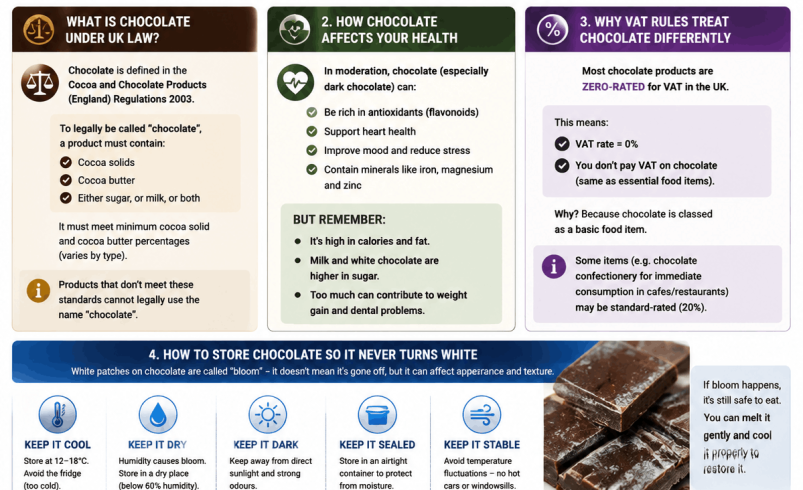
You picked up a bar in the supermarket and wondered why one costs £1.20 and another costs £4.50, or why your dog’s vet asked exactly what type of chocolate was on the kitchen floor. Chocolate isn’t one single product. In the UK, the word “chocolate” is a legally defined term with minimum cocoa content rules, its own VAT quirks, and real risks for pets. This guide covers what chocolate is made from, the different types on UK shelves, what the science says about your health, why some chocolate is taxed differently, and how to keep a bar fresh for longer.
What Counts as Chocolate Under UK Law
Not every sweet, cocoa-flavoured product can legally be called chocolate in the UK. The Cocoa and Chocolate Products Regulations set out fixed minimums for cocoa solids and cocoa butter, and manufacturers who fall short have to use a different name.
Under UK rules, plain chocolate needs at least 35% total dry cocoa solids, made up of a minimum of 18% cocoa butter and 14% non-fat cocoa solids. Milk chocolate has a lower threshold: it only needs 20% cocoa solids and 20% milk solids, which is why UK bars such as Cadbury Dairy Milk taste noticeably sweeter and creamier than continental European milk chocolate, which needs 25% cocoa solids. When UK-style milk chocolate is sold elsewhere in Europe, it has to be labelled “family milk chocolate” instead.
White chocolate has its own rule too. It must contain at least 20% cocoa butter, but no cocoa solids, since cocoa solids are what gives standard chocolate its brown colour and flavour. Some supermarket products marketed as “white chocolate” style bars or biscuits no longer meet that 20% threshold and are legally barred from using the word “chocolate” at all, which is why you’ll sometimes see wording like “white chocolate flavour coating” on the packaging instead.
The Main Types of Chocolate You’ll Find on UK Shelves
Every chocolate product sold in the UK falls into one of a handful of categories, and knowing the difference helps you buy what you actually want, whether that’s for baking, gifting or snacking.
Dark chocolate contains the highest proportion of cocoa solids and little to no milk. It ranges from around 35% cocoa (sweeter, milder) up to 100% (bitter, used mainly for baking). Milk chocolate blends cocoa solids with milk solids and extra sugar, making it the most popular type sold in the UK. White chocolate uses cocoa butter but no cocoa solids, giving it a pale colour and a much sweeter, creamier taste. A newer addition, ruby chocolate, is made from ruby cocoa beans processed without added colouring or berry flavouring, and gets its pink shade and slightly tart taste naturally from the bean itself.
| Type | Minimum cocoa solids (UK) | Typical taste | Common uses |
| Dark chocolate | 35% | Bitter to rich, less sweet | Baking, cooking, snacking |
| Milk chocolate | 20% cocoa solids, 20% milk solids | Sweet, creamy | Bars, Easter eggs, sharing bags |
| White chocolate | 20% cocoa butter, 0% cocoa solids | Very sweet, buttery | Coatings, decoration, baking |
| Ruby chocolate | 35% (as dark chocolate base) | Slightly tart, fruity | Premium bars, patisserie |
How Chocolate Is Made, From Bean to Bar
Chocolate starts life as cacao pods grown on Theobroma cacao trees, mainly across West Africa, South America and Southeast Asia. Farmers split the pods open, ferment the beans for several days to develop flavour, then dry them before they’re shipped to processors.
From there, the beans are roasted, cracked and ground into a thick paste called chocolate liquor or cocoa mass. Pressing this paste separates it into cocoa solids and cocoa butter, the two building blocks that get recombined, along with sugar and sometimes milk, to make the finished chocolate types above. The final stage, tempering, involves carefully heating and cooling the liquid chocolate so the cocoa butter forms stable crystals. Properly tempered chocolate has a glossy finish and a clean snap when you break it. Chocolate that hasn’t been tempered correctly often looks dull or streaky, even though it’s still perfectly safe to eat.
Is Chocolate Good or Bad for You?
The honest answer is that it depends on the type and the amount. The NHS classes chocolate as a high-fat, high-sugar food that should be eaten in small amounts rather than every day, and that guidance applies to milk and white chocolate especially.
Sugar and Calories in Chocolate
A typical 45g milk chocolate bar contains around 25g of sugar, roughly six teaspoons, and about 240 calories. Adults are advised to keep free sugars, meaning sugar added to food rather than sugar found naturally in fruit or milk, to no more than 30g a day. That single bar alone can use up most of that daily allowance. Chocolate-coated biscuits add sugar too: a single one can contain around 4g.
Check the nutrition label on the pack before you buy, since a food is classed as high in sugar if it contains more than 22.5g of total sugars per 100g.
Does Dark Chocolate Have Health Benefits?
Dark chocolate with a high percentage of cocoa solids contains more flavanols, plant compounds linked in some studies to modest improvements in blood pressure and blood vessel function, than milk or white chocolate. The British Heart Foundation notes that dark chocolate generally has more of these compounds, but points out that most dark chocolate products are still high in sugar, saturated fat and calories, so the benefit shouldn’t be treated as a reason to eat more of it. You can get similar plant compounds without the sugar and fat from green tea, berries, apples and pears.
If you’re living with diabetes, occasional small squares of chocolate are usually fine as part of a balanced diet, but “diabetic chocolate” isn’t a better option. It’s still high in fat and calories, and the sweeteners used can upset your stomach.
Why Chocolate Is Taxed Differently in the UK
Here’s something most chocolate guides skip entirely: chocolate has its own quirky place in UK tax law. Standard VAT in the UK is 20%, and most chocolate confectionery is charged at that rate. But cakes and plain biscuits are zero-rated for VAT, which is where things get complicated.
Under HMRC rules, a plain biscuit is zero-rated, but the moment it’s wholly or partly covered in chocolate, it becomes standard-rated at 20%. Cakes, by contrast, stay zero-rated even when they’re covered in chocolate. That distinction produced one of the most famous tax disputes in UK history: the 1991 Jaffa Cake case. HMRC argued Jaffa Cakes were chocolate-covered biscuits and should be taxed at the standard rate. McVitie’s disagreed, and even baked an oversized Jaffa Cake as evidence. The tribunal looked at factors including moisture content, how the product hardens as it goes stale, and its overall composition, and ruled that Jaffa Cakes count as cakes, meaning no VAT applies.
The practical effect for shoppers is small since prices already include VAT, but it explains some odd pricing quirks between similar-looking products, and it’s a useful thing to know if you ever run a bakery or food business, since misclassifying a product can mean a costly correction later.
Chocolate and Pets: Why It’s Dangerous for Dogs
Chocolate that’s a treat for you can be an emergency for your dog. Chocolate contains theobromine, a compound that’s completely harmless to humans but toxic to dogs, cats and rabbits because they can’t break it down the way we do. Chocolate also contains a small amount of caffeine, which adds to the risk.
As a general rule, the darker the chocolate, the more theobromine it contains and the more dangerous it is. Cocoa powder and baking chocolate carry the highest risk, followed by dark chocolate, then milk chocolate, with white chocolate carrying the lowest theobromine risk (though it’s still high in fat and sugar, which can trigger vomiting or pancreatitis). Symptoms of chocolate poisoning in dogs, including restlessness, vomiting, a fast heart rate and, in severe cases, seizures, usually appear within two to four hours but can take up to twelve.
If your dog eats chocolate, don’t wait to see if symptoms develop. Call your vet or the Animal Poison Line straight away, and keep the wrapper handy so you can tell them exactly what type and how much was eaten.
How to Store Chocolate Correctly (and Why It Turns White)
That pale, chalky film that sometimes appears on an old chocolate bar is called bloom, and it’s one of the most common questions people have after their chocolate has been sitting in a cupboard for a while. It isn’t mould, and the chocolate is still safe to eat, but it does mean the texture and appearance have been affected by poor storage.
There are two types of bloom. Fat bloom happens when chocolate gets too warm and the cocoa butter separates and rises to the surface before re-solidifying as a dull, streaky layer. Sugar bloom happens when chocolate gets damp, causing sugar crystals to dissolve slightly and then re-form as a gritty white coating once it dries out again.
To keep chocolate at its best:
- Store it somewhere cool and dry, ideally between 15°C and 18°C, away from direct sunlight and radiators.
- Keep it in its original wrapper or an airtight container to stop it picking up moisture or odours from other food.
- Avoid the fridge unless the room is genuinely too warm, since condensation on unwrapping can trigger sugar bloom.
- Never store chocolate near strong-smelling foods like onions or cheese, since it absorbs odours easily.
- Once opened, use it within a few weeks for the best texture, even though most chocolate is still safe to eat well past its best-before date.
Buying Chocolate in the UK: What to Look for on the Label
A few details on the packaging tell you far more about quality than the price alone. The cocoa solids percentage, which UK law requires manufacturers to state on nearly all chocolate products, is the clearest indicator: generally, the higher the percentage, the less room there is for cheap fillers. Watch out for “vegetable fats in addition to cocoa butter” on the label too. UK and EU rules allow up to 5% of certain non-cocoa vegetable fats, such as shea or palm oil, to be added, and manufacturers must declare this clearly if they do.
If you’re avoiding dairy, look for chocolate specifically labelled vegan rather than assuming dark chocolate is automatically dairy-free, since some dark chocolate still contains milk fat for a smoother texture, and cross-contamination during manufacturing is common even when milk isn’t a listed ingredient. Genuinely vegan bars will say so clearly on the front of the pack.
FAQ
Q: What is chocolate made from?
Chocolate is made from cocoa solids and cocoa butter, both derived from fermented, roasted and ground cacao beans, combined with sugar and, for milk chocolate, milk solids. The ratio of these ingredients determines whether it’s classed as dark, milk or white chocolate under UK rules.
Q: Is dark chocolate healthier than milk chocolate?
Dark chocolate contains more flavanols, plant compounds linked to modest heart health benefits, than milk chocolate, and generally less sugar per 100g. It’s still high in fat and calories though, so it should be treated as an occasional food rather than a health food.
Q: Why is chocolate taxed differently to other sweets in the UK?
Standard VAT of 20% applies to most chocolate and chocolate-covered biscuits, while cakes, including chocolate-covered ones, are zero-rated. This distinction came from the 1991 Jaffa Cake tribunal, which ruled Jaffa Cakes count as cakes rather than biscuits based on their moisture content and texture.
Q: Can dogs eat white chocolate?
White chocolate contains far less theobromine than dark or milk chocolate, but it’s still not safe for dogs. Its high fat and sugar content can trigger vomiting, diarrhoea or pancreatitis, so it should be kept away from pets entirely.
Q: Why does chocolate go white when it’s old?
That white film is called bloom, caused by either cocoa butter rising to the surface after the chocolate gets too warm (fat bloom) or sugar crystals forming after it gets damp (sugar bloom). It’s a texture and storage issue, not mould, and the chocolate is still safe to eat.
Q: Is chocolate vegan?
Not automatically. Milk chocolate contains dairy by definition, and even some dark chocolate includes milk fat or is made in facilities that also handle dairy. Always check for a specific vegan label rather than assuming based on the cocoa percentage alone.
Q: How long does chocolate last?
Most chocolate stays safe to eat for months past its best-before date if stored correctly, though the texture and flavour will gradually decline. Dark chocolate tends to last longer than milk or white chocolate because it contains less milk fat, which is more prone to going stale.
Q: What’s the difference between chocolate and couverture?
Couverture is a professional-grade chocolate used by chocolatiers and bakers, with a UK legal minimum of 35% total dry cocoa solids, including at least 31% cocoa butter. The higher cocoa butter content makes it melt more smoothly, which is why it’s preferred for coating, dipping and moulding.