YouTube Converter: Is It Legal and Safe to Use in the UK?
- August 18, 2026
- 0
If you’ve searched for a YouTube converter, you’re probably trying to save a video or a song for offline listening. The direct answer is that using one to
If you’ve searched for a YouTube converter, you’re probably trying to save a video or a song for offline listening. The direct answer is that using one to
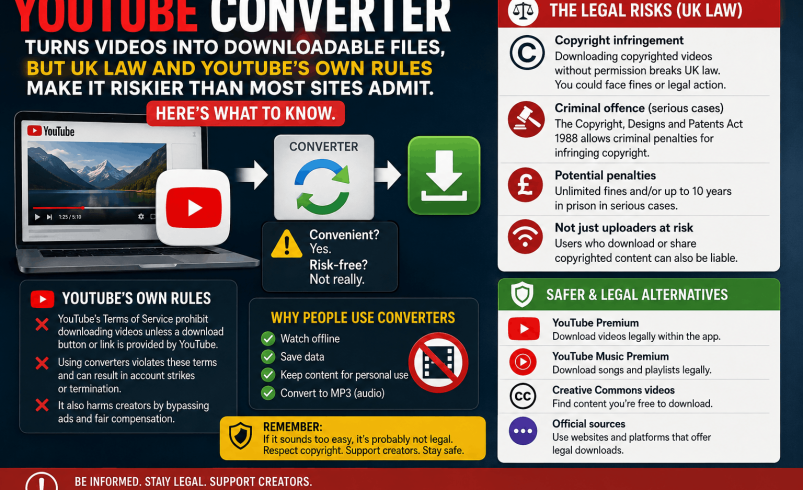
If you’ve searched for a YouTube converter, you’re probably trying to save a video or a song for offline listening. The direct answer is that using one to convert content you don’t own or don’t have permission to copy breaches both YouTube’s terms of service and, in most cases, UK copyright law, even though individual users are rarely pursued for it. This piece covers how converters actually work, where the legal line sits in the UK, the safety risks that rarely get mentioned on converter sites themselves, and the legal routes that get you the same outcome without the exposure.
A YouTube converter is a tool, usually a website or browser extension, that takes the video stream from a YouTube page and saves it as a downloadable file, typically MP4 for video or MP3 for audio. The process is known in the industry as stream-ripping: turning content that was only meant to be streamed into a permanent file you keep.
Most converters work the same way. You paste a YouTube link into a box, choose a format and quality, and the site processes the video on its own servers before offering you a download link. None of this requires an account with YouTube or any interaction with the video’s owner.
The legality depends on two separate things: what YouTube’s own terms allow, and what UK copyright law allows. Both point in the same direction for most everyday use.
YouTube’s terms explicitly prohibit downloading or copying any part of the service or its content unless YouTube itself provides a download button or you have written permission from the rights holder. Using a third-party converter to extract a video or its audio falls outside both of those exceptions, which makes it a breach of the terms you agreed to when you created a Google account, regardless of whether the content itself is copyrighted.
Under the Copyright, Designs and Patents Act 1988, making a copy of a copyrighted work without the rights holder’s permission is an act restricted to the copyright owner. Most music videos, film clips, television content and monetised creator content on YouTube are protected in this way, so converting them without permission is, in most cases, an infringement even if you never share the file with anyone else.
There are narrow exceptions. Content you created yourself, content explicitly released under a Creative Commons or public domain licence, and content you have direct written permission to copy all fall outside this restriction, because you already hold or have been granted the relevant rights.
A 2023 High Court ruling found that UK-facing stream-ripping websites were designed specifically to enable infringing copies and to bypass the technical measures YouTube uses to protect its content, and that the operators of those sites were jointly liable for the infringements committed by their users. The ruling targeted the platforms rather than individual downloaders, but it confirmed that stream-ripping sits on the wrong side of UK copyright law rather than in a legal grey area.
No UK user has been individually sued for personal stream-ripping, and enforcement so far has focused on shutting down converter platforms rather than chasing people who use them. That’s a practical observation about enforcement, not a statement that the activity is lawful.
For most people, using a converter once or twice doesn’t trigger any consequence at all, since YouTube can’t see what you do after you leave the page. The real exposure sits elsewhere.
Yes, and they cover most of the reasons people search for a YouTube converter in the first place. [Table: comparison of download methods showing legality, cost and what content it covers]
If you uploaded the video yourself, you already own the copyright, so downloading your own content is entirely legal. YouTube Studio has a built-in download option: open Studio, go to Content, select the video, and use the download icon next to it. No third-party tool is needed.
YouTube Premium includes an official offline download feature that lets you save videos and music inside the YouTube app for offline playback, fully licensed and within YouTube’s own terms. Check the current YouTube Premium price on YouTube’s official pricing page, since subscription costs change periodically.
Creative Commons-licensed videos, public domain footage and royalty-free music libraries are all legal to download and convert, because the rights holder has already granted that permission in advance. YouTube lets you filter search results by Creative Commons licence under search filters, which is the simplest way to find content you can legally keep.
Legal exposure is only half the story. Converter sites carry practical risks that have nothing to do with copyright.
Many free converter sites are funded entirely by advertising, and that advertising is frequently unmoderated, leading to malware-laced pop-ups, fake “update your browser” prompts, and misleading download buttons that install unwanted software instead of your file. Some sites also request browser permissions or ask you to install an extension to “speed up” conversion, which is a common vector for adware and browser hijacking.
There’s also a data angle: converter sites process the video link you paste, and some log this alongside your IP address, meaning your browsing habits on these sites aren’t necessarily private even if the site itself never asks for a login.
If you do use one despite the risks, avoid entering any personal details, never install a browser extension it recommends, and use a browser with an ad blocker and up-to-date security software as a minimum precaution.
Stream-ripping has been identified by the UK Intellectual Property Office and PRS for Music as the fastest-growing form of music piracy in the UK, with research from the two bodies finding that 15% of UK adults regularly use these services, rising to 33% among 16 to 24 year olds. The most common reasons people gave for ripping were already owning the content in another format, wanting offline access, and wanting to listen on the move, according to the same research.
That popularity is exactly why enforcement has shifted towards the platforms themselves rather than individual users: shutting down one converter site removes access for millions of people at once, which is far more efficient than pursuing them individually.
Q: Is it illegal to use a YouTube converter in the UK? Converting content you don’t own or don’t have permission to copy is, in most cases, a breach of UK copyright law and YouTube’s terms of service, even though individual users are rarely pursued. Converting your own uploads, or content released under a Creative Commons or public domain licence, is legal.
Q: Can YouTube ban my account for using a converter? Using a converter on a separate website doesn’t give YouTube visibility into what you’ve downloaded, so it rarely triggers action against your account directly. Account strikes typically follow from uploading or re-sharing ripped content, not from the download itself.
Q: Are YouTube to MP3 converter websites safe to use? Many are funded by unmoderated advertising and carry a real risk of malware, fake download buttons and unwanted browser extensions. If you use one, avoid installing anything it suggests and never enter personal details.
Q: Is downloading music from YouTube for personal use okay? It’s technically copyright infringement in most cases, even for personal, non-commercial use, though enforcement against individuals for this specific activity has been rare in the UK. The safer route is YouTube Premium’s official offline download feature or royalty-free and Creative Commons sources.
Q: What’s the difference between a YouTube downloader and a YouTube converter? A downloader typically saves the video in its original format, while a converter changes it into a different file type, most often MP3 audio from an MP4 video. Both usually work the same way technically and carry the same legal considerations.
Q: Can I legally download a YouTube video to use in my own project? Only if you have permission from the rights holder, the content is under a Creative Commons or public domain licence, or you’re relying on a specific copyright exception such as fair dealing for criticism or review. Using someone else’s video in a commercial project without permission carries real legal risk.
Q: Does YouTube offer its own official download option? Yes, through YouTube Premium’s offline download feature within the app, and through YouTube Studio for videos you uploaded yourself. Both are within YouTube’s terms of service and don’t require any third-party tool.