When Is Ramadan 2026? Full UK Dates and Timetable
- August 18, 2026
- 0
When is Ramadan 2026? For most UK Muslims, Ramadan 2026 began on Wednesday 18 February and ended on Thursday 19 March, with Eid al-Fitr falling on Friday 20
When is Ramadan 2026? For most UK Muslims, Ramadan 2026 began on Wednesday 18 February and ended on Thursday 19 March, with Eid al-Fitr falling on Friday 20
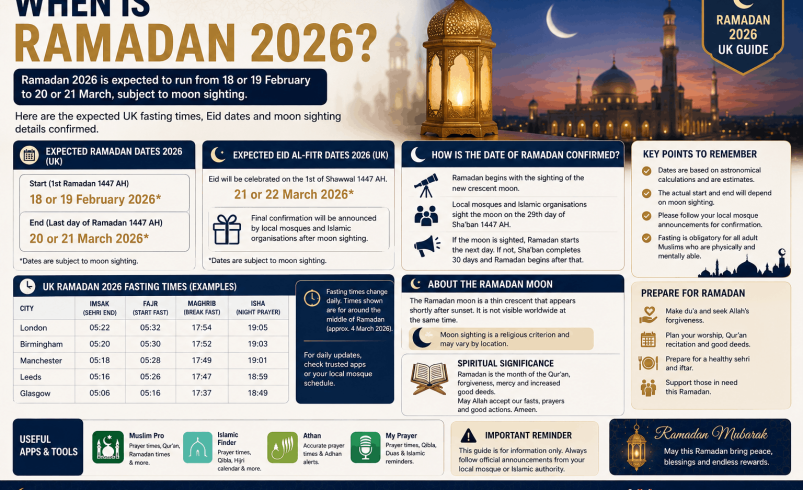
When is Ramadan 2026? For most UK Muslims, Ramadan 2026 began on Wednesday 18 February and ended on Thursday 19 March, with Eid al-Fitr falling on Friday 20 March. Some UK mosques that follow local British moon sighting started a day later, on 19 February, and marked Eid on 21 March. This piece confirms exactly what happened, why the date split across two days again this year, and what it meant for fasting hours, Laylat al-Qadr and Eid across the UK.
Every year, this question gets asked before the month even begins, when the answer is still a forecast. We’re writing this after Ramadan 2026 has already taken place, so instead of guessing at a moon sighting, we can tell you precisely what was confirmed and by whom.
[Image: crescent moon over a UK mosque silhouette — use royalty-free image from Unsplash or Pexels]
Ramadan is the ninth month of the Islamic lunar calendar, so its Gregorian date shifts back by roughly 10 to 11 days every year. In 2026, that shift put the start of Ramadan in mid-February rather than March, where it fell in 2025.
The new crescent moon for Ramadan 1447 AH was sighted in Saudi Arabia on the evening of Tuesday 17 February 2026. Saudi authorities, along with the UAE, Qatar, Kuwait, Bahrain and Iraq, confirmed Wednesday 18 February as the first day of fasting. Most UK mosques follow this Saudi-aligned announcement, so the majority of British Muslims began their first fast on 18 February.
A separate group of UK mosques and Islamic councils follows local moon sighting carried out by the New Crescent Society, an astronomy group based in the British Isles. The moon wasn’t visible in the UK on 17 February, so this group observed Sha’ban as a 30-day month and began fasting on Thursday 19 February, after the moon was sighted over Britain the previous evening.
| UK moon sighting method | Ramadan 2026 start date | First day of fasting |
| Follows Saudi Arabia’s announcement | Evening of 17 February | Wednesday 18 February |
| Follows New Crescent Society (local UK sighting) | Evening of 18 February | Thursday 19 February |
[Table: side-by-side comparison of UK mosques by moon sighting method, with example mosque or council names if available]
Neither method is more “correct” than the other. Both are recognised, long-standing approaches within Sunni jurisprudence, and the one-day gap between them is normal, not a sign of confusion or error.
The reason comes down to a difference in Islamic legal opinion, not a scientific disagreement. Some scholars and communities accept a sighting made anywhere in the world, typically Saudi Arabia, as valid for Muslims everywhere. Others hold that the moon must be sighted locally, or at least within a similar longitude, before the new month can begin where you live.
The European Council for Fatwa and Research examined the astronomical data and concluded that the moon born on 17 February would not be visible anywhere in Europe that evening. It recommended Thursday 19 February as the start of Ramadan for mosques following its guidance, which lines up with the New Crescent Society’s local finding.
This isn’t unique to 2026. The UK has split across two Ramadan start dates in most recent years, and the same pattern is likely again in future years whenever the sighting is marginal rather than clear cut.
Ramadan lasts either 29 or 30 days, depending on when the following new moon, marking the start of Shawwal, is sighted.
For UK Muslims who began fasting on 18 February, the moon for Shawwal wasn’t sighted on the evening of 18 March, so Ramadan ran the full 30 days, ending on Thursday 19 March. This group celebrated Eid al-Fitr on Friday 20 March.
For those who began on 19 February, Ramadan also ran 30 days, taking the final day of fasting to Friday 20 March and Eid al-Fitr to Saturday 21 March.
Eid al-Fitr, the festival marking the end of Ramadan, fell on Friday 20 March 2026 for the majority of UK Muslims who had followed the Saudi-aligned start date. Saudi Arabia, the UAE, Qatar, Kuwait, Bahrain, Turkey and most other countries that hadn’t sighted the Shawwal moon on 18 March also marked Eid on 20 March, after completing 30 days of fasting.
Muslims who had started Ramadan a day later, on 19 February, celebrated Eid al-Fitr on Saturday 21 March 2026, following the New Crescent Society’s local sighting.
Eid prayers took place at mosques and larger outdoor venues across the country that morning, followed by family visits, gift-giving and shared meals. Many UK charities and community groups also hosted open Eid celebrations in cities including London, Birmingham, Manchester and Leicester.
[Image: UK mosque Eid prayer gathering — use royalty-free image from Unsplash or Pexels]
Fasting hours in the UK during Ramadan 2026 ran from around 11 to just over 13 hours a day, shorter than a summer Ramadan because the month fell in February and March, when daylight hours are still relatively limited.
At the start of Ramadan, iftar (the meal that breaks the fast) fell at around 5:30pm across most of England. By the end of the month, as clocks moved closer to British Summer Time and daylight hours lengthened, iftar shifted to around 6:20 to 6:30pm.
| Stage of Ramadan 2026 | Approximate suhoor ends | Approximate iftar |
| Early Ramadan (18 to 19 Feb) | 5:45am to 6:00am | 5:25pm to 5:35pm |
| Mid Ramadan (early March) | 5:15am to 5:30am | 5:50pm to 6:00pm |
| Late Ramadan (mid to late March) | 4:40am to 5:00am | 6:15pm to 6:30pm |
[Table: exact daily suhoor and iftar times for major UK cities, sourced from a verified mosque or Islamic Relief UK timetable]
Fasting times vary by a few minutes between UK cities depending on latitude, so Muslims in Aberdeen or Glasgow saw slightly longer fasts than those in London or Cardiff. Always check your local mosque’s printed timetable rather than a national average, since local calculation methods can differ by a minute or two.
Laylat al-Qadr, the Night of Power, falls among the last ten odd-numbered nights of Ramadan and is widely regarded as the most significant night of the Islamic year. Many UK mosques treated the night of the 27th as the most likely date, though scholars have always maintained that its exact date is deliberately unknown.
For Muslims who began Ramadan on 18 February, the 27th night fell on the evening of Wednesday 16 March 2026. For those who began on 19 February, it fell on the evening of Thursday 17 March 2026.
Mosques across the UK extended night prayers, known as Taraweeh, throughout the final ten nights, with many holding all-night vigils, or i’tikaf, in the last ten days of the month.
UK employers don’t have a specific legal duty tied only to Ramadan, but the Equality Act 2010 covers religion or belief as a protected characteristic, and refusing a reasonable request linked to fasting, such as adjusted break times or annual leave for Eid, can amount to indirect discrimination if there’s no good reason for the refusal. ACAS recommends that employers discuss requests early and apply the same flexibility they’d offer for any other religious observance.
Most UK state schools don’t require pupils to fast, and headteachers generally use their own discretion on things like PE participation or exam scheduling during Ramadan. If your child is fasting and has exams or sports fixtures during the month, it’s worth flagging this with the school in writing before the term starts.
Zakat al-Fitr is a charitable payment due from every Muslim household before Eid prayer, separate from the annual Zakat calculated on savings. For Ramadan 2026, the deadline fell before Eid prayer on 20 or 21 March, depending on which date your mosque observed.
The recommended amount changes each year and depends on the average cost of a staple food such as wheat or rice, so it’s worth checking directly with a recognised UK Islamic charity, such as Islamic Relief UK or the National Zakat Foundation, for the current figure before paying.
[Table: Zakat al-Fitr recommended amount by UK charity, updated for the relevant year]
Q: When did Ramadan 2026 start in the UK? Most UK Muslims started fasting on Wednesday 18 February 2026, following Saudi Arabia’s moon sighting announcement. A separate group of UK mosques, following local British moon sighting through the New Crescent Society, started a day later on Thursday 19 February 2026.
Q: When did Ramadan 2026 end? Ramadan 2026 ended on Thursday 19 March for those who started on 18 February, and on Friday 20 March for those who started on 19 February. Both groups fasted for a full 30 days, since the Shawwal crescent wasn’t sighted the evening before either end date.
Q: Was Ramadan 2026 29 or 30 days long? It was 30 days long for the majority of UK Muslims. This happens when the crescent moon marking the start of the following month, Shawwal, isn’t visible on the 29th night, so the current month completes its full lunar cycle instead.
Q: When was Eid al-Fitr 2026 in the UK? Eid al-Fitr fell on Friday 20 March 2026 for most UK Muslims, and on Saturday 21 March 2026 for those following local UK moon sighting. Both dates followed 30 completed days of fasting.
Q: How many hours did Muslims fast during Ramadan 2026 in the UK? Fasting hours ran from around 11 hours at the start of the month to just over 13 hours by the end, as daylight hours lengthened through February and March. Exact times varied by a few minutes depending on location within the UK.
Q: Why do UK mosques sometimes start Ramadan on different days? It comes down to differing scholarly views on moon sighting: some mosques accept a sighting made anywhere in the world, typically Saudi Arabia, while others require the moon to be sighted locally in Britain before the new month begins. Both approaches are recognised within Islamic jurisprudence.
Q: When was Laylat al-Qadr 2026? Laylat al-Qadr fell among the last ten odd nights of Ramadan, most commonly observed on the 27th night. That fell on the evening of 16 March for those who started Ramadan on 18 February, and 17 March for those who started on 19 February.
Q: Do I have to tell my employer I’m fasting for Ramadan? You don’t have to disclose it, but telling your employer early makes it easier to arrange adjusted breaks, shift changes or leave for Eid. Under the Equality Act 2010, an unreasonable refusal of a fasting-related request can amount to indirect religious discrimination.