Share Code UK: How to Get and Use One for Work
- August 18, 2026
- 0
If you’ve been asked for a share code by a new employer or a landlord, it’s a nine-character code you generate yourself on GOV.UK to prove your immigration
If you’ve been asked for a share code by a new employer or a landlord, it’s a nine-character code you generate yourself on GOV.UK to prove your immigration
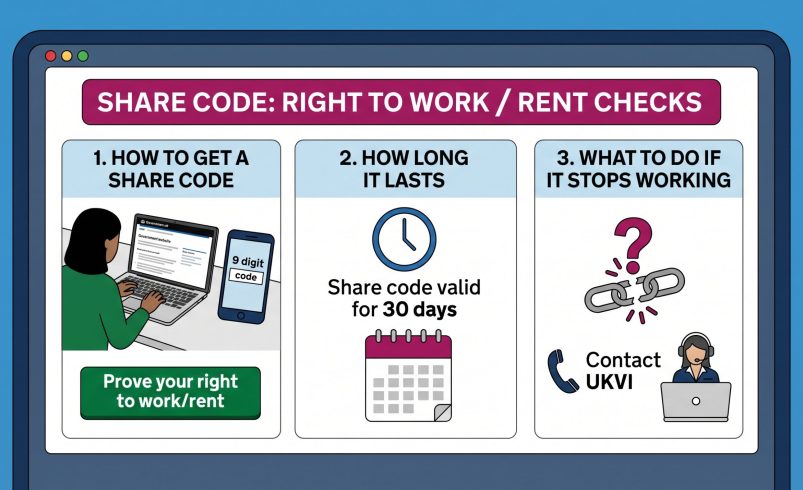
If you’ve been asked for a share code by a new employer or a landlord, it’s a nine-character code you generate yourself on GOV.UK to prove your immigration status digitally. You don’t send documents by post or turn up with a physical card. You log into an online account, answer a few questions, and the system gives you a code the other person types in to see your record.
This guide covers everything a UK adult is likely to need: who has to generate a share code, who doesn’t, exactly how to get one, how the right to work and right to rent versions differ, how long a code lasts, and what to do when a code won’t work or your employer says it’s expired. There’s also a section on the fines employers and landlords face if they get the checking process wrong, since that context explains why they’re often so insistent about seeing one.
A share code is a temporary access key. It links to your Home Office immigration record so that someone else, usually an employer or a landlord, can view your status without you handing over a passport or biometric residence permit. British and Irish citizens cannot get a share code. If you’re a British or Irish citizen, you prove your right to work with a passport, and you never need this system at all.
For everyone else, the code itself proves nothing on its own. It’s the key that unlocks a live Home Office lookup, not a certificate you print out and keep. Each code is tied to one person and one purpose (work or rent), and it isn’t transferable.
[Image: photo of someone using a smartphone to check a government website, use royalty-free image from Unsplash or Pexels]
A right to work share code applies specifically to proving you’re allowed to work in the UK, as distinct from the separate right to rent version covered further down.
If you hold a British or Irish passport, current or expired, that’s all you need to show a new employer. Without a passport, you can instead use a UK or Irish birth or adoption certificate, or a certificate of registration or naturalisation, alongside an official letter from HMRC, the DWP, or the Social Security Agency in Northern Ireland showing your name and National Insurance number.
If you’re not a British or Irish citizen, you can prove your right to work with a share code or your eligible immigration documents. You can choose which one to use, and your employer cannot reject your application because you gave them an eligible immigration document instead of a share code. In practice, most people whose status is held only online, rather than on a physical document, end up using the share code route because it’s the more straightforward option.
You can also get a share code if you’re a British or Commonwealth citizen holding a digital certificate of entitlement to the right of abode, though you cannot get a share code if your certificate of entitlement is a vignette sticker in your passport, since that route uses the physical document instead.
Getting a share code is a short process you complete yourself. You don’t need an appointment, and there’s no fee.
Before you begin, have one of the following to hand: your BRP number, or your passport or national identity card. You’ll also need access to your UKVI account, which you’ll already have if you’ve applied for a visa, used the UK Immigration: ID Check app, applied to the EU Settlement Scheme, or set up access to an eVisa.
[Table: share code services on GOV.UK, columns for purpose, service name, who uses it]
| Purpose | GOV.UK service | Who uses the code |
| Right to work | Prove your right to work to an employer | Employer checks it via “view a job applicant’s right to work” |
| Right to rent | Prove your right to rent to a landlord | Landlord checks it via “Check a tenant’s right to rent” |
| Right of abode | Digital certificate of entitlement route | Employer or landlord, depending on context |
If you were used to carrying a physical biometric residence permit, that card is no longer the main way to prove your status. Biometric residence permits (BRPs) are cards that were used to prove immigration status. All BRPs have now expired and have been replaced by eVisas. An eVisa is simply the digital record that has taken over from the plastic card.
That doesn’t mean your immigration permission has changed. If you have an expired BRP and still have permission to stay in the UK, you need to create a UK Visas and Immigration (UKVI) account to get access to your eVisa. Once your account is set up, generating a share code works the same way whether your status originally came through a BRP, an EU Settlement Scheme decision, or a fully digital visa application.
For the right to work service specifically, a physical BRP can still be used as your identity document to unlock the process. A biometric residence permit can be used for 18 months after the expiry date printed on the card when generating a share code through this route. Separately, for general purposes, you might be able to use your expired BRP for 24 months after the expiry date printed on the card, or until 31 December 2026, whichever comes first. The two figures apply to different situations, so if your BRP has been expired a while, don’t assume it will always work as your ID document. Log in with your passport or national identity card instead if you run into problems.
Getting a share code costs nothing, and the code itself has a fixed shelf life once it’s generated. The service is free and the code is usually valid for 90 days and can be reused during that period.
That reuse matters in practice. If you’re job hunting and speaking to several employers in the same window, you can hand the same code to each of them rather than generating a fresh one for every application, provided the 90 days haven’t run out. Once the code expires, you go back to your UKVI account and generate a new one at no cost.
Keep the share code and your date of birth together, since an employer or landlord needs both pieces of information to run the check, not the code alone.
Once you’ve handed over your code, the employer’s side of the process is quick. Employers use the GOV.UK “check a job applicant’s right to work” service at gov.uk/view-right-to-work, entering the worker’s share code and date of birth, then viewing the live Home Office record.
The result shows the employer whether you have permission to work, what kind of work you’re allowed to do, and how long that permission lasts. Employers can also check someone’s original documents instead of a share code, and British or Irish citizens cannot get a share code in the first place, so if a candidate says they’re British, don’t ask them for one. A correctly completed check like this gives the employer a statutory excuse, meaning they’re protected from a civil penalty even if it later turns out the worker’s status had a problem the check couldn’t have picked up.
Right to rent works on the same principle as right to work but through a separate GOV.UK service, aimed at landlords and letting agents in England rather than employers.
A tenant with digital-only status generates their code through the “prove your right to rent” side of the service, which produces a code beginning with the letter R rather than the general format used for work. The landlord then enters that code and the tenant’s date of birth into the “Check a tenant’s right to rent in England” service to see whether the tenant has an unlimited or time-limited right to rent.
If your status is time-limited, expect your landlord to come back for a follow-up check nearer your permission’s expiry date. This time-limited statutory excuse lasts until whichever of the following occurs last: 12 months from the date of the right to rent check, the expiry of the individual’s permission to be in the UK, or the expiry of the validity of their document evidencing their right to rent. Your landlord isn’t being unreasonable by asking again. It’s a legal requirement on their side to keep their own protection against a penalty.
Employers and landlords aren’t just being cautious for the sake of it. Both sides of the system carry real financial risk if they skip the check or don’t do it properly.
For employers, liable parties can face final penalty values well into six figures where multiple workers are involved, and the framework behind those figures is set out in a Home Office code of practice that came into force on 13 February 2024. Under that code, the starting points are as follows.
[Table: illegal working civil penalty amounts]
| Breach type | Maximum penalty per worker |
| First breach within 3 years | £45,000 |
| Repeat breach within 3 years | £60,000 |
An employer who pays within 21 days of a first-breach penalty notice can usually claim a 30% reduction under the Fast Payment Option, cutting a £45,000 figure down considerably, though the exact reduction depends on the individual case.
Landlords face a comparable, though separate, framework under the right to rent scheme. The civil penalty amount is determined by reference to whether the breach is a first or repeat breach, and whether the disqualified individual is a lodger or an occupier.
[Table: right to rent civil penalty amounts]
| Type of tenant | First breach (3 years) | Repeat breach (3 years) |
| Lodger | £5,000 | £10,000 |
| Occupier | £10,000 | £20,000 |
The Faster Payment Option reduces the final penalty amount from £5,000 to £3,500 per occupier for a lodger, or from £10,000 to £7,000 per occupier, where the landlord pays within 21 calendar days of the penalty notice. These figures come from the code of practice due to take effect on 1 October 2026, and third-party industry guides describe broadly the same amounts as already applying under the version in force earlier in 2026, so the framework isn’t expected to shift dramatically around that date. [FACT UNVERIFIED, CHECK BEFORE PUBLISHING: confirm whether the outgoing sixth code, in force until 30 September 2026, used identical penalty figures to the incoming seventh code]
None of this is your responsibility as the worker or tenant generating the code. It’s context for why the process feels formal: your employer or landlord has genuine financial exposure if they skip it or get it wrong, which is exactly why a valid share code matters to them as much as it does to you.
A handful of issues come up repeatedly, and most have a straightforward fix.
[Image: screenshot of the GOV.UK “get a share code online” start page]
Q: What is a share code and who needs one? A share code is a nine-character code, generated free on GOV.UK, that lets an employer or landlord view your immigration status online. Non-British and non-Irish citizens generally need one, along with British or Commonwealth citizens using a digital certificate of entitlement. British and Irish citizens don’t need a share code at all.
Q: How do I get a share code for right to work? Go to the GOV.UK “prove your right to work to an employer” service, sign in with your UKVI account details or verify using your BRP number, passport, or national identity card, then select the right to work option. The system generates your code instantly, and it’s completely free.
Q: How long does a share code last? A share code is usually valid for 90 days from the point you generate it, and you can reuse the same code as many times as you like within that window. Once it expires, you simply generate a new one at no cost.
Q: Can I use the same share code for right to work and right to rent? No. The two services generate different codes for different purposes, and a right to rent code starts with the letter R. Make sure you select the correct option on GOV.UK depending on whether your employer or your landlord is asking for it.
Q: What if I don’t have a share code and can’t generate one? You can prove your right to work using your original eligible immigration documents instead, and your employer can’t refuse this in favour of a share code. If you’re genuinely unable to provide either, your employer can use the Home Office employer checking service to confirm your status directly.
Q: Does my share code expire if I change jobs? No, the 90-day validity period is tied to when the code was generated, not to a specific employer. You can give the same valid code to a new employer as long as it hasn’t expired, though many people generate a fresh one anyway for a clean record.
Q: Can my employer ask for a share code if I’m British? No. British and Irish citizens cannot get a share code, and an employer should be checking a passport or one of the alternative documents instead. If an employer insists on a share code from a British citizen, that’s a misunderstanding of the process on their part.
Q: What happens if my BRP has expired? Your immigration permission doesn’t end just because the physical card has expired. You’ll need a UKVI account to access your eVisa and generate a share code, and for this specific service, an expired BRP can still be used as your identity document for up to 18 months after the printed expiry date.