Is CricHD Illegal in the UK? The Facts and Safer Options
- August 18, 2026
- 0
You’ve typed “CricHD” into Google because you want to watch cricket without paying for a subscription, and you want to know if that’s going to land you in
You’ve typed “CricHD” into Google because you want to watch cricket without paying for a subscription, and you want to know if that’s going to land you in
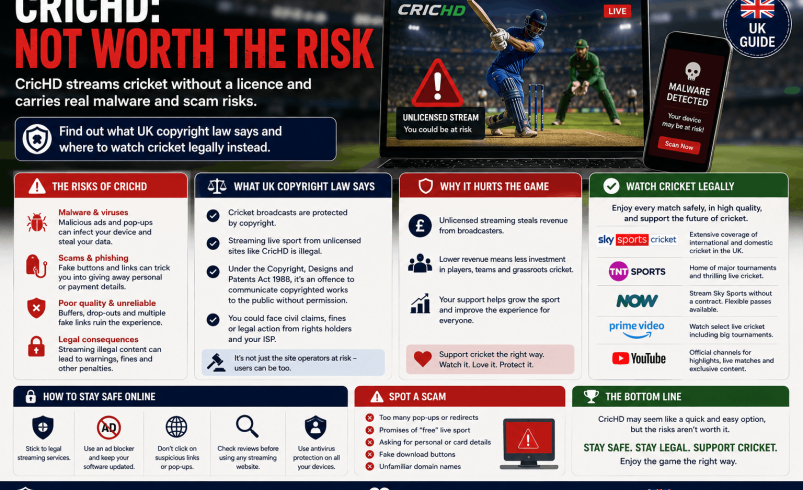
You’ve typed “CricHD” into Google because you want to watch cricket without paying for a subscription, and you want to know if that’s going to land you in trouble. The short answer is that CricHD is an unlicensed streaming site, and using it isn’t safe even if prosecution of an individual viewer is unlikely. This post explains what UK copyright law actually says, what CricHD’s own track record shows about the risks, and which legal options give you the same matches without the malware, scam ads, or unstable links.
Yes. CricHD is a link directory that streams cricket, football and other sport without holding broadcasting rights from the leagues, boards or broadcasters involved. It doesn’t pay the England and Wales Cricket Board, Sky, or any other rights holder for the content it distributes, which makes the site’s operation a breach of UK copyright law.
The site itself isn’t one fixed address. It operates as a brand name across a rotating set of domains, and several of those domains have already been shut down by law enforcement.
[Image: screenshot of a government domain seizure notice — use royalty-free image from Unsplash or Pexels]
That’s three separate enforcement actions against the same brand across different years. Taking down one domain doesn’t stop a near-identical replacement appearing soon after, because the site never held any rights to lose in the first place. If you’re currently on a version of CricHD, there’s a good chance it’s already been flagged, blocked by your ISP, or seized once already under a different name.
The Copyright, Designs and Patents Act 1988 (CDPA) is the law that gives cricket broadcasters and rights holders control over how their footage is shown and distributed. Sites like CricHD infringe that law by transmitting matches to the public without a licence from the rights owner. That’s clear enough. What’s less obvious to most readers is where the legal risk actually falls.
The Digital Economy Act 2017 raised the maximum sentence for online copyright infringement from two years to ten, bringing online offences in line with physical piracy. That change targets the operators who run and profit from sites like CricHD: the people uploading streams, selling ad space, or distributing infringing copies. A UK operator of a pirate Premier League streaming service was jailed for five years, and two suppliers of illicit streaming devices received four and a half years each, both under earlier versions of this law.
Individual viewers who watch a stream without downloading or redistributing it are extremely unlikely to face criminal charges. The Digital Economy Act was written to catch people who make copyrighted content available, not people who passively watch it, and the government has said the ten-year sentence is intended for the most serious cases. That said, “unlikely to be prosecuted” isn’t the same as “risk-free.” Rights holders can still pursue civil claims in theory, and the bigger practical dangers, which the next section covers, have nothing to do with prosecution at all.
This is the gap that most guides to CricHD skip over: the legal question is almost beside the point when the security risks are this well documented.
A 2019 study by the Digital Citizens Alliance found that close to one in three piracy sites exposed visitors to malware. A follow-up 2022 investigation, run jointly with White Bullet and the cybersecurity firm Unit 221B, tracked how piracy operators and ad networks profit from malicious adverts, estimating the ecosystem generates over $121 million from tricking visitors into installing malware, including ransomware that locks a device’s files and demands payment to release them.
CricHD-style pages don’t host the streams themselves. They act as a link hub that sends you to third-party embedded players, and it’s those third-party players and the ad networks around them that carry most of the risk. A single misplaced click on a pop-up or a fake “play” button is often all it takes.
A 2023 Digital Citizens Alliance investigation found that people who used a credit card to sign up for a piracy streaming subscription were four times more likely to report fraudulent charges than people who stuck to licensed services. Some CricHD mirrors and lookalike apps push “premium” upgrades or ask for card details to remove ads, and neither is backed by any real customer service if the charge turns out to be unauthorised.
[Table: comparison of typical illegal streaming site risks vs licensed UK broadcasters, showing malware exposure, payment safety, stream reliability and legal status]
Licensed UK services such as Sky, NOW and the BBC are registered UK businesses. If a stream drops out, a payment fails, or you want to cancel, you have a real company to contact, and your consumer rights under UK law apply.
None of that exists with CricHD. There’s no registered company behind it, no UK contact address, and no complaints process. If a mirror site takes your card details and the “subscription” turns out to be a scam, you’re not covered by the Consumer Rights Act 2015 in any meaningful way, because there’s no legitimate trader to hold to account. Your bank’s fraud team is your only real recourse, and even then, recovering the money isn’t guaranteed.
The good news is that UK cricket coverage is genuinely strong, and a decent chunk of it doesn’t cost anything at all.
The BBC shows a set number of live matches each summer without a subscription. For The Hundred 2026, that’s 16 matches shown live on BBC Two and BBC iPlayer, including the opening fixture and both finals. You’ll need a UK postcode, a free BBC account, and a valid TV licence to use iPlayer. Every match of The Hundred also gets ball-by-ball radio commentary on BBC Radio 5 Live and BBC Sounds, and Sky Sports streams a selection of matches free on its own YouTube channel.
Channel 5 also carries four live men’s T20 international fixtures a year free-to-air, under a four-year deal agreed with the ECB.
Sky Sports Cricket holds the rights to the full England international summer (Tests, ODIs and T20Is), the IPL, and every match of The Hundred. If you don’t want a long Sky contract, NOW gives you the same channels with no fixed term.
| Service | What it covers | Price | Contract |
| NOW Sports Day Pass | All Sky Sports channels for 24 hours | £14.99 | None |
| NOW Sports monthly pass | All Sky Sports channels | From £27.99 to £34.99 a month | None |
| Sky Sports (via Sky TV) | All Sky Sports channels, including cricket | From £20 a month as an add-on | Typically 24 months |
| TNT Sports via discovery+ | Football and rugby rights, not cricket | £30.99 a month | None |
| BBC iPlayer | 16 Hundred matches plus finals | Free with a TV licence | None |
Prices for pay-TV packages change often and rise mid-contract, so check the Sky and NOW websites for the current rate before you sign up. A single £14.99 day pass covers you for any one-off match without committing to a monthly subscription at all.
[Table: Sky Sports vs NOW Sports vs BBC iPlayer for cricket coverage — full comparison as above]
A few signs are consistent across CricHD and similar sites, so it’s worth knowing what to look for before you click through from a search result or a forum link.
Q: Is it illegal to watch CricHD in the UK? Watching an illegal stream isn’t the same offence as running one, and individual viewers are very unlikely to face prosecution. The bigger risks are practical, not legal: malware, scam charges and unreliable streams, none of which come with any consumer protection if they go wrong.
Q: Can you get in trouble for using illegal streaming sites? It depends on what you’re doing. UK law under the Digital Economy Act 2017 targets people who distribute or make content available, with sentences of up to ten years for the most serious operators. Simply watching a stream carries a much lower legal risk, though it still isn’t advisable given the security issues involved.
Q: Why does CricHD keep coming back after being shut down? Because it’s a brand name, not a fixed site. The people behind it have never held broadcasting rights, so seizing one domain doesn’t stop a near-identical replacement appearing under a slightly different address soon after.
Q: Is CricHD safe to use? No. Independent research has repeatedly found piracy sites in this category carry a much higher risk of malware, malicious ads and fraudulent card charges than licensed streaming services, and CricHD-style link hubs route you through third-party players that are outside anyone’s control.
Q: What’s the cheapest legal way to watch cricket in the UK? BBC iPlayer is free with a TV licence and shows 16 matches of The Hundred each year, including both finals. For matches only on Sky, a NOW Sports Day Pass at £14.99 covers a single fixture with no ongoing commitment.
Q: Does Sky Sports show every cricket match live? Yes, Sky Sports Cricket carries the full England international summer, the IPL and every game of The Hundred. Some Hundred matches are also shown free on BBC Two, BBC iPlayer and Sky Sports’ YouTube channel.
Q: Can I be fined for watching an illegal stream? There’s no fixed fine for individual viewers written into UK law, and prosecutions of viewers (as opposed to site operators) are rare. The realistic financial risk comes from card fraud or scam subscriptions on the site itself, not from a legal penalty.
Q: Are CricHD apps on the Play Store or App Store safe? There’s no verified official CricHD app on either store. Unofficial APKs found through search or forum links carry a genuine malware risk, since they haven’t been through any app store’s security checks.