
 Haris
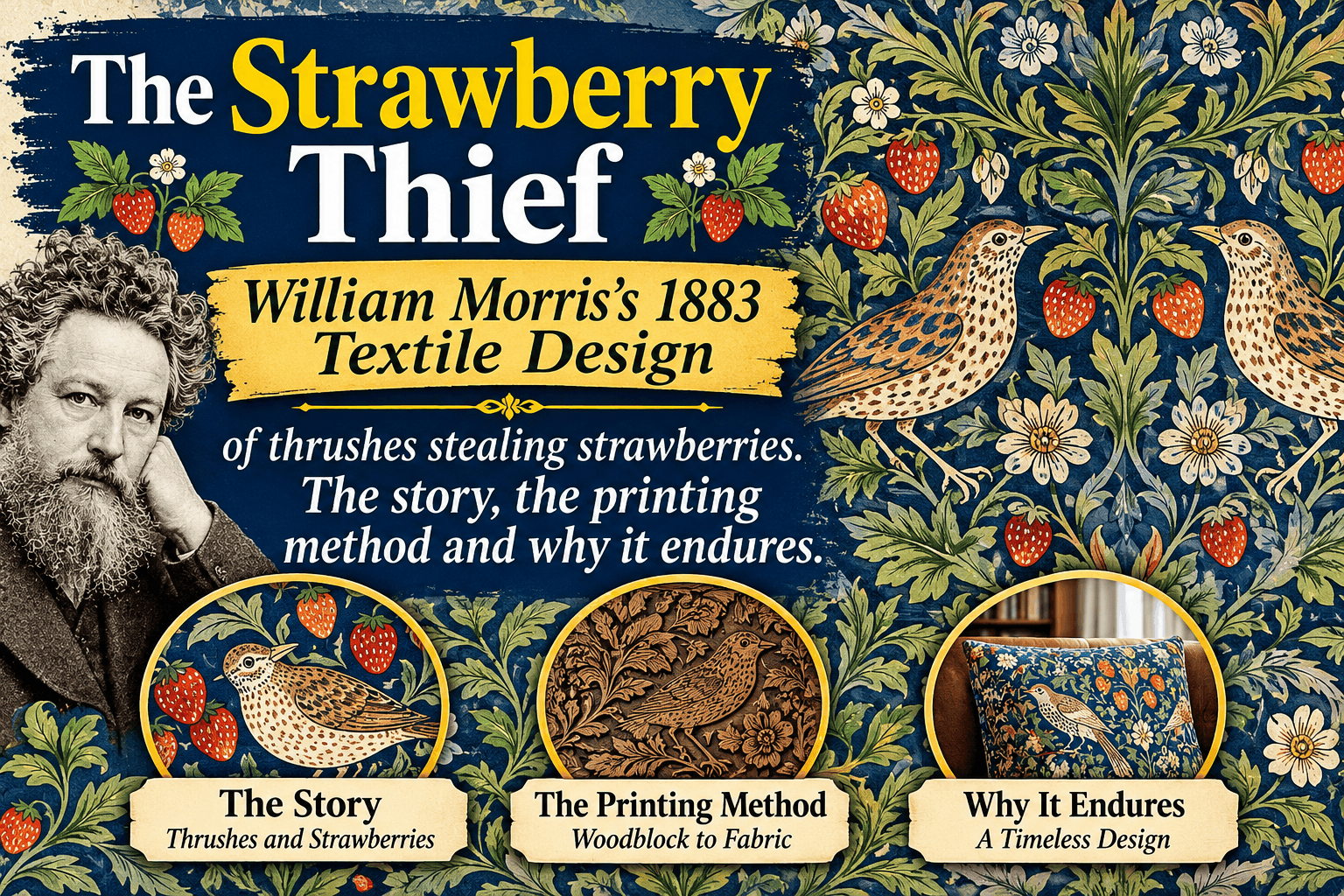
The Strawberry Thief is one of William Morris’s most famous textile designs, created in 1883 and still printed today on everything from curtains to tea towels . The pattern shows thrushes stealing strawberries in the kitchen garden of Morris’s home, Kelmscott Manor in Oxfordshire . It is not a single object. It is a repeating design that Morris registered with the Patent Office after years of trying to perfect the complex indigo discharge printing method . This guide explains the story behind the pattern, how it was made, and why it remains one of the most recognisable British designs more than 140 years later.
The Story Behind the Name
The design is based on something Morris actually watched happen. Thrushes kept stealing strawberries from his kitchen garden at Kelmscott Manor, and he found the birds fascinating rather than annoying . His daughter May Morris later recalled: “You can picture my Father going out in the early morning and watching the rascally thrushes at work on the fruit beds and telling the gardener who growls, I’d like to wring their necks! that no bird in the garden must be touched” .
That story gives the design its charm. It is not a decorative pattern invented in a studio. It is a record of a small, real moment in a garden, turned into a repeat that has been printed on fabric for well over a century.
The Printing Technique That Took Years to Master
The Strawberry Thief was not easy to make. Morris used the indigo discharge method, an ancient technique he admired for the depth of colour and crispness of detail it produced . The process worked like this: the entire cloth was first dyed blue with indigo. Then a bleaching agent was applied to the areas that would become the lighter colours, and the fabric was block-printed with additional colours . It took days to complete, which is why it was one of Morris & Co.’s most expensive cottons .
Morris first tried to print by this method in 1875, but he did not succeed until 1881, when he moved into his factory at Merton Abbey, near Wimbledon . In May 1883, he wrote to his daughter: “I was a great deal at Merton last week … anxiously superintending the first printing of the Strawberry thief, which I think we shall manage this time” .
He was right. The print worked, and he registered the design with the Patent Office. It was the first design using this technique in which red (alizarin dye) and yellow (weld) were added to the basic blue and white ground .
Why It Became So Popular
The price did not put customers off. Despite being one of the most expensive printed furnishings Morris & Co. sold, the Strawberry Thief became a firm favourite . The Art Institute of Chicago notes that the small birds invading a strawberry patch have charmed consumers for more than 120 years, making it one of the most recognisable and popular Morris & Co. patterns .
Part of the appeal is the design itself. Morris drew on Islamic textiles for the flattened profile of the birds and the stylisation of the plant forms, which gives the pattern a decorative quality that feels both natural and ordered . The repeat is made up of pairs of thrushes perched among foliage, with one pair “warbling” and another pair about to break off ripe strawberries . It is a small drama, repeated across the fabric.
The Design in the 21st Century
The Strawberry Thief has not stayed in the 19th century. It has been adapted and reused in ways Morris could not have imagined.
Video game. In 2014, designer Sophia George released a game based on the pattern while working as the first Game Designer in Residence at the Victoria and Albert Museum. The player controls a bird flying around the screen, gradually colouring in the design .
Novel. Joanne Harris’s 2019 novel The Strawberry Thief draws inspiration from the Morris design, though the story is set in a French village and is part of the Chocolat series .
Modern fabric. The pattern is still sold by fabric retailers. Just Fabrics, for example, lists a reduced-scale, recoloured version for curtains, blinds and upholstery, described as “the iconic William Morris Strawberry Thief pattern” .
Collectors’ items. Original pieces are held by major museums. The Victoria and Albert Museum has several examples, including a curtain and a furnishing fabric . The Art Institute of Chicago holds a printed curtain with wool trim and tassels, made between 1883 and 1917 .
Common Misunderstandings
“It is a wallpaper design.” It was designed as a furnishing textile, intended for curtains, wall draping or loose furniture covers . It has since been adapted for wallpaper, but that was not its original purpose.
“Morris designed it in a single attempt.” He first tried the indigo discharge method in 1875 and did not succeed until 1881, with the first successful print in 1883 . It took years of experimentation.
“The birds are decorative inventions.” They are thrushes, and the design is based on Morris’s direct observation of them stealing fruit at Kelmscott Manor .
“It is a cheap, mass-market design.” It was one of the most expensive printed furnishings Morris & Co. produced, precisely because the process was so labour-intensive .
Frequently Asked Questions
What is the Strawberry Thief?
It is a textile design by William Morris, created in 1883, showing thrushes among strawberries and foliage. It is one of his most famous and commercially successful patterns .
Why is it called the Strawberry Thief?
The name comes from the thrushes that stole strawberries from Morris’s kitchen garden at Kelmscott Manor in Oxfordshire. He based the design on watching them .
Where was the Strawberry Thief printed?
It was printed at Merton Abbey, near Wimbledon, the factory Morris moved into in 1881. That is where he finally succeeded with the indigo discharge method .
Can I still buy Strawberry Thief fabric?
Yes. The design is still produced and sold by fabric retailers, often in reduced-scale or recoloured versions for curtains, blinds and upholstery .