 Haris
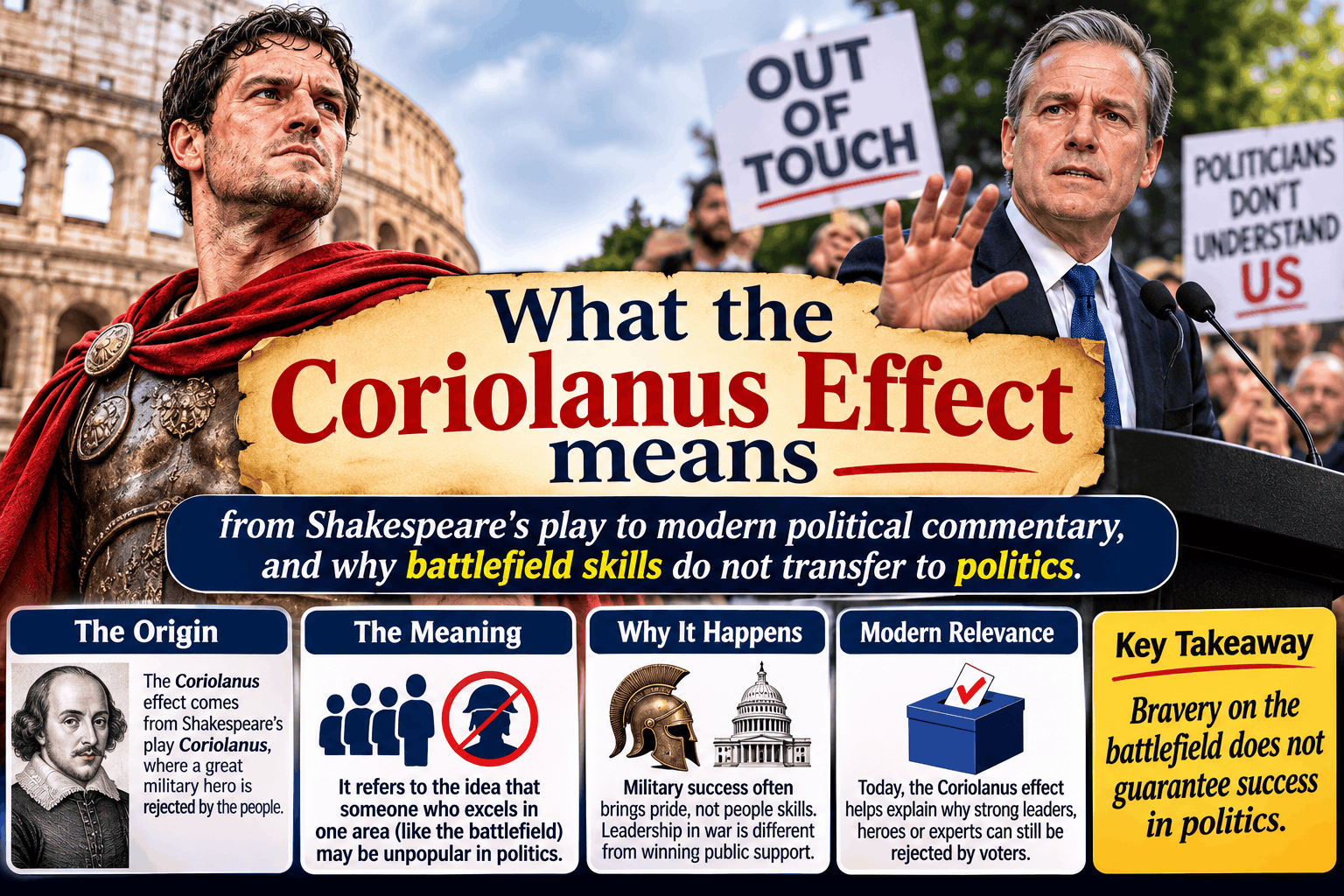
The Coriolanus effect is a term used by journalists and commentators to describe the difficulties a military figure faces when transitioning into political life. It comes from Shakespeare’s tragedy Coriolanus, whose central character is a celebrated general who wins a great battle, is honoured with the name Coriolanus, and then fails disastrously when he seeks political office . The phrase captures a specific pattern: the qualities that make a warrior successful, such as decisiveness, pride and contempt for compromise, become liabilities in a system that requires persuasion, humility and the ability to court public opinion. This guide explains the play, the pattern, and why the term keeps returning in modern political commentary.
The Play Behind the Term
Coriolanus is one of Shakespeare’s late tragedies, and it is famously difficult and historically unpopular . Its protagonist, Caius Martius, is a Roman aristocrat and soldier of extraordinary violence. He earns the name “Coriolanus” after single-handedly capturing the enemy city of Corioles, emerging “drenched in blood” . He has fought in seventeen battles and is described as a “thing of blood” .
The play’s political plot turns on what happens next. Roman custom requires a candidate for consul, the highest public office, to show his battle scars to the plebeians and ask for their votes. Coriolanus refuses. He despises the common people, calling them a “common cry of curs,” and he believes that politics is dishonest performance . Two tribunes, Sicinius and Brutus, exploit his contempt. They manipulate the crowd, and Coriolanus is banished from Rome. In his rage, he joins Rome’s enemies and marches on the city he once defended .
The tragedy is that his personal pride and love of force undo the very cause that pride was meant to serve.
The Pattern the Term Describes
The “Coriolanus effect” is not a formal theory. It is a shorthand for a recurring political story, and journalists use it because the play reads, in LitCharts’ words, “almost like a 21st-century political tragedy” .
The pattern has four elements.
Military success creates political capital. The general returns from victory with prestige and public gratitude. He is encouraged to run for office.
The skills do not transfer. Battle requires decisiveness, command and a clear hierarchy. Politics requires persuasion, compromise and the appearance of humility. Coriolanus is “more strategically prudent at battle than he is at governance” . He cannot adapt to the “performative” nature of political power .
Contempt for the people becomes fatal. Coriolanus does not hide his disdain for the plebeians. He refuses to perform the ritual of showing his scars. He believes his virtue should be enough. It is not. The tribunes use his arrogance against him, and the crowd turns .
The backlash is personal and extreme. Banished and humiliated, Coriolanus does not accept defeat. He joins the enemy. The man who was Rome’s defender becomes its attacker. This is the self-destructive endpoint of the pattern: the warrior who cannot function in peace turns his violence against the society that rejected him .
The Modern Uses of the Term
The term appears most often when a military or authoritarian figure enters democratic politics and struggles with its demands.
The Berggruen Institute published an essay in 2019 arguing that Donald Trump’s presidency resembled Coriolanus “almost too well.” The author, Stephen Marche, drew parallels between Coriolanus’s belief that he alone could save Rome and Trump’s “I alone can fix it” rhetoric. He also noted the shared contempt for political elites and the sense of personal grievance when the political system does not deliver the love the leader believes he is owed .
The essay described “Coriolanism” as “a type of populism without people in it,” where loyalty is divided between the nation and a sense of belonging to a ruling class. It argued that the pattern is global, not just American, and that nationalist parties in Europe often exhibit the same contradiction: running against elites while being led by elites .
This is an opinion, not a settled finding. But it illustrates how the term is used: as a lens for reading a specific kind of political failure.
What the Term Is Not
It is not a scientific concept. It is not a theory of political science with predictive power. It is a literary allusion that journalists and essayists use to make sense of a familiar story.
It is also not related to the Coriolis effect, the scientific principle that causes weather systems to rotate in different directions in the northern and southern hemispheres. The names are similar, but the two have nothing in common beyond the coincidence of letters. The “Coriolanus effect” is about Shakespeare. The Coriolis effect is about the rotation of the Earth.
A separate, satirical use of the phrase appears on Tumblr, inventing a fictional rule about actors playing Malvolio revolving clockwise or counterclockwise . That is a joke, not a recognised usage.
Frequently Asked Questions
What is the Coriolanus effect?
It is a term used by journalists to describe the difficulties a military figure faces when entering politics, drawn from Shakespeare’s Coriolanus. The pattern is that battlefield skills do not transfer to political life, and contempt for the public becomes fatal .
Who was Coriolanus?
Caius Martius Coriolanus is the protagonist of Shakespeare’s tragedy. He is a Roman general who earns his name by capturing the city of Corioles. He is then persuaded to run for consul but refuses to perform the required rituals of public humility, is banished, and turns against Rome .
Why does Coriolanus fail in politics?
He fails because he cannot adapt. He despises the plebeians, refuses to show his scars or ask for their votes, and believes his military virtue should be enough. His pride and inflexibility make him vulnerable to the tribunes, who manipulate the crowd against him .
Is the Coriolanus effect a real theory?
No. It is a literary allusion and a journalistic shorthand, not a formal theory. It is used to illuminate patterns in political behaviour, not to predict them. It is entirely unrelated to the scientific Coriolis effect.