 Haris
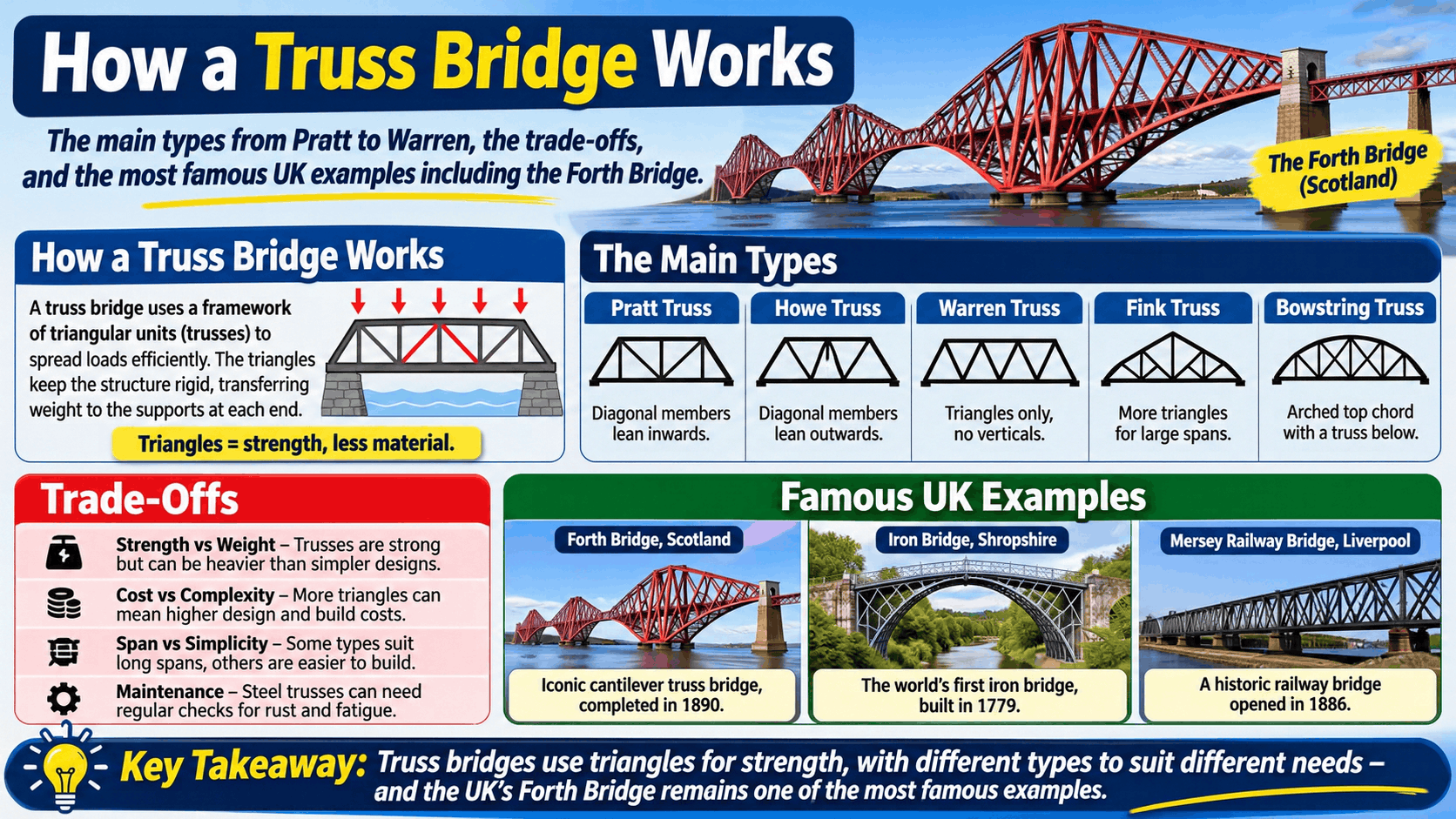
A truss bridge is a bridge whose load-bearing superstructure is built from a framework of interconnected triangles. Those triangles are the defining feature: they cannot be distorted by stress, which is why a relatively small amount of material can carry a considerable load . The design has been in use for centuries, from simple wooden crossings to the steel giants of the railway age, and it remains one of the most efficient ways to span a gap. This guide explains how a truss bridge works, the main types you will encounter, the trade-offs involved, and where you can still see them in the UK.
How a Truss Bridge Actually Works
The principle is simple and elegant. A truss is made up of straight members arranged in a series of triangles. When a load is placed on the bridge, each member is pushed (compression) or pulled (tension). Because a triangle cannot change shape without one of its sides changing length, the structure is inherently stable .
The members themselves are chosen for the forces they will carry. Stiff struts or posts can withstand both tension and compression, while thin rods or bars can only withstand tension. A well-designed truss uses the right member for the right job, which is why truss bridges can be surprisingly light for the weight they support .
The basic anatomy includes a top chord and a bottom chord running the length of the bridge, connected by vertical and diagonal web members. Most trusses have lateral bracing at the top and bottom to keep the two parallel trusses aligned, though pony trusses lack upper bracing .
The Main Types of Truss Bridge
The two most historically significant designs are the Pratt truss and the Warren truss, both developed in the 1840s. The Warren truss, patented in 1848 by two British engineers, Captain James Warren and Theobald Monzani, is recognisable by its alternating diagonals that form a series of equilateral triangles. Its simplicity made it popular in the United States and it is still used today .
The Pratt truss uses diagonals that slope towards the centre of the span, which puts them in tension under gravity loads. Both designs offered simplified fabrication because they used a limited number of different member types, and both could be analysed mathematically, which was a significant advance in the mid-nineteenth century .
Other notable types include the Howe truss (whose diagonals are in compression, making it heavier and more expensive than the Pratt), the Whipple truss, the Town lattice truss (a wooden design patented in 1820), and the Bailey bridge (a portable, prefabricated truss designed in the Second World War for rapid deployment) .
There are also three basic configurations based on where the deck sits: through trusses (deck at the bottom, bracing above), pony trusses (deck at the bottom, no top bracing), and deck trusses (deck on top).
The Trade-Offs: Efficiency vs Maintenance
Truss bridges are efficient, but they are not maintenance-free. The large exposed surface area of the members, particularly in through and pony trusses that are not protected by a deck, means they demand high maintenance .
A more serious structural characteristic is that many trusses are isostatic, meaning every individual member is “fracture critical.” The failure of a single member can lead to the collapse of the entire structure. The 2007 collapse of the I-35W Mississippi River bridge, which killed 13 people, was attributed to the failure of undersized gusset plates. Redundancy can be achieved by adding extra parallel trusses, but this increases cost significantly .
This does not mean truss bridges are unsafe. It means they require rigorous inspection and maintenance, and that the design must account for the loads it will actually carry, not just the loads it was originally designed for.
Truss Bridges in the UK
The UK has several significant truss bridges, and the most famous is a cantilever truss that changed engineering history.
The Forth Bridge, opened in 1890, was the world’s first major steel structure. It uses three balanced cantilever towers joined by suspended spans, with more than 50,000 tonnes of steel and 6.5 million rivets in its iconic red trusses. It held the world record for the longest bridge spans until 1917, and it was inscribed as a UNESCO World Heritage Site in 2015 . It remains a vital rail link carrying thousands of passengers each day .
The Royal Albert Bridge at Saltash, designed by Isambard Kingdom Brunel and opened in 1859, is a lenticular truss, a combination of an arch and a chain that forms a lens shape. It is a fascinating example of a design where it is not immediately clear whether the load is carried by tension in the chain or compression in the arch, a deliberate ambiguity that Brunel used to create a structure that was both efficient and expressive.
What the Longest Spans Tell You
The longest continuous truss span in the world is the Ikitsuki Bridge in Nagasaki Prefecture, Japan, with a main span of 400 metres, opened in 1991. It is followed by the Astoria-Megler Bridge in Oregon, USA, at 376 metres (1966), and the Francis Scott Key Bridge in Baltimore at 366 metres (1977), which was destroyed in 2024 .
These spans are modest compared to suspension bridges, which can exceed 1,900 metres. The truss bridge’s strength is not in achieving the longest possible span but in carrying heavy loads with minimal material over moderate distances, and in being buildable without the massive anchorages that suspension bridges require.
Frequently Asked Questions
What is a truss bridge?
A truss bridge is a bridge built from a framework of interconnected triangles. The triangular structure cannot be distorted by stress, which allows the bridge to carry heavy loads with relatively little material. The members are arranged so that each is in either tension or compression .
What are the main types of truss bridge?
The most common historic types are the Pratt and Warren trusses, both developed in the 1840s. Other types include the Howe, Whipple, Town lattice and Bailey bridge. Trusses are also classified by deck position as through, pony or deck trusses .
What are the advantages and disadvantages of truss bridges?
The advantages are efficiency (high load capacity for the material used) and the ability to span gaps without temporary supports. The disadvantages are high maintenance demands due to exposed surfaces, and the fact that many trusses are fracture-critical, meaning the failure of one member can cause collapse .
What is the most famous truss bridge in the UK?
The Forth Bridge in Scotland is the most famous. Opened in 1890, it was the world’s first major steel structure and is a UNESCO World Heritage Site. It uses a cantilever truss design with three towers and carries thousands of passengers each day .