
 Haris
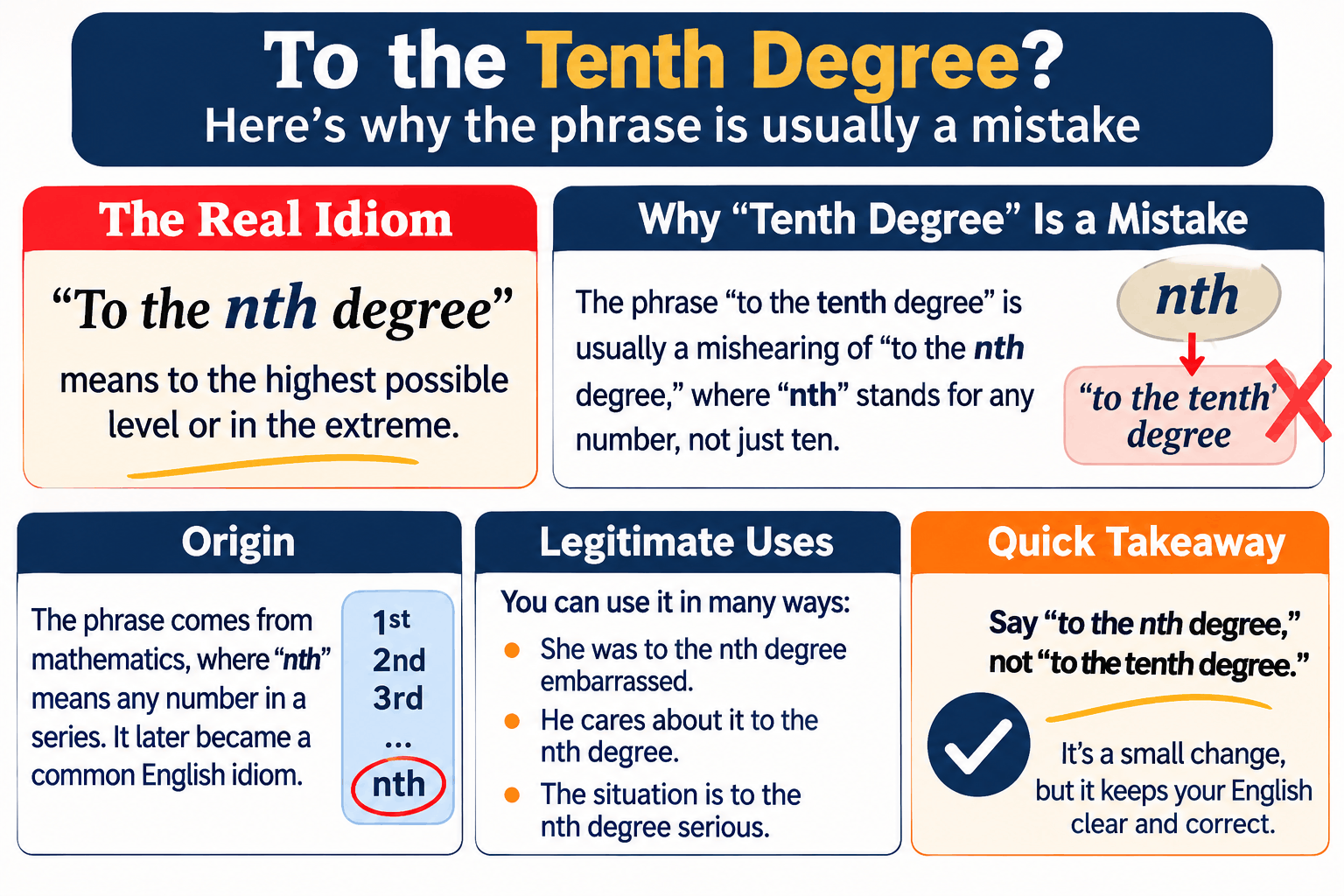
“Tenth degree” is almost always a mishearing or miswriting of “nth degree.” The idiom is “to the nth degree,” meaning to the utmost, as much as possible, or extremely. It comes from mathematics, where *n* stands for any number or power, so “to the nth degree” means to any extent you like. There is no standard English idiom “to the tenth degree.” This guide explains the correct phrase, why the mistake happens, and the specific contexts where “tenth degree” does have a legitimate meaning.
The Correct Idiom: To the Nth Degree
The phrase you are looking for is “to the nth degree.” Every major dictionary defines it the same way. Merriam-Webster says it means “extremely: as much as possible.” Collins says it means doing something or having a quality “to an extreme degree.” The American Heritage Dictionary traces the expression to mathematics and records its first figurative use in 1852.
The *n* in the phrase is a mathematical placeholder. In algebra, *n* can represent any number, so “to the nth degree” means “to whatever power is required.” The phrase transferred from mathematics to everyday speech to mean “to the maximum extent.”
Examples of correct usage:
- “She is a perfectionist to the nth degree.”
- “The film is cheesy to the nth degree, but intentionally so.”
- “He carried discretion to the nth degree.”
Why People Say “Tenth Degree” by Mistake
The confusion is easy to understand. “Nth” is not a common English word outside this idiom. When people hear “to the nth degree” spoken aloud, the “n” sound can be misheard as “en,” and “enth” can become “tenth.” A newspaper columnist for the Gallup Sun noted this exact phenomenon: they heard someone say “to the tenth degree” and recognised it as a mistake, because the correct term is “to the nth degree.”
There is also a logical temptation to substitute a real number for the abstract *n*. If “nth” means “any number,” then “tenth” seems like a specific, impressive number. But the idiom does not work that way. The power of the phrase comes from its abstraction, not from a specific figure.
The Legitimate Uses of “Tenth Degree”
While “to the tenth degree” is not a standard idiom, the phrase “tenth degree” does appear in several specific, legitimate contexts. These are not the idiom, and they should not be confused with it.
Measurement and Precision
In scientific and technical writing, “a tenth of a degree” is a precise quantifier used for small temperature changes or angular measurements. For example: “The experiment requires temperature control to within a tenth of a degree.” This is a legitimate use, but it is a measurement, not an idiom. The phrase is “a tenth of a degree,” not “to the tenth degree.”
Martial Arts Rankings
In some martial arts systems, particularly those with Japanese or Korean roots, a tenth-degree black belt (or 10th dan) is a recognised rank. It is often reserved for founders of systems or awarded posthumously. A martial arts forum discussion notes that in some organisations, 10th dan is “only available posthumously,” and that the rank varies widely between systems. This is a legitimate use of the phrase, but it refers to a specific rank, not to an extreme degree of a quality.
Freemasonry and Other Orders
The term “tenth degree” appears in the Scottish Rite of Freemasonry, where the 10th degree is called “Master Elect.” It also appears in some Christian theological writing referring to a tenth stage of humility. These are specific, technical uses within those traditions.
A Cancelled Atari Game
Tenth Degree was a prototype fighting game developed by Atari Games in 1996. It was tested but never produced, cancelled because Atari cited the poor state of the fighting game market. This is a curiosity, not a common reference.
How to Use the Phrase Correctly
If you want to express that something is extreme or maximal, use “to the nth degree.” That is the idiom, and it is the form that will be understood by anyone familiar with English idiom.
If you are writing about temperature or angles, use “a tenth of a degree” as a measurement.
If you are writing about martial arts, “tenth-degree black belt” is the correct construction.
The one thing to avoid is “to the tenth degree” as a substitute for “to the nth degree.” It is not idiomatic, and it marks the writer as unfamiliar with the phrase.
Frequently Asked Questions
Is “to the tenth degree” correct?
No. The standard idiom is “to the nth degree,” meaning to the utmost or as much as possible. “To the tenth degree” is a common mishearing of the phrase, not a recognised variant.
What does “to the nth degree” mean?
It means extremely, to the highest level, or as much as possible. It comes from mathematics, where *n* stands for any number or power. If someone is “a perfectionist to the nth degree,” they are extremely perfectionist.
Where does the phrase come from?
It comes from mathematics. In algebra, *n* represents an unspecified number, so “to the nth degree” means to any required power. The phrase was first recorded in its figurative sense in 1852.
When is “tenth degree” a legitimate phrase?
It is legitimate in specific contexts: a tenth-degree black belt in some martial arts, the 10th degree in Scottish Rite Freemasonry, or a tenth of a degree as a precise measurement in science. It is not legitimate as a substitute for “to the nth degree.”