 Haris
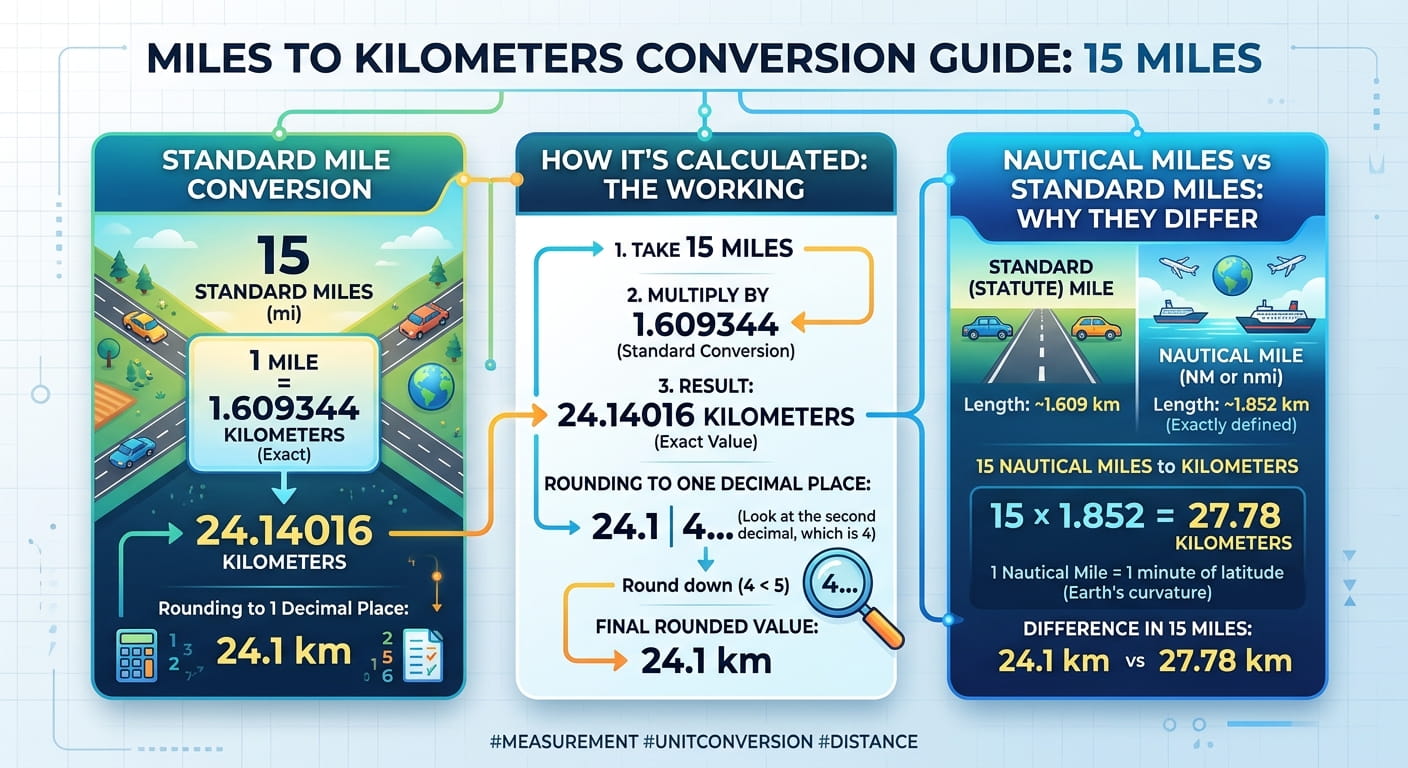
15 miles in km is 24.14016 kilometres using the standard international mile of 1,609.344 metres. Most people round this to 24.1 km, and for almost every practical purpose that is the figure to use. But there are two different miles in circulation, and the difference between them affects the answer. This guide gives the exact conversion, explains the rounding rule, shows the working so you can convert any distance yourself, and flags the historical mile that produces a slightly different result.
The Exact Answer
One international mile is defined as exactly 1,609.344 metres . That definition has been standard since 1959, when the United States and countries of the Commonwealth agreed on a unified yard and pound .
To convert 15 miles to kilometres, multiply by 1.609344:
15 × 1.609344 = 24.14016 km
Rounded to one decimal place, that is 24.1 km. Rounded to two decimal places, it is 24.14 km. For running, driving, cycling or planning a walk, 24.1 km is the number you want.
The Working, So You Can Do It Yourself
The conversion factor is the only thing you need to remember. 1 mile = 1.609344 km.
To convert any distance in miles to kilometres, multiply by 1.609344. To go the other way, from kilometres to miles, divide by 1.609344.
A useful approximation for mental arithmetic is to multiply by 1.6 and add a small amount. For 15 miles, 15 × 1.6 = 24, which is close to the exact 24.14. The approximation is good enough for estimating travel time, but not for anything that requires precision.
| Miles | Kilometres (exact) | Kilometres (1 d.p.) |
| 1 | 1.609344 | 1.6 |
| 5 | 8.04672 | 8.0 |
| 10 | 16.09344 | 16.1 |
| 15 | 24.14016 | 24.1 |
| 20 | 32.18688 | 32.2 |
| 26.2 (marathon) | 42.1648128 | 42.2 |
The Two Miles and Why the Answer Can Differ
There are two miles in historical use, and they give different conversions.
The international mile is the one defined as 1,609.344 metres. It is used in the UK and the US for most purposes, including road distances, athletics and navigation. This is the mile that produces 24.14016 km for 15 miles.
The historical British mile was not identical to the international mile before standardisation. Older British measures used a mile of about 1,609.3 metres, and before the 1593 statute mile there were other variants. The difference is small, but it matters if you are converting from a very old document or a historical map.
There is also the nautical mile, which is 1,852 metres exactly. It is used in aviation and maritime navigation. Fifteen nautical miles is 27.78 km, a significantly different figure. If you are converting a distance from a nautical chart, do not use the standard mile conversion.
| Mile type | Length in metres | 15 miles in km |
| International mile | 1,609.344 | 24.14016 |
| Nautical mile | 1,852 | 27.78 |
Practical Context: What 15 Miles Looks Like
Fifteen miles is a meaningful distance in several contexts, and knowing what it represents helps you judge whether a route or a race is within your capability.
Running. Fifteen miles is 24.1 km, which is a common long run distance for half marathon training. A half marathon is 13.1 miles or 21.1 km, so 15 miles is slightly longer than a half marathon. If you can run 15 miles comfortably, you are in good shape for a half.
Cycling. Fifteen miles is a short to moderate ride for a regular cyclist, taking roughly an hour at a steady pace. In kilometres, 24.1 km is a common beginner target.
Driving. Fifteen miles at 60 mph takes 15 minutes. In kilometres, the same distance at 100 km/h takes about 14.5 minutes. The conversion matters if you are using a navigation app that displays one unit and a road sign that displays the other.
Walking. Fifteen miles is a long day walk. At a typical walking pace of 3 mph, it takes about five hours of walking time. In kilometres, 24.1 km at 5 km/h takes about 4.8 hours.
Common Mistakes When Converting Miles to Km
Using 1.5 as the factor. A rough mental shortcut is to multiply by 1.5, which gives 22.5 km for 15 miles. That is off by more than 1.6 km, which is a significant error over a long distance. The correct factor is closer to 1.6.
Forgetting which mile you are using. Nautical miles are longer than statute miles. If you are converting a distance from a maritime or aviation context, use 1.852, not 1.609.
Rounding too early. If you are converting a series of distances and adding them together, round at the end rather than at each step. Rounding 1.6 for every mile accumulates error over long distances.
Assuming the UK uses kilometres. The UK uses miles for road distances, and road signs show miles and yards. Kilometres are used in some contexts, such as athletics and some official documents, but if you are reading a UK road sign, it is in miles.
Frequently Asked Questions
How many km is 15 miles?
15 miles is 24.14016 km, using the international mile of 1,609.344 metres. Rounded to one decimal place, it is 24.1 km. Rounded to two decimal places, it is 24.14 km.
What is the formula to convert miles to km?
Multiply the number of miles by 1.609344. To convert kilometres to miles, divide by 1.609344. The factor is derived from the international definition of the mile as exactly 1,609.344 metres .
Is 15 miles the same as 15 nautical miles?
No. Fifteen statute miles is 24.14 km, while fifteen nautical miles is 27.78 km. A nautical mile is 1,852 metres, which is longer than the international mile. Use the correct factor depending on the context.
How long does it take to run 15 miles?
At a pace of 10 minutes per mile, 15 miles takes 2 hours 30 minutes. In kilometres, that is 24.1 km at a pace of about 6 minutes 13 seconds per kilometre. The time depends entirely on your pace, not on the unit of measurement.