
 Haris
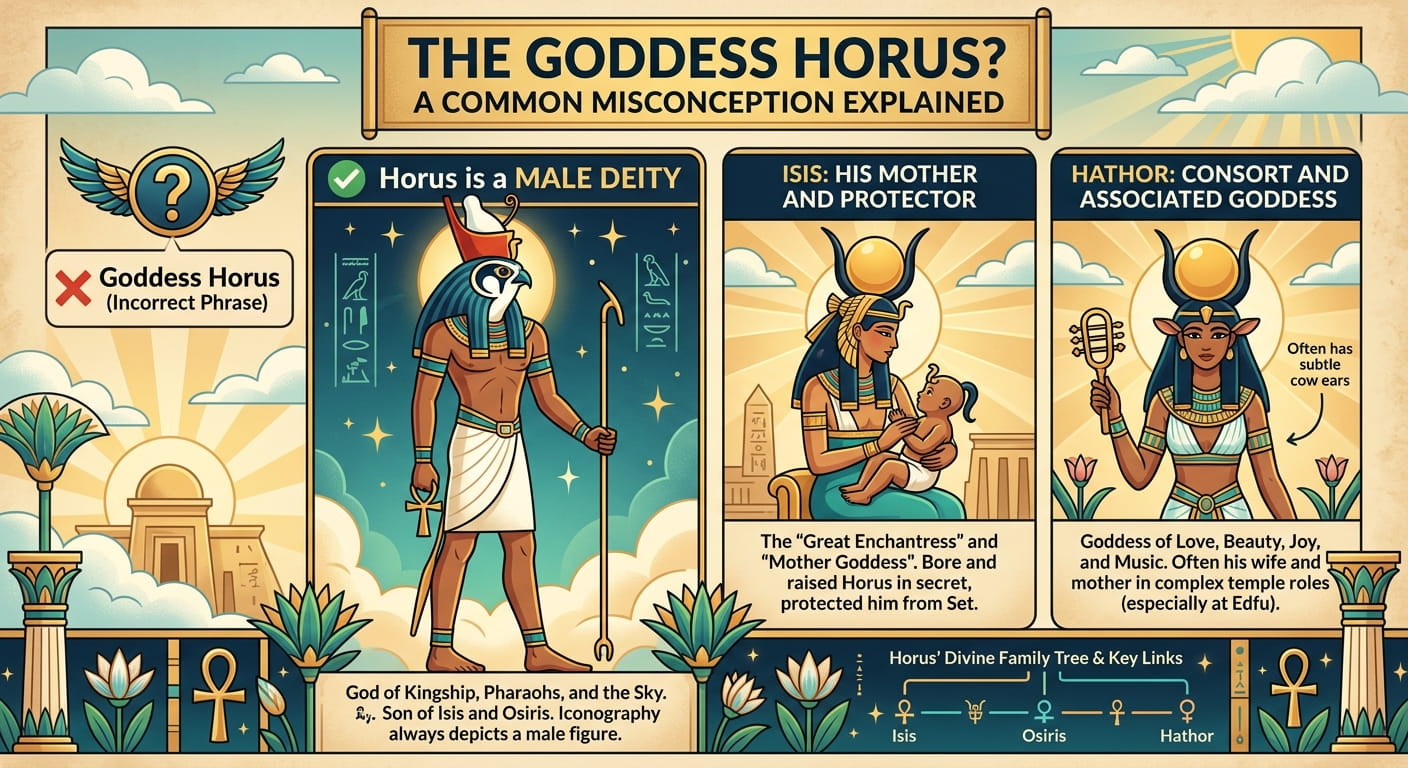
There is no goddess named Horus in ancient Egyptian religion. Horus is a male deity, one of the most important gods in the Egyptian pantheon, typically depicted as a falcon or a falcon-headed man . The phrase “goddess horus” likely arises from confusion with Hathor, a major goddess whose name literally means “House of Horus” and who was closely associated with him as mother, consort, or counterpart depending on the myth and location . This article explains who Horus actually is, why the confusion happens, and which goddesses are most closely linked to him.
Who Horus Actually Is
Horus is a god, not a goddess. His name most probably means “the Distant One,” a reference to his celestial falcon form whose wings were believed to span the sky . He was associated with kingship, the sky, and protection, and every living pharaoh was considered the earthly manifestation of Horus .
Horus originated very early in Egyptian history, appearing in imagery by around 3100 BCE . His most famous myth involves avenging his father Osiris, who was murdered by his brother Seth. Horus fought Seth for control of Egypt and eventually won, becoming the rightful king and establishing the pattern for royal succession .
The Many Forms of Horus
Horus is not a single, simple figure. Over Egypt’s long history, several distinct Horus figures were worshipped and eventually became closely associated:
- Horus the Child (Harpocrates): the son of Isis and Osiris, hidden in the Nile marshes as an infant and later depicted nursing from Isis .
- Horus the Elder (Haroeris): an ancient sky god, sometimes considered a brother of Osiris and Isis.
- Horus of Edfu: the form worshipped at the temple of Edfu, the best-preserved Egyptian temple, where the falcon god’s cult was centred .
By the Late Period, these forms had become closely associated in the minds of worshippers .
Why “Goddess Horus” Is a Mistake
The confusion almost certainly stems from Hathor. Her ancient Egyptian name, Hwt-Hr, translates literally as “House of Horus” or “Dwelling of Horus” . She was one of the most important and beloved goddesses in Egyptian history, associated with love, beauty, music, dance, joy, fertility, and childbirth .
Hathor’s relationship with Horus is complex and varies by source and location. At her cult centre in Dendera, she was considered not just Horus’s mother or wet nurse, but also his consort . She was also linked to all three of the major divine kings: Ra, Osiris, and Horus . The name “House of Horus” may originally have referred to the sky as a dwelling place for the falcon god, with Hathor personifying that sky .
A reader who sees “Hathor” and “Horus” in the same sentence, or who encounters the title “House of Horus” without context, might easily assume Horus is female. But the grammar and the mythology are clear: Horus is male, Hathor is female.
The Goddesses Most Closely Linked to Horus
If you are looking for a goddess associated with Horus, these are the main candidates.
Isis: The Mother
Isis is the most famous mother of Horus. She was the wife of Osiris and, after his murder, magically conceived Horus. She gave birth to him in the papyrus marshes of the Nile Delta to protect him from Seth, and raised him in hiding . The image of Isis nursing the infant Horus (Isis lactans) became one of the most widespread and recognisable motifs in Egyptian art, and some scholars have noted its resemblance to later Christian depictions of Mary and Jesus .
Hathor: Mother, Consort, and “House”
Hathor’s connection to Horus is the most ambiguous and the most likely source of the “goddess horus” confusion. She was the “House of Horus,” the goddess who in some traditions was his mother, in others his consort, and in others the cosmic cow who gave birth to the sun . Her association with Horus was so close that the two were paired in temple imagery and ritual.
Sekhmet: The Fierce Aspect
Sekhmet, the lioness goddess of war and healing, was an aspect of Hathor and thus shared her connection to Horus. In the myth of the Destruction of Mankind, Hathor as Sekhmet slaughters humanity on Ra’s orders . Her ferocity contrasts sharply with Hathor’s usual association with joy and love, but the two goddesses were intimately linked.
Common Misunderstandings
“Horus is a goddess because the Eye of Horus is female.” The Eye of Horus (wedjat) is a symbol, not a deity. It represents healing and protection and was often worn as an amulet . In some texts, Hathor states that she “is that eye of Horus,” but this is a symbolic identification, not a claim that Horus himself is female .
“Hathor and Horus are the same.” They are distinct deities. Hathor is a goddess; Horus is a god. Their names are linked, and their myths overlap, but they are not interchangeable.
“Goddess Horus” is an alternative title. It is not. No ancient Egyptian text uses this phrase. If you encounter it in a book or online, it is either an error or a modern invention.
Frequently Asked Questions
Is Horus male or female?
Horus is male. He is a god, typically depicted as a falcon or a falcon-headed man, and was associated with kingship, the sky, and protection. Every living pharaoh was considered the earthly embodiment of Horus, which reinforces his masculine role in Egyptian religion .
Is there a goddess named Horus?
No. There is no goddess named Horus in ancient Egyptian religion. The confusion likely comes from Hathor, whose name means “House of Horus” and who was closely associated with him in various myths and temples, sometimes as his mother and sometimes as his consort .
Who is the goddess associated with Horus?
The main goddesses associated with Horus are Isis, his mother, and Hathor, whose name means “House of Horus” and who was linked to him as mother, consort, and cosmic counterpart. Isis is most famous for nursing the infant Horus in the marshes, a motif widely depicted in Egyptian art .
What does “House of Horus” mean?
“House of Horus” is the literal translation of the name Hathor (Hwt-Hr). It may originally have referred to the sky as the dwelling place of the falcon god Horus, with Hathor personifying that sky or serving as its goddess . The title emphasises her close connection to Horus, not that she is Horus.
A Practical Note
If you are researching ancient Egyptian deities, check the gender of a name before assuming it. Horus is consistently male in every ancient source. If you see “goddess” and “Horus” together, the intended figure is almost certainly Hathor, or possibly Isis in her role as Horus’s mother. The mistake is understandable given the shared name element, but it is worth correcting.