 Haris
Haris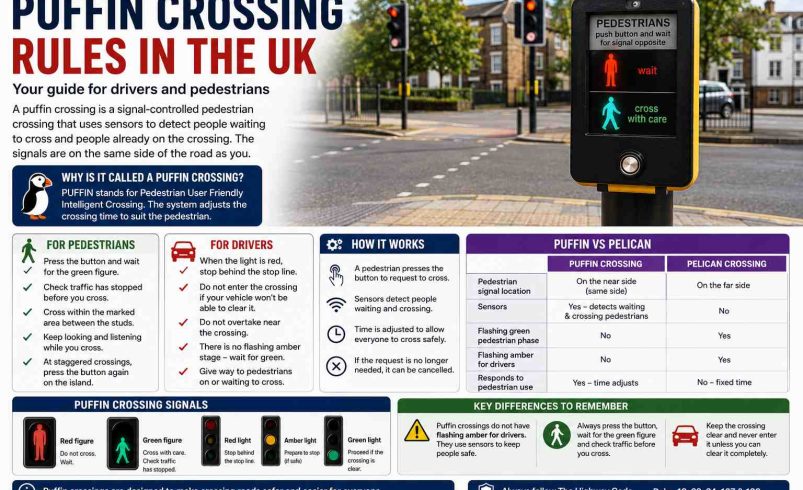
“What is a puffin crossing?” A puffin crossing is a signal-controlled pedestrian crossing that uses sensors to detect people waiting to cross and people who are still crossing. The red and green pedestrian figures sit beside the road, above the push-button control, rather than on the far side as they do at a traditional pelican crossing.
The name comes from Pedestrian User Friendly Intelligent Crossing. The system is designed to adjust the crossing period according to pedestrian movement, so someone who takes longer to cross isn’t expected to rush simply because a preset timer has expired.
For pedestrians, the basic rule is simple: press the button, wait for the green figure, check that traffic has stopped and then cross. For drivers, a puffin crossing follows the normal traffic-light sequence and doesn’t use the flashing amber phase found at pelican crossings.
How does a puffin crossing work?
A puffin crossing combines a pedestrian push button with detection equipment. When someone presses the button, the crossing registers a request and changes the traffic signals so vehicles are stopped.
Sensors can detect pedestrians waiting and can monitor people on the crossing. If someone is still crossing, the system can keep traffic stopped for longer. A demand can also be cancelled at some installations if a person presses the button and then moves away without crossing.
This is one of the main differences from older pelican crossings. A pelican crossing uses a conventional signal sequence, including a flashing green pedestrian signal and flashing amber for drivers. A puffin crossing doesn’t use those flashing stages.
What do the sensors do?
The equipment can perform two useful jobs. A kerbside detector can identify someone waiting or cancel a request if the person leaves, while an on-crossing detector can monitor pedestrians who have entered the carriageway.
The exact equipment can vary between installations, but the purpose is the same: the crossing responds to pedestrian use instead of relying solely on a fixed crossing period.
Puffin crossing rules for pedestrians
Pedestrians using a puffin crossing should press the button and wait for the green figure. The pedestrian signals are located on the same side of the road as the person waiting.
Before stepping into the road, check that vehicles have stopped. Pedestrians should cross between the studs or over the marked crossing area rather than walking around the side.
A useful point can be missed because the pedestrian signal is behind you once you’ve started crossing. You don’t need to turn around to watch it. Keep moving across the marked crossing while continuing to look and listen for traffic.
If you reach a puffin crossing when the red figure is showing, wait. Don’t assume that a vehicle stopping means you can immediately step out. Wait for your green figure and still check that approaching traffic has stopped.
[Image: Pedestrian waiting at a puffin crossing with the red figure showing]
What if the road is congested?
Traffic can sometimes be stopped on one side while vehicles continue moving elsewhere. Don’t rely simply on seeing vehicles stopped nearby.
Press the button and wait for the pedestrian signal before crossing. This matters on wide roads and near junctions, where turning traffic can create a separate hazard.
Keep looking as you cross, even when the traffic lights have stopped the main flow.
Puffin crossing rules for drivers
Drivers approaching a puffin crossing should treat it as a signal-controlled crossing. When the vehicle light is red, you must stop behind the stop line and wait for the signal to change.
Puffin crossings don’t have the flashing amber stage used by pelican crossings. After the pedestrian phase has finished, the traffic signals follow the normal sequence, including red and amber before green. A driver must wait for the green signal before moving.
Don’t enter the crossing if your vehicle won’t be able to clear it. Drivers should not enter a signal-controlled crossing when they cannot completely clear it, because doing so can obstruct pedestrians and other users.
You should also avoid overtaking near crossing facilities. Drivers should not overtake where they might come into conflict with other road users, including on the approach to crossing facilities.
Crossing puffin: how should you use it?
The phrase “crossing puffin” sometimes appears in searches from people trying to find the correct procedure. The process is straightforward:
- Stop at the kerb. Stand where you can see the pedestrian signal and approaching traffic.
- Press the button. This sends the crossing demand to the signal system.
- Wait for the green figure. Don’t start crossing simply because vehicles appear to have stopped.
- Check both directions. Make sure traffic has actually stopped before stepping onto the road.
- Cross at a normal pace. Keep within the marked crossing area and continue paying attention to traffic.
- Reach the opposite pavement. The sensors can detect pedestrians still using the crossing and may keep vehicle traffic stopped for longer.
The green figure is an invitation to cross, not a reason to stop looking. Pedestrians should always check that traffic has stopped before starting to cross.
Is there a flashing amber light at a puffin crossing?
No. A puffin crossing does not use the flashing amber phase for drivers. This is one of the easiest ways to distinguish it from a pelican crossing.
At a pelican crossing, flashing amber follows the red vehicle signal. Drivers may proceed cautiously during flashing amber only when the crossing is clear, and they must give way to pedestrians who remain on it.
Puffin crossings work differently because their sensors monitor pedestrian movement. Once the pedestrian phase has finished, the vehicle signals follow the ordinary traffic-light sequence rather than switching to flashing amber.
[Table: Puffin vs pelican crossing showing pedestrian signal position, sensors, flashing green figure, flashing amber and vehicle signal sequence]
| Feature | Puffin crossing | Pelican crossing |
| Pedestrian signal | On the pedestrian’s side | Usually on the far side |
| Push button | Yes | Yes |
| Pedestrian sensors | Yes | No puffin-style detection |
| Flashing green figure | No | Yes |
| Flashing amber for drivers | No | Yes |
| Vehicle signal after red | Red and amber, then green | Flashing amber phase |
Puffin crossing vs zebra, toucan and pelican crossings
Knowing the visual differences helps drivers and pedestrians react correctly.
A zebra crossing has black and white road markings and no traffic-light sequence. Drivers must give way when a pedestrian has moved onto the crossing, and drivers should be ready to slow down or stop for pedestrians waiting to cross.
A pelican crossing is push-button operated and has pedestrian signals on the far side. Its distinctive feature is the flashing green pedestrian stage and flashing amber phase for vehicles.
A toucan crossing is designed for pedestrians and cyclists. Its signals include a cycle symbol, and cyclists can ride across when the appropriate signal allows them to do so.
[Table: UK pedestrian crossing types showing users, signals and identifying features]
| Crossing | Main users | Easy way to identify it |
| Zebra | Pedestrians | Black and white stripes with Belisha beacons |
| Pelican | Pedestrians | Far-side pedestrian signals and flashing stages |
| Puffin | Pedestrians | Near-side red/green figure and sensors |
| Toucan | Pedestrians and cyclists | Pedestrian and cycle signals |
What happens at a staggered puffin crossing?
A staggered puffin crossing has a pedestrian refuge or island where the two halves aren’t directly aligned. The two sections are treated as separate crossings.
If you reach the central island, don’t assume your first green signal applies to the second half. Press the button on the island and wait for the steady green figure before continuing across.
For drivers, this distinction also matters. A straight puffin crossing with a central island can be treated as one crossing, while a staggered arrangement consists of separate crossings controlled independently.
Why are puffin crossings useful?
The main benefit is that the crossing can respond to the person using it. Someone walking slowly doesn’t have to rely on a short fixed period, because detection equipment can keep vehicles stopped when pedestrians remain on the road.
The near-side pedestrian signal also lets people watch the approaching traffic while waiting. This can be particularly useful for people who find far-side signals harder to see. Some crossings also provide audible signals or tactile features for people with sight or hearing impairments.
Puffin crossings can also reduce unnecessary delays. If someone presses the button and then leaves before the crossing phase begins, detection can cancel the demand at installations equipped for this function.
Common puffin crossing mistakes
Most mistakes come from treating a puffin like a pelican. The two look similar, but their signals and operation aren’t identical.
Watch out for these errors:
- Starting to cross before the green figure appears.
- Assuming a stopped car means every lane is safe.
- Looking for a flashing green pedestrian signal that isn’t used at a puffin.
- Expecting flashing amber after the red vehicle light.
- Entering the crossing when traffic hasn’t fully stopped.
- Driving into the crossing when congestion means you can’t clear it.
- Overtaking another vehicle near the crossing when its driver may be stopping for pedestrians.
Does the puffin crossing work the same across the UK?
The basic design and rules are consistent across Great Britain, but Northern Ireland publishes its own Highway Code and transport guidance. Northern Ireland’s official guidance confirms the same key features: near-side pedestrian signals, sensors, no flashing pedestrian phase and detection that can extend the time available to cross.
For England and Wales, GOV.UK provides the Highway Code and also lets people request a new pedestrian crossing through their local council. The online request service is available for England and Wales.
Scotland has local authority guidance that follows the same basic Puffin operation, including the requirement for pedestrians to press the button, wait for the green figure and check that traffic has stopped.
Frequently asked questions about puffin crossings
Q: What is a puffin crossing?
A puffin crossing is a signal-controlled pedestrian crossing with near-side red and green pedestrian signals and pedestrian detection. The system uses sensors to monitor people waiting and crossing, allowing the crossing period to respond to pedestrian movement.
Q: Why is it called a puffin crossing?
Puffin stands for Pedestrian User Friendly Intelligent Crossing. The name describes the crossing’s pedestrian-focused design and its use of detection technology to manage the crossing phase.
Q: Does a puffin crossing have flashing amber lights?
No. Puffin crossings don’t have the flashing amber phase used by pelican crossings. Vehicle signals follow the normal traffic-light sequence, so drivers wait for green before moving.
Q: Do you have to press the button at a puffin crossing?
Yes, pedestrians normally press the demand button to request the crossing phase. You should then wait for the green figure before crossing and check that approaching traffic has stopped.
Q: Can a puffin crossing detect slow pedestrians?
Yes. Puffin crossings use pedestrian detection to monitor people on the crossing, allowing the traffic signals to remain red when someone still needs time to reach the other side.
Q: What is the difference between a puffin and a pelican crossing?
A puffin has near-side pedestrian signals and pedestrian detection, while a pelican has far-side pedestrian signals and uses a flashing green pedestrian phase followed by flashing amber for drivers.
Q: Can cyclists use a puffin crossing?
A standard puffin crossing is intended for pedestrians. Cyclists who want to ride across a signal-controlled crossing should use a toucan crossing where cycling is specifically provided for.
Q: What should a driver do if a puffin crossing is not working?
Proceed with extreme caution. Keep the crossing clear and don’t enter it if you cannot completely clear it. Stay alert for pedestrians and follow any temporary traffic signs or directions.